
Adobe Sign Is Testing a 4th, Cheaper Pricing Tier. Here's Why That's Risky
Adobe caught testing a fourth "Express" plan on its Acrobat Sign pricing page, using its own Adobe Target to A/B a decoy tier. Here's what it means for your pricing table.
Diego Hernandez
Growth Marketer · Aug 6, 2026
Adobe is running a pricing experiment on itself. Ironic, since Adobe Target probably powers half the A/B tests you're reading about this year.
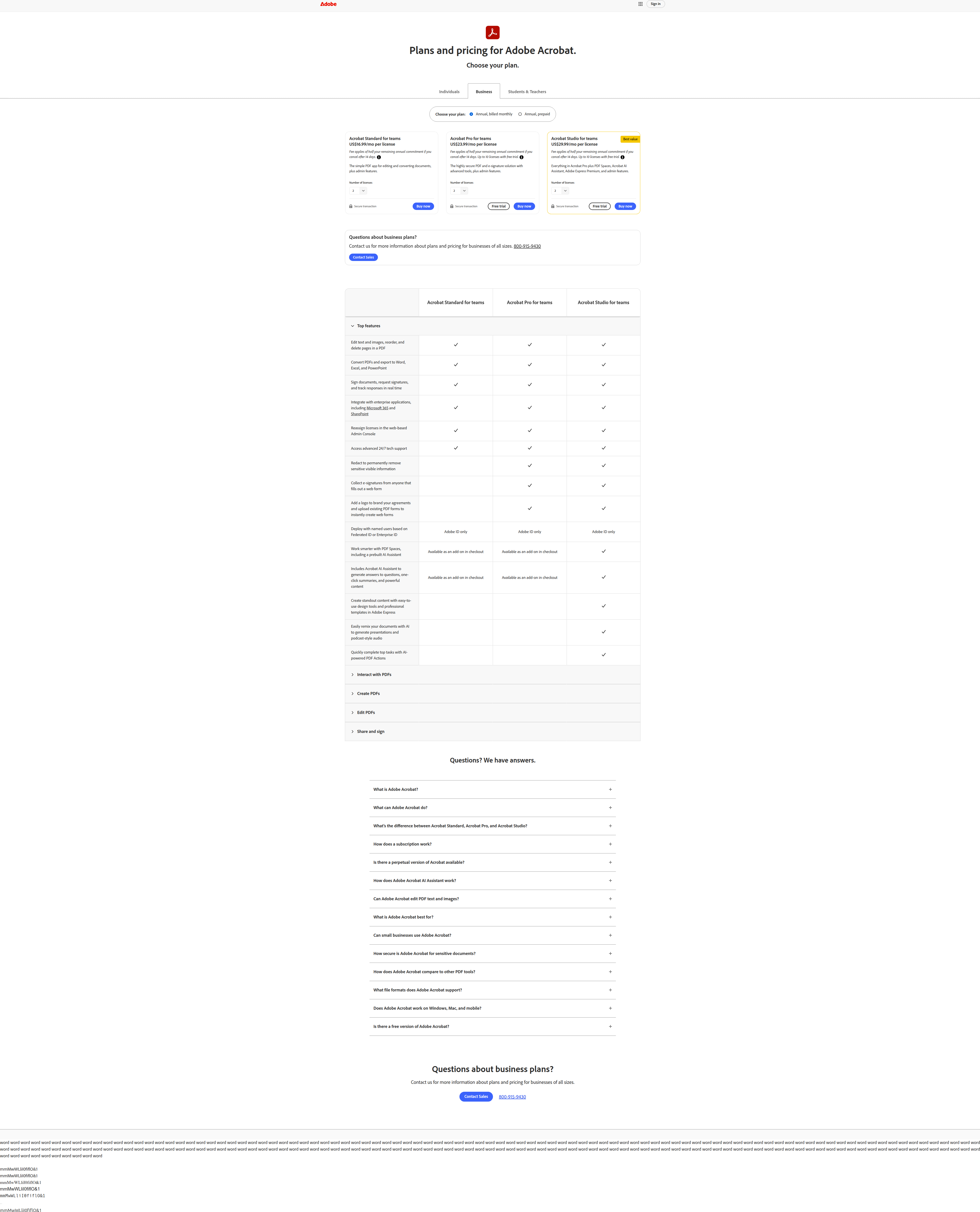
We caught it live on adobe.com/acrobat/business/pricing/plans. Control shows the usual 3-tier lineup: Standard, Pro, Studio for teams. The variant slides in a fourth plan — "Acrobat Express for teams" at $11.99, discounted to $11.08/mo — and puts it first, ahead of Standard.
That's not a cosmetic tweak. That's a new anchor.
What Actually Changed
This isn't a copy test or a button color swap. The variant changes plan count, plan order, and the entire comparison table structure. Four columns instead of three. A new cheapest option sitting at the left edge of the table, which is prime pricing-page real estate — it's the first thing your eye hits before you scan right.
We confirmed this with same_run_variance detection: divergent final URLs, separate mbox cookie buckets, same Chrome rendering engine across both experiences. This is server-side, Adobe Target, fully bucketed. Not a caching glitch. Not a regional rollout. A real test, live right now, with 90% confidence on our end.
Takeaway: if you're serving different plan structures to different users, don't assume no one's watching. We caught this in one detection cycle.
The Hypothesis Is Obvious — And Textbook
Adobe is almost certainly testing whether a low-cost entry tier grows the top of the funnel without cannibalizing Pro and Studio upgrades.
This is the classic decoy-pricing play. Add a cheap option, watch what happens to the middle tiers. Sometimes the cheap option becomes a magnet and total revenue per user drops. Sometimes it's a foot-in-the-door that upsells later. You don't know until you run it — which is exactly why Adobe is running it instead of guessing.
Adobe's own A/B testing guide is blunt about this: you need a real baseline before you touch anything. Adobe knows its current conversion rate on the 3-tier layout down to the decimal. That's the bar Express has to clear.
Takeaway: if you're adding a tier to your pricing page, you need your current tier-by-tier conversion split in hand first. Otherwise you can't tell if Express "worked" — you're just vibing.
Why a 4th Tier Is a Gamble, Not a Freebie
More options usually means more friction, not less. Every CRO person knows the paradox-of-choice research by heart at this point. But B2B software pricing pages are a different animal than DTC checkout — buyers here are often doing a real comparison shop, not an impulse buy. A cheaper anchor can genuinely help committee-based buyers justify a mid-tier pick to their finance team.
That's the bet Adobe's making. Express isn't there to sell Express. It's there to make Standard look like the obvious "serious" choice by comparison. Classic anchor-and-upsell.
The risk: if Express is good enough, it steals share from Standard and Pro instead of feeding them. Adobe's margins on a $11.08/mo team seat are thin. If this variant wins on raw signup volume but tanks average revenue per account, that's a losing test dressed up as a winning one.
Takeaway: don't just measure conversion rate on a pricing test like this. Measure blended ARPU across the whole funnel, or you'll ship a "win" that quietly shrinks revenue.
The Two-Week Rule Still Applies
Xerago's breakdown of Adobe Target testing makes a point that gets ignored constantly: run pricing tests long enough to smooth out day-of-week noise. Enterprise buyers behave differently on a Tuesday morning versus a Sunday. Pricing decisions, especially team-plan pricing, often involve multiple stakeholders and multi-day research before a card gets entered.
A pricing page test needs weeks, not days, especially when you're testing something as structurally different as adding a whole new tier. If Adobe is smart — and Adobe Target's own team built the tooling everyone else uses — they're not calling this test on a three-day spike.
Takeaway: structural pricing changes need longer test windows than button or headline tests. Set your sample size and duration before you look at day-3 results, or you'll talk yourself into a false positive.
What This Means If You Run a Pricing Page
Most teams treat their pricing page as a settled artifact. Ship it once, tweak copy occasionally, move on. Adobe's treating it as a live experiment surface — same as their homepage or their onboarding flow.
That's the real signal here. Not "add a cheap tier," but "your pricing page is not done." If a company as mature as Adobe is still actively testing plan structure, not just plan copy, that tells you the biggest CRO gains left on the table for most SaaS and ecommerce teams aren't in microcopy. They're in the architecture of the offer itself: how many tiers, what order, what's anchored against what.
Most teams A/B test the stuff that's easy to test — headlines, CTAs, hero images. Structural pricing tests are harder to build, harder to instrument, and easier to get wrong. That's exactly why they matter more when they work.
Your Move This Sprint
Don't copy Adobe's exact move. Copy the instinct behind it.
Pull up your own pricing page and ask: when's the last time you tested tier count, not just tier copy? If the answer is "never," that's your test idea for the sprint. Start small — test adding or removing one tier, watch conversion rate and blended revenue per account, and give it real weeks, not days.
Pricing structure is the highest-leverage, least-tested surface on most sites. Adobe's proving it's still worth poking at, even at their scale.
Read next
More from the ABWatcher blog
Aug 5, 2026
Beyond Meat's Hero Test: Superpowers vs. Clean Protein
Beyond Meat is A/B testing its homepage hero and carousel copy — swapping a "clean protein" message and email modal for a benefit-driven "Plants have superpowers" narrative.
Aug 4, 2026
Ladder Life Is A/B Testing Whether Height and Weight Need Labels at All
We caught Ladder running a live split test on its life insurance signup form — explicit field labels vs. placeholder-only inputs. Here's the math on what that bet actually costs or earns.
Aug 3, 2026
Discover Tests Reordering Its Homepage "How Can We Help?" Nav
Discover.com is running a live A/B test that swaps the order of Personal Loans and Online Banking in its homepage quick-nav. Here's what it likely signals about the funnel.
Aug 2, 2026
GEICO's Homepage Hero Is Running Two Very Different Quote Flows
GEICO is A/B testing a ZIP-code-first hero against a tabbed product-selector hero on geico.com — here's what the split reveals and what to steal for your own roadmap.
Aug 1, 2026
USAA Is A/B Testing One Word in Its Retirement Headline. Here's Why That's Smart.
USAA is running a live homepage test on legislation-driven retirement copy — one word, one hypothesis, real conversion signal. Here's what we caught and why it matters.
Jul 31, 2026
Schwab Is A/B Testing Tabs vs. Flat Cards on Its Homepage Account Finder
Charles Schwab is running a live homepage test on how it presents account types—flat popular-account cards vs. a tabbed, goal-based navigator. Here's what the layout choice signals.
From the glossary
Vocabulary the article uses. See all terms →
- Experiment Prioritization Framework— A structured method (like PIE or ICE) for scoring and ranking test ideas so teams run the highest-value experiments first.
- Above-the-Fold Fold Detection— N/A
- Placebo Test— A validation check that runs a fake or null intervention to confirm an experimentation system doesn't produce false positives.
- Above vs Below Median Split— A segmentation technique that divides users into two groups at the median of a metric to compare high and low engagers.
- Qualitative Feedback Loop— A recurring process of collecting and acting on user comments, session recordings, and survey responses to inform test hypotheses.
- Experiment Metadata— The structured record of who, what, when, and how for a test — hypothesis, owner, dates, variants, and metrics used to track and audit it.
See more like this
ABWatcher catches A/B tests like this across 1,000+ brands.
Watch live experiments at 1,000+ high-converting brands, complete with hypothesis and takeaway. Free forever for ten watched companies.