
Beyond Meat's Hero Test: Superpowers vs. Clean Protein
Beyond Meat is A/B testing its homepage hero and carousel copy — swapping a "clean protein" message and email modal for a benefit-driven "Plants have superpowers" narrative.
Aiko Tanaka
Design Director · Aug 5, 2026
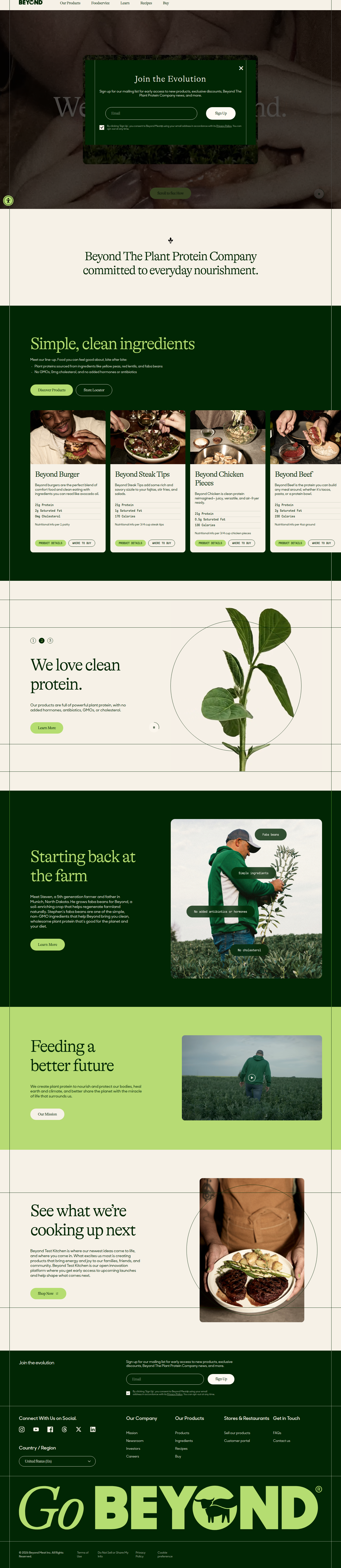
Beyond Meat's homepage hero is doing double duty right now: for most visitors it's an email capture moment, and for a smaller slice of traffic, it's a full-bleed plant close-up making a much bigger claim. That's the tell we caught mid-flight — a live test running on beyondmeat.com's hero and the mid-page rotating content block.
What the eye hits first
In the control (visits 1-4), the hero real estate is spent on an email sign-up modal overlaying the hero image. That's a lot of top-of-fold weight given to a low-commitment ask before the brand has said anything about the product itself. The rotating carousel underneath reinforces a narrow, almost defensive message: "We love clean protein." It's a purity claim — reactive to the "ultra-processed food" scrutiny plant-based brands have faced.
In the variant (visit 5, Chrome), that modal is gone. Instead, the hero leads with a tight plant close-up and a headline that reads like a thesis statement: "Plants have superpowers." No pop-up competing for attention, no secondary decision to make before you've even engaged with the primary message. The carousel echoes the same register with "Plants are nutrition powerhouses," paired with a different supporting image than the control.
This is a classic figure-ground swap. In the control, the modal is the figure — it sits on top, demands a click or a dismiss, and pushes the hero image (the actual ground) into the background both literally and cognitively. In the variant, the plant imagery and headline are the figure. There's no layer to peel back before the message lands. Under Gestalt principles, removing that competing layer restores a single point of entry — the eye isn't asked to resolve two conflicting priorities in the first 200ms.
Hierarchy: claim first, capture later
The sequencing difference matters as much as the copy difference. Control-visit users meet a transactional ask (give us your email) before they've been given a reason to care. Variant-visit users meet a positioning statement first — "superpowers" is doing brand work, not funnel work. It's a bet that value proposition clarity outperforms lead-gen aggression on a first-touch homepage visit, especially for a brand that's spent the last few years fighting narrative headwinds about processing and ingredient panels.
It also changes what an F-pattern scan actually returns. With the modal in place, the first horizontal sweep across the fold lands on modal copy and a CTA button — generic, and identical to what a hundred other DTC sites show. With the modal removed, that same horizontal sweep lands on the hero headline and the plant macro photography, which is brand-specific and harder to scan past without registering the message.
The copy shift: purity claim vs. benefit claim
"We love clean protein" is a feelings statement about the product. It's defensive positioning — it answers a criticism nobody in the hero has raised yet. "Plants are nutrition powerhouses" is a benefit statement about the category. It doesn't ask the visitor to already be skeptical of processed food; it makes an affirmative case for plants generally, which is a bigger tent than "our protein is clean."
For a brand navigating a well-documented perception problem around ultra-processed ingredients, this is a meaningful strategic fork, not just an A/B microcopy tweak. Testing "superpowers" language suggests Beyond Meat is trying to reposition around nutritional upside rather than continuing to litigate cleanliness — a shift from reassurance to aspiration.
Motion and modal removal as a UX decision
The absence of the sign-up modal in the variant is worth flagging on its own. Modals interrupt; they force a decision (submit, dismiss, or hunt for the tiny close icon) before a visitor has context. Removing it on a homepage hero — arguably the highest-intent-signal real estate on the site — is a deliberate bet that engagement with the message beats immediate list-building. That's not a small call for a growth team to greenlight; email capture is usually treated as sacred. Seeing it dropped in a live variant tells us Beyond Meat's team is willing to sacrifice a top-of-funnel metric (email signups) to test a brand-metric hypothesis (message resonance, time on page, scroll depth into the carousel).
Detected via vendor_sdk_active at 82% confidence — this is a genuine live split, not a caching artifact, which is worth noting because homepage hero tests are exactly the kind of surface teams claim they can't touch due to traffic concentration risk. As one CRO breakdown on hero testing notes, guardrail metrics for hero-level changes should include bounce rate and downstream engagement, not just the primary conversion event — which lines up with what looks like Beyond Meat measuring engagement and scroll into the "powerhouses" carousel rather than pure email capture.
What to take from this
If your homepage hero is currently carrying both a value proposition and a lead-capture modal, you're asking visitors to process two competing hierarchies in the same glance. This sprint, try isolating them: run the message-only variant against your current modal-first control and watch scroll depth and time-on-page, not just form fills. Beyond Meat's test suggests even category-defining brands are questioning whether the immediate ask is worth the cost of a diluted first impression — and that's a hypothesis worth stealing before you assume your modal is untouchable.
See more like this
ABWatcher catches A/B tests like this across 1,000+ brands.
Watch live experiments at 1,000+ high-converting brands, complete with hypothesis and takeaway. Free forever for ten watched companies.