
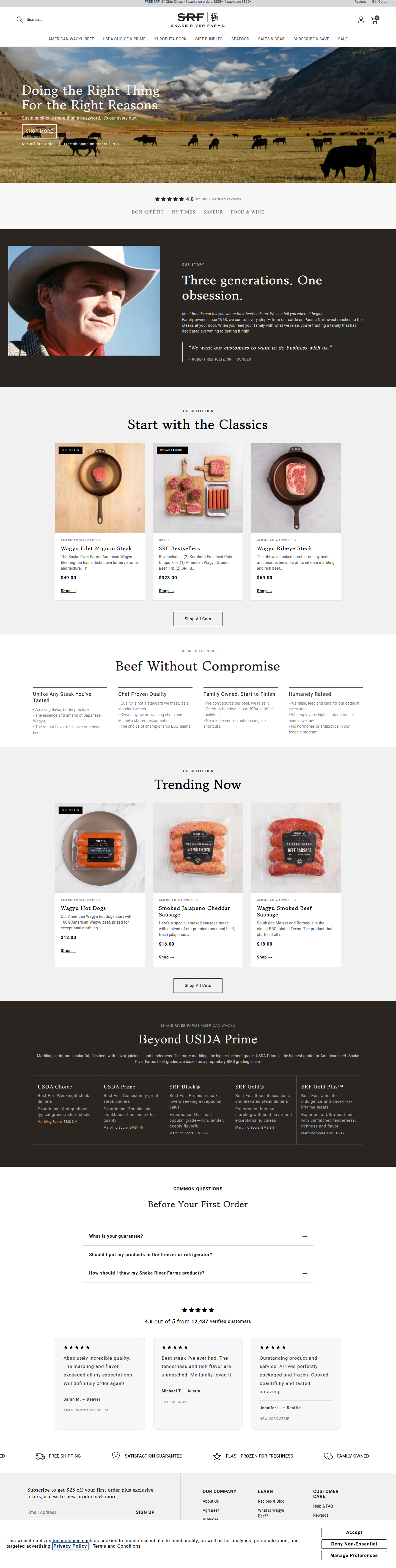
Snake River Farms Tests Popup vs. Footer Signup on Its $25 Off Page
Snake River Farms is running a lead-capture placement test on its "top reasons" landing page — mid-page popup vs. clean footer form. Here's what we caught and what it means for your roadmap.
Diego Hernandez
Growth Marketer · · Updated
TL;DR
- Brand: Snake River Farms, tested on
/pages/ad-top-reasons, detected via vendor_sdk_active, analyst confidence 75%. - Variant A (visits 1, 3, 6, 7 — Safari, Firefox, Chrome): mid-page "$25 OFF SITEWIDE... UNLOCK ACCESS" email module + popup overlay that blocks testimonials.
- Variant B (visits 2, 4, 5 — Chrome, Edge): no mid-page capture, testimonials fully visible, signup form moved to footer.
- Chrome shows up in both variant groups — this rules out browser-rendering noise and confirms real cookie-bucketed testing.
- This is Snake River Farms' second lead-capture test we've caught — a related test on
/pages/ad-top-compromisewas flagged at 85% confidence. - Hypothesis under test: aggressive early ask vs. deferred footer ask, after social proof.
What did Snake River Farms actually change?
One variant front-loads the email ask with a popup that covers testimonials; the other hides the ask until the footer and leaves social proof untouched.
Here's the breakdown our vision-AI analyser caught across seven site visits:
| Visit # | Browser | Variant | Mid-page capture module | Popup overlay | Testimonials visible | Signup location |
|---|---|---|---|---|---|---|
| 1 | Safari | A | Yes | Yes | Obscured | Mid-page |
| 2 | Chrome | B | No | No | Fully visible | Footer |
| 3 | Firefox | A | Yes | Yes | Obscured | Mid-page |
| 4 | Edge | B | No | No | Fully visible | Footer |
| 5 | Chrome | B | No | No | Fully visible | Footer |
| 6 | Chrome | A | Yes | Yes | Obscured | Mid-page |
| 7 | Chrome | A | Yes | Yes | Obscured | Mid-page |
Same offer, same page, two totally different funnels. That's the tell.
Takeaway: if you're going to test capture placement, keep the offer constant and only move the ask — Snake River Farms nailed that isolation.
Why does the Chrome overlap matter?
Because Chrome appears in both Variant A and Variant B, this is proof of user-bucketed testing, not a browser quirk.
If every Safari visit landed in Variant A and every Edge visit landed in Variant B, you'd suspect a rendering bug or a responsive breakpoint issue — not a real experiment. That's not what happened here. Chrome shows up on visits 2, 5, and 6, 7 — split across both groups. That's a cookie or session-ID bucket doing its job.
This matters for anyone auditing competitor tests or reviewing your own QA logs. Cross-browser variant overlap is the single fastest way to confirm you're looking at a genuine test and not a CDN caching artifact. Contentful's CRO guide makes the same point about layout testing generally — the variable you're isolating has to be the only thing that moves, and browser shouldn't be a proxy for bucket.
Takeaway: before you trust any "competitor is testing X" claim — including ours — check whether the same browser shows up in both variants. If it doesn't, you might just be looking at noise.
Is this the same test as their other landing page?
Not quite — it's a sibling test, and that's the more interesting story.
We flagged a near-identical pattern on Snake River Farms' /pages/ad-top-compromise page a few weeks back, detected at 85% confidence. Same $25-off offer. Same mid-page email form plus exit-intent popup in Variant A. Same clean Variant B with zero capture friction.
The /ad-top-reasons test we're covering here swaps the "zero capture" control for a footer-placed form instead of removing capture entirely. That's a meaningful iteration — it suggests the brand already learned something from the first test (maybe: "some capture is better than none") and is now testing placement rather than presence.
This is a brand running a real testing program, not a one-off. Multiple landing pages, same offer, iterative hypotheses. That's the CRO maturity level most DTC teams claim to have and few actually do.
Takeaway: if a test wins or loses, don't just move on — spin up the next question. Snake River Farms went from "capture vs. no capture" to "where does capture go." That's the right sequence.
Should you block testimonials with a popup?
Almost never — and this test will probably prove it.
Variant A's popup overlay obscures the testimonials section. That's a real cost. Social proof is doing conversion work on a landing page that's explicitly built around "top reasons" to buy — presumably reasons that include what other customers say. Burying that behind a popup to force an early email capture is a classic case of optimizing one micro-metric (form starts) at the expense of a bigger one (trust, and ultimately purchase).
CXL's guide to running A/B tests stresses testing off of real conversion research, not just "let's try a popup." The risk with Variant A is that it might lift email signups while quietly tanking purchase conversion — a classic false-positive win if the team is only watching the top-of-funnel metric.
Takeaway: if your test can lift a micro-conversion by hiding proof or content, make sure you're measuring the metric that actually pays the bills, not just the easiest one to move.
Common questions
What page is Snake River Farms testing?
The test is live on https://snakeriverfarms.com/pages/ad-top-reasons, a paid-traffic landing page built around "top reasons" to buy, offering $25 off sitewide. It was detected via vendor SDK activity at 75% confidence, with variant behavior confirmed across four visits in one group and three in the other.
How do we know this isn't a rendering bug?
Because Chrome appears in both variant groups. If the difference were browser-specific rendering, one browser wouldn't show up on both sides of the split. Seeing Chrome in Variant A (visits 6, 7) and Variant B (visits 2, 5) confirms this is a cookie/session-bucketed experiment, not noise.
What's the actual hypothesis being tested?
Likely: does an early, prominent email-capture module with a popup drive more signups than waiting until the footer, after visitors have seen testimonials? It's a classic aggressive-ask-early vs. earn-trust-first tradeoff, common in DTC lead-gen funnels.
Is this related to their other landing page test?
Yes — a related test on /pages/ad-top-compromise was flagged at 85% confidence with a similar mid-page-capture-plus-popup pattern. This /ad-top-reasons test looks like an iteration: instead of removing capture entirely in the control, they moved it to the footer.
What should other CRO teams take from this?
Test placement and intensity of an ask independently from whether to ask at all. And always check whether your "winning" variant is quietly suppressing content — like testimonials — that matters for a metric you're not watching closely enough.
The takeaway for your roadmap this sprint
Don't just test "capture vs. no capture." Test where and how loud the ask is, and watch your downstream metric, not just signups. Snake River Farms is doing exactly that — pull the same move on your own highest-traffic landing page this week.
Read next
More from the ABWatcher blog
Nov 22, 2026
Snake River Farms Tests a $25-Off Popup on Its Ad Landing Page
We caught Snake River Farms split-testing an email-capture form and $25-off modal on its landing page. Here's the math on what it would take to call a winner.
Nov 21, 2026
Snake River Farms Tests Mid-Page Email Capture on Its Ad Landing Page
SRF is A/B testing a mid-page lead-capture block and a $25-off popup against a simpler hero-only promo banner on its paid landing page, detected 2024 week-over-week.
Nov 20, 2026
Attio Is Testing a New Tier, Higher Prices, and a New Pitch
Attio is running a live pricing page test with a new $1,000 "Ultra" tier, higher Plus/Pro prices, and a new headline — here's what we caught and what it means.
Nov 19, 2026
Found Quietly Tested a 25% Price Cut on Its Pricing Page
We caught Found running a live pricing A/B test with an annual billing toggle that drops Found Plus from $35 to $26.25/mo. Here's what changed and why it matters.
Nov 8, 2026
Astro Proves "Zero Lock-In" With a Live Code Demo, Not a Claim
Astro's homepage replaces a trust badge row with a working, clickable framework demo — here's the hierarchy and interaction design behind it, detected 60% rare on astro.build.
Nov 7, 2026
Basecamp's Big Numbers: Why Hyper-Precise Stats Beat Vague Social Proof
Basecamp's homepage swaps "trusted by thousands" for 1.7 billion to-dos and 5 petabytes of data. We break down why precision beats vagueness as social proof — and how to test it.
From the glossary
Vocabulary the article uses. See all terms →
- Shrinkage Estimator— A statistical adjustment that pulls noisy per-variant or per-segment estimates toward an overall average to reduce overfitting to randomness.
- Flicker Test— A diagnostic check to confirm whether users briefly see the original page before a variant renders in client-side experiments.
- Pre-Experiment Bucketing Audit— A review process confirming users are being randomly and evenly assigned to experiment variants before launch.
- Above-Fold Exclusion Rule— A test-design rule that deliberately prevents changes to above-the-fold elements so an experiment isolates below-the-fold effects.
- Flicker-Free Testing— A technical setup that prevents users from briefly seeing the original page before a test variant loads.
- Orthogonal Test Design— A test structure where multiple variables are changed independently so their individual effects can be measured without interference.
See more like this
ABWatcher catches A/B tests like this across 1,000+ brands.
Watch live experiments at 1,000+ high-converting brands, complete with hypothesis and takeaway. 7 days of Pro, free, no card, then Free forever for ten watched companies.