
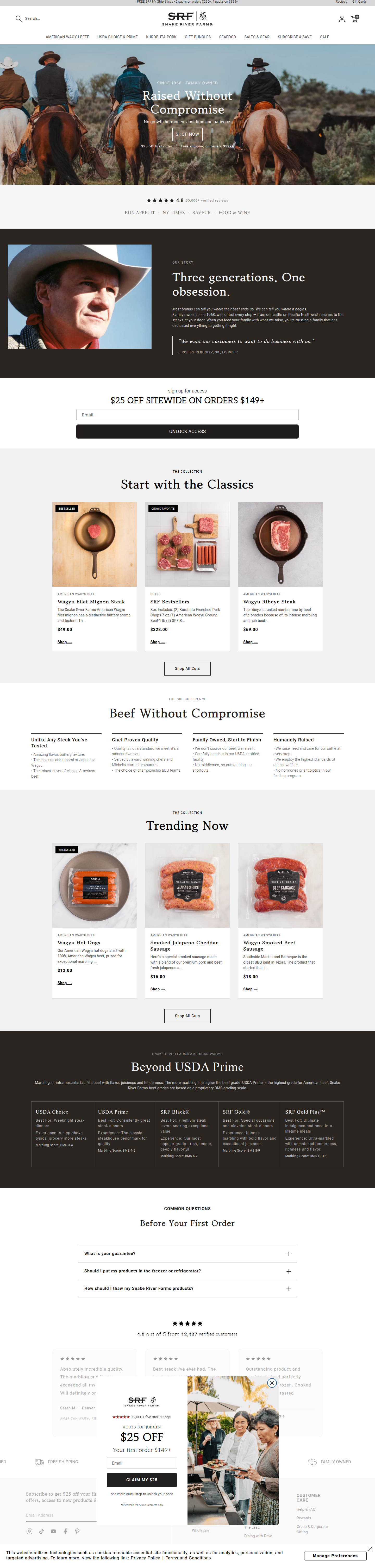
Snake River Farms Tests Double Lead Capture on Its $25 Off Landing Page
We caught Snake River Farms running a same-page A/B test stacking a mid-page email form and exit-intent popup against a version with zero lead capture. Here's what it means.
Diego Hernandez
Growth Marketer · · Updated
TL;DR
- Detected 85% confidence live A/B test on Snake River Farms'
/pages/ad-top-compromiselanding page. - Variant A shows a mid-page "$25 OFF SITEWIDE" email form plus an exit-intent popup with lifestyle imagery.
- Variant B shows the same page layout with zero lead-capture elements.
- Detection method: same_run_variance, confirmed across Chrome, Edge, and Firefox — not a rendering bug.
- Same $25 offer appears twice in Variant A: once mid-scroll, once on exit-intent.
- This is a classic "capture now vs. capture never" test, not a copy or design tweak.
What did Snake River Farms actually change on this page?
One variant stacks two lead-capture surfaces — a mid-page form and an exit-intent popup — while the other shows neither on an identical layout. Variant A has a mid-page block reading "$25 OFF SITEWIDE" with an "UNLOCK ACCESS" CTA, tied to an email field. Scroll or move to leave and you also get an exit-intent modal, lifestyle photo included, offering the same $25 off. Variant B runs the identical page shell — same hero, same product content — with neither element present. No form, no popup, no discount ask.
That's a big swing. This isn't a headline test or a button-color tweak. It's testing whether asking for an email at all helps or hurts.
Takeaway: when you test lead capture, test presence vs. absence first — optimize copy second.
Why does this look like a real test and not a bug?
The pattern held across three separate browser engines, which rules out a rendering glitch. Our analyst flagged this via same_run_variance — meaning both variants were live in the same traffic window, not sequential rollouts. Critically, the presence/absence split showed up consistently in Chrome, Edge, and Firefox. If this were a caching issue or a broken script in one engine, you'd expect it to break in one browser and behave normally in others. It didn't. That's a strong signal of a genuine server-side or cookie-based split test, logged at 85% confidence.
Takeaway: cross-engine consistency is your fastest gut-check for "is this a real test" before you copy a competitor's move.
Does stacking a form and a popup actually help conversion?
The honest answer: it depends on what "conversion" means to Snake River Farms here, and that's exactly what this test is built to find out. A mid-page form catches engaged scrollers. An exit-intent popup catches people already leaving. Together they're two nets for the same fish — email capture — but they also add friction, visual noise, and an extra "no" moment for someone who just wants to see the product.
CRO research backs both sides of this coin. Digital Applied's 2026 CRO guide pegs landing-page drop-off at 40-50%, largely from unclear value prop or slow load — meaning any added element that muddies the page's core pitch is a real risk, not a freebie. On the other hand, Convert's rundown of A/B testing examples shows that reducing visible friction in forms (like hiding optional fields) reliably beats more complex variants — a reminder that every extra field or popup you add needs to earn its place.
Takeaway: don't assume more capture surfaces equals more conversions — the added friction has to be paid for by a real lift in email signups or AOV.
How does this compare to standard landing page test patterns?
Most brands test copy or layout tweaks; testing the entire presence of a lead-capture system is rarer and riskier.
| Test type | What's varied | Risk level | What Snake River Farms is running |
|---|---|---|---|
| Copy/headline test | Words only | Low | No |
| Button color/CTA test | Visual only | Low | No |
| Form field count test | Fields shown/hidden | Medium | No |
| Full element presence/absence | Entire form + popup exist or don't | High | Yes |
This is a structural test, not a polish test. It sits at the top of the risk ladder because it changes the fundamental page experience, not a detail within it. When brands run this kind of test, they're usually questioning a core assumption — in this case, whether email capture belongs on a paid-traffic landing page at all, or whether it's just tax on the checkout path.
Takeaway: structural tests like this deserve bigger sample sizes and longer run times than a button-color test — don't call it early.
What should growth teams borrow from this for their own roadmap?
Test the existence of your lead-capture mechanism before you polish its copy. Snake River Farms' page URL slug — "ad-top-compromise" — hints this traffic is paid and testing the tension between immediate purchase intent and list-building. That's a compromise a lot of DTC and ecommerce teams face: every popup you add to capture emails is a popup that can also tank your primary conversion event.
Freshpaint's writeup on form page A/B testing makes the point that personalizing or simplifying the ask — tailoring the form to what the visitor actually wants — moved the needle more than just adding more capture points. Snake River Farms isn't personalizing yet. They're testing the blunt instrument: form and popup, or nothing. That's a smart first step. The next iteration, if this wins, should be testing the offer and timing, not just the on/off switch.
Takeaway: if you're stacking a mid-page form and an exit popup with the same offer, you're not testing two ideas — you're testing one idea twice. Measure it that way.
Common questions
What is a same_run_variance detection?
It means two page variants were live and serving real traffic in the same time window, not one after another. This rules out seasonal or timing bias and is a stronger signal of an intentional A/B test than sequential before/after snapshots.
Why does cross-browser consistency matter for confirming a test?
If a difference only shows up in one browser engine, it's likely a rendering bug, broken script, or caching artifact — not a real experiment. Snake River Farms' variant split held across Chrome, Edge, and Firefox, which is why analysts logged 85% confidence it's a genuine test.
Is testing form presence vs. absence a common pattern?
It's less common than copy or CTA tests but not rare — brands run it when they suspect a lead-capture element might be hurting primary conversion more than it's helping list growth. It's a higher-risk, higher-signal test than typical micro-optimizations.
What's the risk of running a mid-page form and exit popup with the same offer?
Repetition can feel redundant to users and may not add incremental signups beyond what one well-placed capture point would generate. Testing them together, as Snake River Farms did, makes it hard to isolate which element — if either — is actually driving the lift.
What should I test first if I'm considering adding an exit-intent popup?
Test presence vs. absence on a subset of traffic before optimizing the offer or design. Confirm the popup doesn't cannibalize your primary conversion event first — then iterate on copy, image, and discount depth once you know it's a net positive.
Read next
More from the ABWatcher blog
Nov 22, 2026
Snake River Farms Tests a $25-Off Popup on Its Ad Landing Page
We caught Snake River Farms split-testing an email-capture form and $25-off modal on its landing page. Here's the math on what it would take to call a winner.
Nov 21, 2026
Snake River Farms Tests Mid-Page Email Capture on Its Ad Landing Page
SRF is A/B testing a mid-page lead-capture block and a $25-off popup against a simpler hero-only promo banner on its paid landing page, detected 2024 week-over-week.
Nov 20, 2026
Attio Is Testing a New Tier, Higher Prices, and a New Pitch
Attio is running a live pricing page test with a new $1,000 "Ultra" tier, higher Plus/Pro prices, and a new headline — here's what we caught and what it means.
Nov 19, 2026
Found Quietly Tested a 25% Price Cut on Its Pricing Page
We caught Found running a live pricing A/B test with an annual billing toggle that drops Found Plus from $35 to $26.25/mo. Here's what changed and why it matters.
Nov 8, 2026
Astro Proves "Zero Lock-In" With a Live Code Demo, Not a Claim
Astro's homepage replaces a trust badge row with a working, clickable framework demo — here's the hierarchy and interaction design behind it, detected 60% rare on astro.build.
Nov 7, 2026
Basecamp's Big Numbers: Why Hyper-Precise Stats Beat Vague Social Proof
Basecamp's homepage swaps "trusted by thousands" for 1.7 billion to-dos and 5 petabytes of data. We break down why precision beats vagueness as social proof — and how to test it.
From the glossary
Vocabulary the article uses. See all terms →
- Shrinkage Estimator— A statistical adjustment that pulls noisy per-variant or per-segment estimates toward an overall average to reduce overfitting to randomness.
- Flicker Test— A diagnostic check to confirm whether users briefly see the original page before a variant renders in client-side experiments.
- Pre-Experiment Bucketing Audit— A review process confirming users are being randomly and evenly assigned to experiment variants before launch.
- Above-Fold Exclusion Rule— A test-design rule that deliberately prevents changes to above-the-fold elements so an experiment isolates below-the-fold effects.
- Flicker-Free Testing— A technical setup that prevents users from briefly seeing the original page before a test variant loads.
- Orthogonal Test Design— A test structure where multiple variables are changed independently so their individual effects can be measured without interference.
See more like this
ABWatcher catches A/B tests like this across 1,000+ brands.
Watch live experiments at 1,000+ high-converting brands, complete with hypothesis and takeaway. 7 days of Pro, free, no card, then Free forever for ten watched companies.