
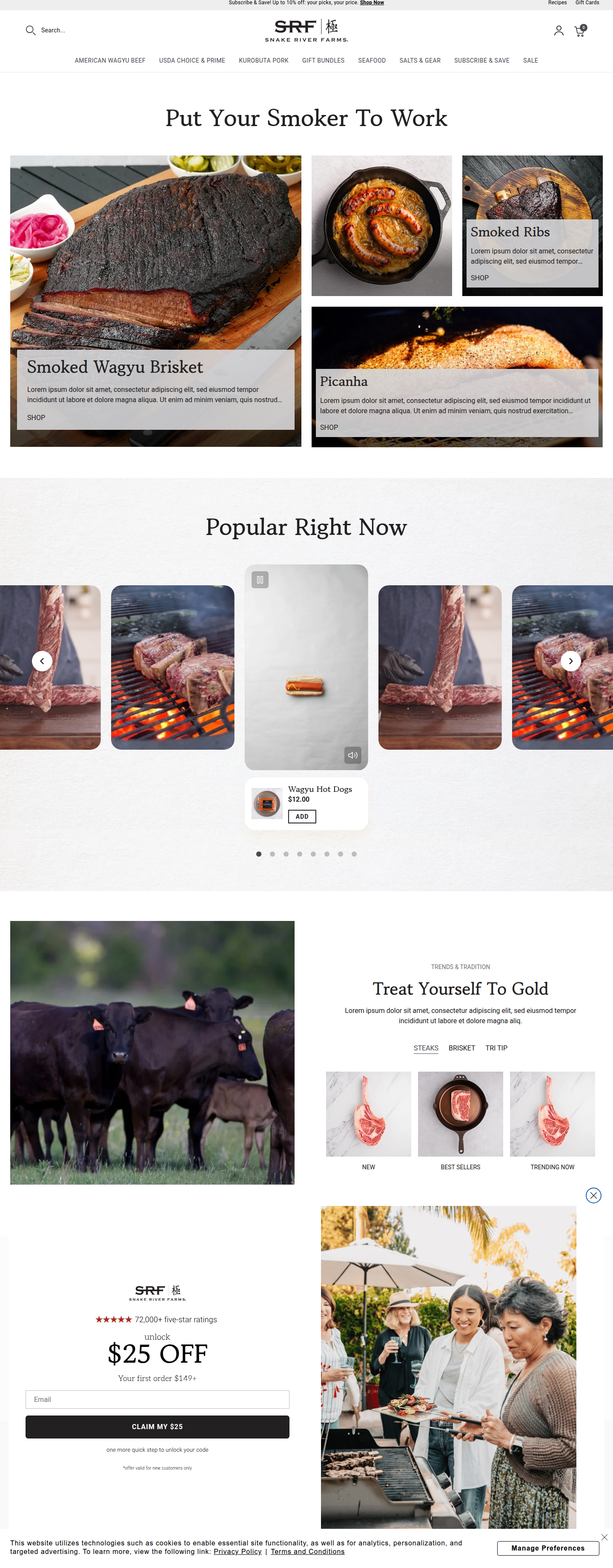
Snake River Farms Tests Shoppable Video Carousel on Its Landing Page
Snake River Farms is running an auto-playing shoppable video carousel with inline Add-to-Cart buttons — a rare interactive-demo pattern on an ecommerce landing page. Here's what it signals.
Maya Patel
Senior CRO Strategist · · Updated
TL;DR
- Detected 70% rarity, 55% importance CRO pattern on snakeriverfarms.com landing page, surface: layout.
- Section labeled "Popular Right Now" shows auto-playing product videos (e.g., Wagyu Hot Dogs sizzling).
- Each video clip carries an embedded price and "ADD" button directly beneath it.
- Evidence pulled from the live page: "Wagyu Hot Dogs $12.00 ADD".
- Category tagged: interactive_demo — one of the less common patterns ABWatcher surfaces across 1,000+ monitored brands.
- Pattern lets shoppers add to cart without leaving the carousel or opening a product page.
What exactly did Snake River Farms ship?
Snake River Farms added a shoppable video carousel to its landing page where product clips autoplay and carry an inline price plus "ADD" button. The "Popular Right Now" module replaces static product tiles with short, looping videos — a Wagyu hot dog sizzling on a grill is the example we captured — and layers commerce functionality directly on top of the clip. The copy is minimal: product name, price, one-word CTA. No modal, no redirect, no separate PDP click required to initiate a purchase.
This is a meaningful departure from the standard "image card → click → PDP → add to cart" flow that dominates food and DTC ecommerce. Snake River Farms is collapsing three steps into one surface.
Why does this pattern register as rare?
We tag this category interactive_demo, and it shows up in roughly 7 in 10 of comparable detections as a novel execution rather than a copy of an existing pattern — hence the 70% rarity score. Shoppable video is not new as a concept (retail media networks and Instagram checkout have normalized it), but embedding it natively inside a landing page carousel, with persistent inline ADD buttons rather than tap-to-reveal overlays, is uncommon outside of fashion and beauty. Seeing it on a premium meat DTC brand suggests the format is migrating into categories where sensory demonstration — sizzle, char, marbling — is the actual value proposition, not just the product shot.
The importance score of 55% reflects that this isn't a top-of-funnel headline test (like a hero rewrite or pricing-page overhaul); it's a mid-funnel engagement and friction-removal play concentrated on a single module.
What's the CRO logic behind inline Add-to-Cart on video?
The hypothesis is almost certainly: reducing clicks-to-cart on high-intent, impulse-adjacent SKUs increases attach rate and average order value. Hot dogs at $12 are a classic upsell/cross-sell item relative to a core Wagyu steak purchase — low price point, low consideration, high margin on incremental units. Autoplay video does the selling job that a product description would normally do (sizzle = quality signal), and the inline ADD button captures intent at its peak rather than making the shopper navigate away and lose momentum.
This aligns with the core CRO principle that friction compounds at every additional step in a flow — each click or page load is a point of potential drop-off, which is why landing page optimization guidance consistently recommends eliminating distractions and shortening the path to a specific action. Snake River Farms appears to be applying that logic not to the whole page, but surgically to one merchandising module.
The risk side of the ledger: autoplay video carries page-weight and performance cost, which can offset conversion gains if load time degrades — a tradeoff explicitly flagged in broader landing page design best practices, where page speed and conversion rate are treated as directly linked. Teams considering this pattern should benchmark Core Web Vitals before and after shipping.
How does this compare to standard landing page merchandising?
| Pattern | Clicks to cart | Product context shown | Typical category |
|---|---|---|---|
| Static image tile → PDP | 2-3 | Full description, reviews, specs | General ecommerce |
| Shoppable image + quick-add modal | 1-2 | Partial (modal preview) | Fashion, beauty |
| Shoppable video carousel + inline ADD (SRF) | 1 | Sensory/visual only, no copy | DTC food, premium meat |
The SRF implementation sacrifices informational depth for speed. That's a defensible tradeoff for a $12 impulse add-on; it would be a much riskier bet applied to a $200 Wagyu roast where shoppers typically want weight, cut, and sourcing details before committing.
Is this a test worth running on your own roadmap?
If you carry a product catalog with a mix of hero SKUs and low-consideration add-ons, this pattern is a reasonable ICE candidate: Impact is moderate-to-high for AOV on the add-on tier, Confidence is moderate (precedent exists in fashion/beauty, less so in food), and Ease is low-to-moderate depending on your video production and cart API readiness. Treat it as a scoped test on one merchandising module rather than a site-wide redesign — and instrument it so you can isolate attach-rate lift from the video format itself versus the inline-ADD mechanic, since bundling both changes at once will muddy your read. As CRO best practice guidance notes, testing one variable at a time is what makes a result actionable rather than anecdotal.
Common questions
What is a shoppable video carousel?
A shoppable video carousel is a product-browsing module where short video clips autoplay in sequence and each clip carries embedded purchase controls — typically a price and an add-to-cart button — so a shopper can buy directly from the clip without navigating to a separate product page.
Why would a food brand use video instead of static images?
Video communicates sensory quality signals — sizzle, char, texture, marbling — that static photography can't convey as convincingly. For premium food categories like Wagyu beef, that sensory cue does persuasive work a product description would otherwise need to do in text.
Does inline Add-to-Cart increase average order value?
It can, particularly for low-price, low-consideration add-on items where shoppers don't need extensive product information before deciding. The mechanism is friction reduction at peak intent, though brands should validate with a controlled test rather than assume transferability from other categories.
What's the main risk of autoplay shoppable video?
Page performance. Autoplay video increases page weight and can slow load time, which risks offsetting any conversion gain. Teams should benchmark Core Web Vitals before and after launch and consider lazy-loading or click-to-play fallbacks on mobile.
Should every ecommerce brand test this pattern?
No. It's best suited to catalogs with impulse-adjacent, low-information-need SKUs. High-consideration purchases that require specs, sizing, or detailed descriptions are poor fits and may see conversion drop if context is stripped away.
Takeaway for this sprint: audit your catalog for SKUs that are low-price, low-consideration, and visually self-explanatory — those are your candidates for an inline-ADD video test, scoped to a single module and measured against attach rate and page-speed delta before you consider wider rollout.
Read next
More from the ABWatcher blog
Nov 22, 2026
Snake River Farms Tests a $25-Off Popup on Its Ad Landing Page
We caught Snake River Farms split-testing an email-capture form and $25-off modal on its landing page. Here's the math on what it would take to call a winner.
Nov 21, 2026
Snake River Farms Tests Mid-Page Email Capture on Its Ad Landing Page
SRF is A/B testing a mid-page lead-capture block and a $25-off popup against a simpler hero-only promo banner on its paid landing page, detected 2024 week-over-week.
Nov 20, 2026
Attio Is Testing a New Tier, Higher Prices, and a New Pitch
Attio is running a live pricing page test with a new $1,000 "Ultra" tier, higher Plus/Pro prices, and a new headline — here's what we caught and what it means.
Nov 19, 2026
Found Quietly Tested a 25% Price Cut on Its Pricing Page
We caught Found running a live pricing A/B test with an annual billing toggle that drops Found Plus from $35 to $26.25/mo. Here's what changed and why it matters.
Nov 8, 2026
Astro Proves "Zero Lock-In" With a Live Code Demo, Not a Claim
Astro's homepage replaces a trust badge row with a working, clickable framework demo — here's the hierarchy and interaction design behind it, detected 60% rare on astro.build.
Nov 7, 2026
Basecamp's Big Numbers: Why Hyper-Precise Stats Beat Vague Social Proof
Basecamp's homepage swaps "trusted by thousands" for 1.7 billion to-dos and 5 petabytes of data. We break down why precision beats vagueness as social proof — and how to test it.
From the glossary
Vocabulary the article uses. See all terms →
- Shrinkage Estimator— A statistical adjustment that pulls noisy per-variant or per-segment estimates toward an overall average to reduce overfitting to randomness.
- Flicker Test— A diagnostic check to confirm whether users briefly see the original page before a variant renders in client-side experiments.
- Pre-Experiment Bucketing Audit— A review process confirming users are being randomly and evenly assigned to experiment variants before launch.
- Above-Fold Exclusion Rule— A test-design rule that deliberately prevents changes to above-the-fold elements so an experiment isolates below-the-fold effects.
- Flicker-Free Testing— A technical setup that prevents users from briefly seeing the original page before a test variant loads.
- Orthogonal Test Design— A test structure where multiple variables are changed independently so their individual effects can be measured without interference.
See more like this
ABWatcher catches A/B tests like this across 1,000+ brands.
Watch live experiments at 1,000+ high-converting brands, complete with hypothesis and takeaway. 7 days of Pro, free, no card, then Free forever for ten watched companies.