
Ro Tests Reversing the Dead-End: Insurance Ineligibility Gets a Second Chance
Ro is A/B testing whether disqualified GLP-1 signups should hit a hard-stop page or get looped back to reconsider their insurance selection. Here's what the funnel split reveals about recovery-path CRO.
Maya Patel
Senior CRO Strategist · Jul 14, 2026
Ro's GLP-1 insurance checker has a quiet dead end built into it — a page that tells users their government insurance doesn't qualify, paired with a single "Got it" CTA and nowhere else to go. Our detection engine caught Ro testing whether that dead end should exist at all.
What We Caught
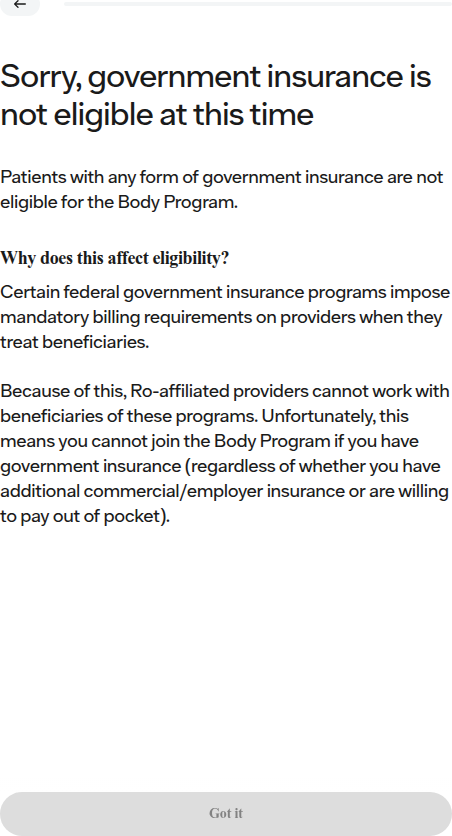
Across five monitored visits to the same signup URL — /weight-loss/glp1-insurance-checker/signup/insurance-not-eligible/ — four sessions (Safari, Firefox, Edge, and one Chrome instance) landed on the "insurance-type" question step: "What type of insurance do you have?" with six answer options. One Chrome session landed somewhere entirely different: the ineligibility dead-end page itself, showing "Sorry, government insurance is not eligible at this time."
Same URL path, same day, divergent final destinations. That's the signature of a server-side funnel split, not a rendering quirk — confirmed here by differing experiment bucket values in localStorage and genuinely different final URLs. Our same-run variance method exists precisely to catch this kind of split, where a brand controls routing at the server rather than swapping DOM elements client-side. We're logging this at 95% confidence.
The Two Paths, Concretely
Control: A user who selects (or is inferred to have) government insurance hits the wall immediately. Message delivered, one button, session effectively over. Clean, honest, fast — and almost certainly a conversion killer for anyone who mis-clicked or wasn't sure which insurance category applied to them.
Variant: That same user gets rerouted back to the insurance-type question, with all six options back on screen. No hard stop. The implicit logic: maybe they selected "Medicaid" when they meant "Medicare Advantage," maybe they have a secondary private plan, maybe they just need another shot at the multiple-choice step before the system concludes they're truly ineligible.
This is a classic recoverable vs. terminal state decision, and it's more common in regulated or eligibility-gated funnels than most teams realize — insurance, lending, age-verification, geographic-restriction flows all face this same fork.
Why This Test Matters More Than It Looks
On the surface this reads as a small UX tweak. Under a CRO lens, it's a test of a much bigger question: is your disqualification logic actually correct, or is it catching false negatives?
If a meaningful share of users hitting the ineligible page are there because of a selection error — not true ineligibility — the redirect variant should show a lift in downstream conversion (more users reaching the actual signup or provider-match step). If the disqualification logic is accurate and most of these users truly don't qualify, the redirect just adds friction and delays an outcome that was going to happen anyway, potentially with a worse user sentiment (nobody likes being asked the same question twice before hearing "no" a second time).
That tension maps cleanly to a standard Confidence-Lift-Risk framework:
- Confidence — how often is the ineligibility trigger a genuine misclassification vs. an accurate read? Ro likely has funnel logs showing back-selection rates on this exact question, which would have informed the hypothesis before this test even launched.
- Lift — the upside is recovered signups from users who were one click away from a false disqualification. In eligibility-gated healthcare funnels, even a few percentage points of recovery on a high-intent audience (someone actively checking GLP-1 coverage) is meaningful revenue.
- Risk — the downside is a longer, more frustrating path for users who are correctly disqualified, plus the possibility that repeat-looping creates a perception of a broken or manipulative flow if it happens more than once per session.
Contentful's CRO guide frames this well: successful tests require running long enough for statistical significance while accounting for the actual behavioral driver behind the hypothesis, not just the surface metric. Ro's team almost certainly isn't just watching "did they click Got It" vs. "did they reselect" — they're likely watching full-funnel completion, since the real question is whether redirected users convert further downstream, not whether they merely avoid the exit page.
The ICE Read
If I were scoring this as a candidate on Ro's roadmap using Impact, Confidence, Ease:
- Impact: Medium-high. Eligibility gates in healthcare funnels are high-stakes drop-off points; recovering even a slice of false negatives compounds against paid acquisition costs that are typically steep in this vertical.
- Confidence: Medium. Without visibility into how often users select the wrong insurance type on the first pass, the hypothesis rests on an assumption rather than hard prior data — though the fact that Ro shipped the test suggests they had at least directional signal.
- Ease: Low-medium. This required actual funnel re-architecture (server-side routing, bucket assignment, state persistence in localStorage) rather than a copy or layout change — a heavier lift than most A/B tests, which signals Ro sees this as a priority bet, not a quick win.
Digitalapplied's 2026 CRO guide notes the gap between average and top-performing conversion rates is driven far more by structural funnel decisions than by micro-copy — this test is a good example of a brand investing in the former rather than the latter.
What to Watch For
The open question we'll be tracking: does Ro cap the number of redirects per session? An unbounded loop (redirect back to insurance-type indefinitely) would be a red flag — it suggests the team hasn't fully reconciled the risk side of this test. A capped loop (one redirect, then hard stop) is the more defensible implementation and the one we'd expect a mature CRO org to ship.
Takeaway for Your Roadmap
If your funnel has a hard-disqualification page anywhere in it — insurance, credit, eligibility, geographic, age-gate — audit whether that "dead end" is actually a terminal state or a mislabeled recoverable one. Pull your own back-navigation and re-selection rates on the question immediately upstream of any disqualification page this sprint. If reselection rates are meaningfully above zero, you likely have a false-negative problem worth testing a recovery path against, the same bet Ro appears to be making here.
See more like this
ABWatcher catches A/B tests like this every day.
Watch live experiments at 1,000+ high-converting brands, complete with hypothesis and takeaway. Free forever for ten watched companies.