
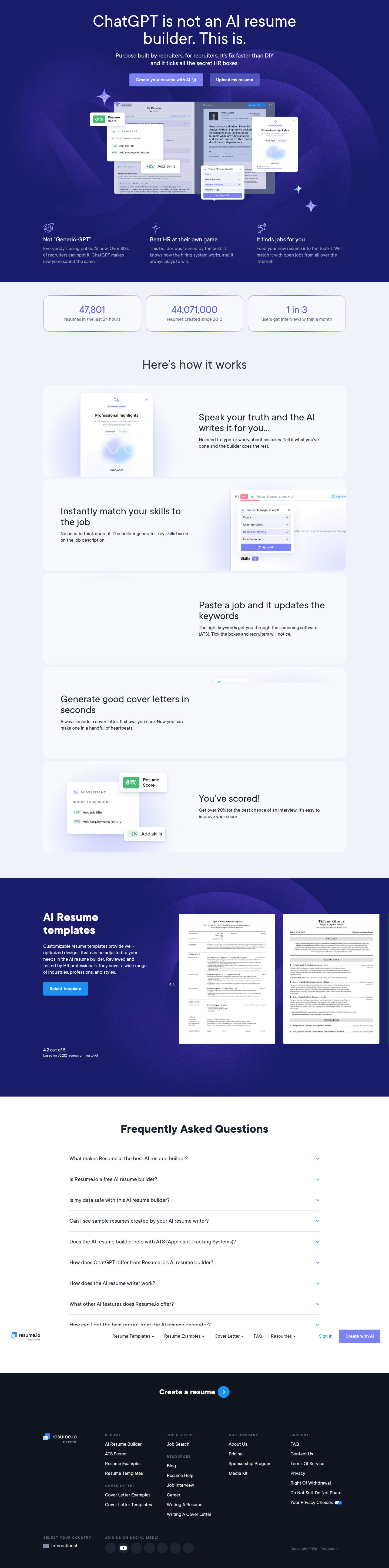
Resume.io Calls Out ChatGPT by Name in Its Hero — Should You?
Resume.io is directly naming ChatGPT as the villain in its hero section. We break down the "Not Generic-GPT" module and when a direct non-category callout actually works.
Jordan Reeves
Founder & Operator · · Updated
Resume.io just did something most SaaS homepages are too scared to do: it put a competitor's name in the hero, and that competitor isn't even in the same category. On a product-page hero surface, we caught a dedicated module titled "Not Generic-GPT," calling out ChatGPT directly and citing a recruiter-detection stat to make the case. This is the kind of move you don't see twice a year.
TL;DR
- Detected on resume.io, product page, hero surface
- Module headline: "Not Generic-GPT"
- Claim cited on-page: "Over 80% of recruiters can spot it" when a resume was written with public AI
- Rarity score: 70% — ABWatcher flags this as an uncommon pattern
- Importance score: 55% — moderate-to-high expected conversion impact
- Category: direct callout against a non-category tool (ChatGPT, not a resume-builder competitor)
What exactly is the variant?
The variant is a standalone comparison block in the hero that names ChatGPT and attacks the output quality of generic AI writing. The evidence quote reads: "Not 'Generic-GPT' — Everybody's using public AI now. Over 80% of recruiters can spot it. ChatGPT makes everyone sound the same." This isn't a feature comparison table against a rival resume builder — it's a referendum on a tool nearly every visitor has already used personally, which is what makes it rare and risky at once.
Most comparison modules in CRO tests pit you against the obvious adjacent player — Canva vs. Adobe Express, Notion vs. Coda. Calling out ChatGPT is different because it's infrastructure, not a competitor. Resume.io is betting that visitors have already tried pasting their resume into ChatGPT, gotten something generic back, and felt that twinge of "this sounds like everyone else." The module meets them at that exact memory.
Why would a resume builder attack ChatGPT instead of Canva?
Because the real competitor for Resume.io's buyer isn't another resume tool — it's a free alternative they already tried and didn't trust. ChatGPT isn't a category competitor, it's a substitution threat: it's free, it's already open in another tab, and it's good enough to tempt someone away from paying for a dedicated builder. I've run into this pattern before — not with resumes, but with any product where a general-purpose AI tool is "good enough" to kill your funnel at the top. When we shipped a comparison callout against "just doing it in a spreadsheet" on one onboarding flow years back, signups ticked up because we weren't fighting a direct competitor's brand, we were fighting the inertia of the free option already sitting on the visitor's desktop.
The 80% recruiter-detection stat does double duty. It's a fear-based differentiator, but it's also a numeric credibility anchor — which lines up with what FullStory's CRO guidance calls out directly: numerical evidence builds trust and creates urgency faster than vague superlative claims. "Recruiters can spot generic AI resumes" is forgettable. "80% of recruiters can spot it" is a number a visitor will repeat to a friend.
Does naming a non-competitor in your hero actually convert?
It can work when the tool you're naming is a real substitution threat the visitor has already tried and quietly distrusts. The risk is real: naming ChatGPT also reminds visitors that a free option exists, which could send some of them away to go try it again instead of converting. This is a classic high-variance test — it either sharpens the wedge or it plants the exact idea you didn't want in the visitor's head. Unbounce's best-practices guide makes the point that testing different angles of a value prop — benefit-focused versus problem-focused — is exactly how you find out which framing wins before you commit the whole hero to it. A direct-attack module is a problem-focused bet, and it should be tested as one, not shipped on faith.
How rare is this pattern across the sites ABWatcher tracks?
Direct non-category competitor callouts in a hero are uncommon — ABWatcher scored this detection 70% on rarity, well above typical hero copy tests.
| Pattern type | How common | Typical target |
|---|---|---|
| Category competitor comparison table | Common | Direct rival (e.g., builder vs. builder) |
| Pricing/feature comparison callout | Common | Direct rival |
| Non-category substitution callout (this detection) | Rare | Free/general tool (e.g., ChatGPT) |
| Anonymous "other tools" jab | Occasional | Unnamed competitor |
Most teams default to the safer, more generic "other tools" jab because naming a specific brand — especially one as dominant as ChatGPT — carries legal and brand-risk friction most legal teams will flag. Resume.io shipping this live on a hero surface suggests either strong internal data backing it or enough confidence to run it as a live test and watch the numbers.
What should a small team take from this?
You don't need a named competitor to borrow the mechanic — you need to identify the free substitute quietly killing your top of funnel and name the specific failure mode, backed by a number. If your product competes against "doing it manually," "using a spreadsheet," or "asking ChatGPT," that's your real hero-section opponent, not the other paid tool in your category. The number matters more than the name: "over 80% of recruiters can spot it" works because it's specific and falsifiable, not because ChatGPT is in bold text.
Common questions
Is naming a specific competitor like ChatGPT legally risky for SaaS hero copy?
Generally low risk for factual, non-disparaging comparative claims in most jurisdictions, especially in the US, but it varies by country and by how the claim is phrased. Teams should run specific wording past legal before shipping, particularly if the stat cited (like the 80% recruiter figure) isn't independently sourced on the page.
Should a small team test a direct competitor callout before committing to it?
Yes — treat it as a high-variance experiment, not a copy refresh. Run it against your current hero as an A/B test with enough traffic to detect a meaningful lift or drop, since this pattern can swing conversion sharply in either direction depending on audience trust.
Why do non-category callouts like this show up so rarely in hero sections?
Because most teams default to comparing against the obvious paid rival, not the free general-purpose tool quietly stealing top-of-funnel visitors. It takes more customer research to realize the real substitution threat isn't a competitor's logo — it's a free tab already open in the visitor's browser.
Does this pattern apply outside of resume and career tools?
Yes. Any SaaS or ecommerce product competing against a "free or manual" alternative — spreadsheets, generic AI chat tools, DIY workflows — can test a similarly specific, numbers-backed callout naming that exact substitute instead of a same-category rival.
What I would actually do next: before you write a single word of new hero copy, go find the actual free tool or manual workaround your last 20 lost trials tried before they found you — then write one sentence that names it and backs the claim with a real number, and A/B test that sentence against your current hero this sprint.
Read next
More from the ABWatcher blog
Nov 22, 2026
Snake River Farms Tests a $25-Off Popup on Its Ad Landing Page
We caught Snake River Farms split-testing an email-capture form and $25-off modal on its landing page. Here's the math on what it would take to call a winner.
Nov 21, 2026
Snake River Farms Tests Mid-Page Email Capture on Its Ad Landing Page
SRF is A/B testing a mid-page lead-capture block and a $25-off popup against a simpler hero-only promo banner on its paid landing page, detected 2024 week-over-week.
Nov 20, 2026
Attio Is Testing a New Tier, Higher Prices, and a New Pitch
Attio is running a live pricing page test with a new $1,000 "Ultra" tier, higher Plus/Pro prices, and a new headline — here's what we caught and what it means.
Nov 19, 2026
Found Quietly Tested a 25% Price Cut on Its Pricing Page
We caught Found running a live pricing A/B test with an annual billing toggle that drops Found Plus from $35 to $26.25/mo. Here's what changed and why it matters.
Nov 8, 2026
Astro Proves "Zero Lock-In" With a Live Code Demo, Not a Claim
Astro's homepage replaces a trust badge row with a working, clickable framework demo — here's the hierarchy and interaction design behind it, detected 60% rare on astro.build.
Nov 7, 2026
Basecamp's Big Numbers: Why Hyper-Precise Stats Beat Vague Social Proof
Basecamp's homepage swaps "trusted by thousands" for 1.7 billion to-dos and 5 petabytes of data. We break down why precision beats vagueness as social proof — and how to test it.
From the glossary
Vocabulary the article uses. See all terms →
- Shrinkage Estimator— A statistical adjustment that pulls noisy per-variant or per-segment estimates toward an overall average to reduce overfitting to randomness.
- Flicker Test— A diagnostic check to confirm whether users briefly see the original page before a variant renders in client-side experiments.
- Pre-Experiment Bucketing Audit— A review process confirming users are being randomly and evenly assigned to experiment variants before launch.
- Above-Fold Exclusion Rule— A test-design rule that deliberately prevents changes to above-the-fold elements so an experiment isolates below-the-fold effects.
- Flicker-Free Testing— A technical setup that prevents users from briefly seeing the original page before a test variant loads.
- Orthogonal Test Design— A test structure where multiple variables are changed independently so their individual effects can be measured without interference.
See more like this
ABWatcher catches A/B tests like this across 1,000+ brands.
Watch live experiments at 1,000+ high-converting brands, complete with hypothesis and takeaway. 7 days of Pro, free, no card, then Free forever for ten watched companies.