
Prismatic's $99 + $500 Referral Payout: A CRO Teardown
Prismatic replaced vague referral credits with a tiered $99 + $500 cash payout. Here's what the mechanic signals about funnel design and where it could backfire.
Maya Patel
Senior CRO Strategist · · Updated
TL;DR
- Detected on prismatic.io's landing page layout, logged as a unique_mechanic pattern with 70% rarity and 55% importance.
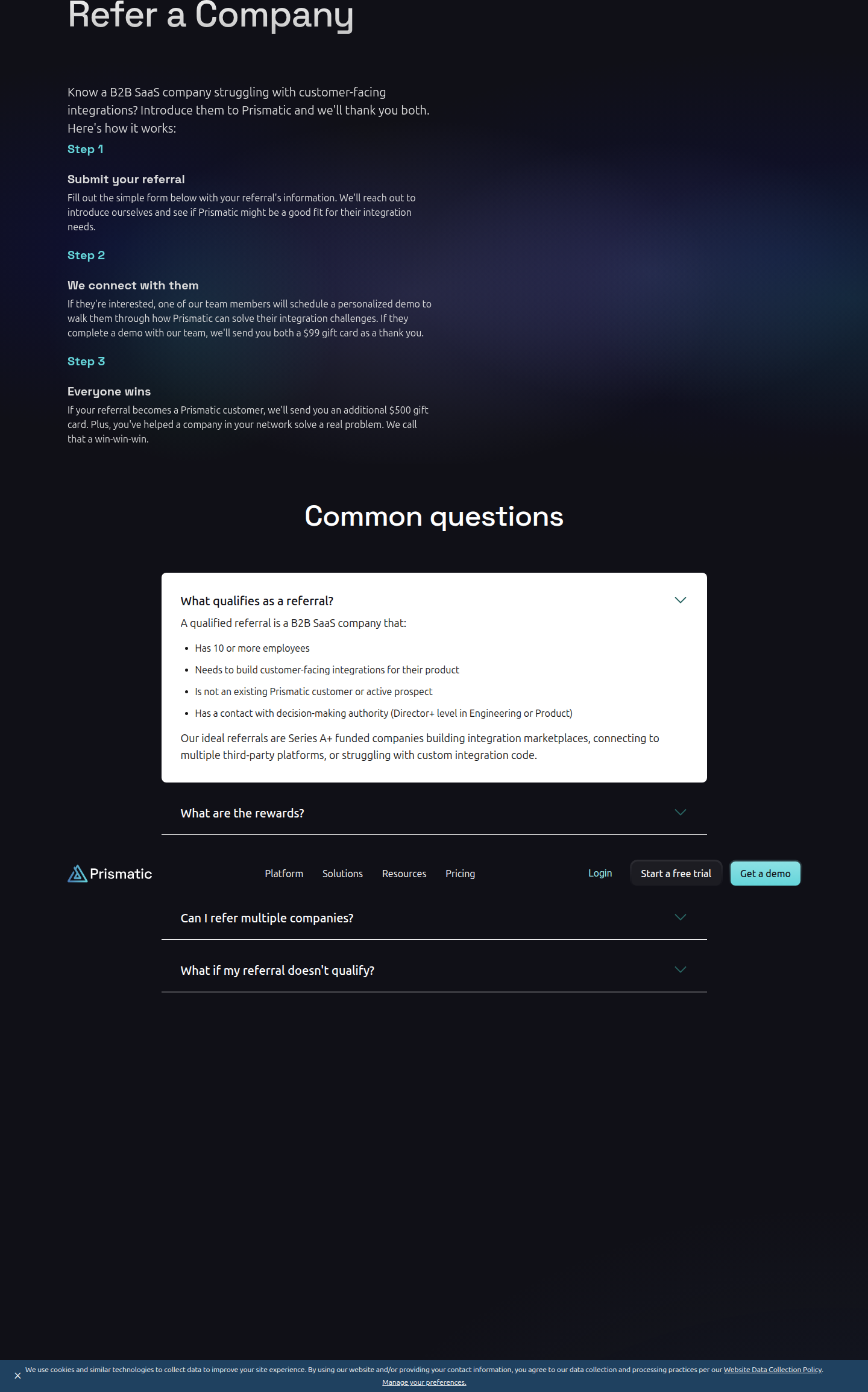
- The offer: a $99 gift card paid at demo completion, plus an additional $500 gift card once the referral converts to a paying customer.
- Evidence pulled directly from the page: "we'll send you both a $99 gift card as a thank you... we'll send you an additional $500 gift card."
- The mechanic is dual-sided (both referrer and referred party benefit) and tiered to two distinct funnel milestones rather than one.
- This replaces the generic "refer a friend for credit" pattern common in SaaS referral programs with explicit, escalating dollar amounts.
What exactly did Prismatic change on its landing page?
Prismatic restructured its referral offer into two cash-value payouts tied to two separate conversion events instead of a single vague incentive. The first $99 gift card fires on demo completion — a top-of-funnel, low-commitment action. The second $500 gift card fires only when the referred account becomes a paying customer — a bottom-of-funnel, revenue-qualified event. That's a meaningful structural choice: most referral programs pay once, at signup or at "becomes a customer," and leave the earlier stages uncompensated.
By splitting the payout, Prismatic effectively builds a mini funnel inside its referral mechanic. The $99 reduces the psychological cost of asking a colleague to "just take a 20-minute demo." The $500 is the real retention hook — large enough to make a B2B buyer actively hunt for someone in their network who might buy, not just passively share a link.
Why does dollar-specificity matter more than it seems?
Specific dollar amounts outperform vague credit language because they remove ambiguity about what the referrer is actually getting. "Refer a friend and earn rewards" requires the visitor to do mental math or trust an unknown point system. "$99" and "$500" require no interpretation. This is the same principle behind clear value-proposition testing that Optimizely's landing page optimization glossary flags as a top lever — test language that matches how visitors actually think, not internal company jargon. A gift card amount is about as close to plain language as an incentive can get.
There's a secondary effect worth noting: escalating, staged rewards create a sunk-cost-adjacent commitment loop. Once someone collects the $99, they have a reason to follow up on the referral to unlock the $500. That's a retention mechanic disguised as an acquisition mechanic, and it's rare enough in B2B SaaS (hence the 70% rarity score) that most competitors are still running single-stage, single-amount programs.
How does this compare to standard referral program structures?
Most referral tests we track optimize copy or placement, not the underlying payout architecture, which is what makes this detection notable.
| Pattern | Typical structure | Prismatic's structure |
|---|---|---|
| Payout trigger | Single event (signup or purchase) | Two events (demo + closed deal) |
| Reward framing | Vague credit / points / "reward" | Explicit dollar gift card amounts |
| Recipient | Often one-sided (referrer only) | Dual-sided (both parties benefit) |
| Funnel stage targeted | Bottom-funnel only | Top-funnel + bottom-funnel |
| Visible amount | Frequently hidden until signup | Disclosed upfront on landing page |
This table format itself matters for CRO teams: it's a reminder that referral testing isn't just a copy exercise. The surface here is "layout," meaning this is structural placement and offer architecture, not a headline A/B swap.
What's the tradeoff before teams copy this pattern?
The tradeoff is cost predictability versus conversion lift, and teams should model both before committing budget to a two-stage payout. A flat, single-trigger referral cost is easy to forecast against CAC targets. A two-stage payout with a $599 combined ceiling per successful referral is harder to model, especially if demo-stage fraud or low-intent referrals inflate the $99 payout line without producing enough $500 conversions to justify it.
Running this through an ICE framework: Impact is plausibly high for a high-ACV B2B product where $599 is a rounding error against contract value. Confidence is moderate — we have one detection, not a controlled test result, so we don't know Prismatic's actual lift. Ease is low-to-moderate: standing up a two-stage payout requires referral tracking that can attribute both a demo and a closed-won event back to the same referrer, which is more engineering lift than a single-trigger program.
Teams should also weigh this against general landing page hygiene. Impulse Creative's optimization guide notes that users scan pages and want to know "exactly what they need to do to get the offer and exactly what the offer is" — a two-stage payout only works if both stages are stated with equal clarity, not buried after the primary CTA. If the $500 tier is mentioned in smaller type or lower on the page, most visitors will anchor only on the $99 and the mechanic loses its escalating effect.
Common questions
What makes this a "unique mechanic" rather than a standard referral test?
Most referral programs we monitor use a single payout tied to one event. Prismatic's version uses two explicit dollar amounts tied to two distinct funnel stages — demo completion and closed-customer status — which is structurally rarer than copy or placement changes.
Is a tiered referral payout better than a single flat reward?
It depends on sales cycle length and ACV. For high-ACV, long-cycle B2B products, splitting the reward can sustain referrer engagement across a multi-week sales cycle. For low-ACV or self-serve products, the added complexity likely isn't worth the operational overhead.
What's the biggest risk in replicating this on our own site?
Attribution. You need reliable tracking from the initial referral link through to a closed-won event, weeks or months later, without losing the thread. Without that infrastructure, you risk promising a $500 payout you can't accurately verify or pay against.
How was this detection scored?
We logged it at 70% rarity and 55% importance — rare because of the dual-trigger, dollar-explicit structure, moderately important because referral mechanics influence a narrower slice of total conversion volume than core pricing or CTA tests.
Takeaway for your sprint
If your referral program still says "earn credit" instead of a number, that's your first test this sprint — not the two-stage structure itself. Ship the dollar-specific, single-stage version first, measure lift against your current vague-language baseline, and only layer in a second payout tier once you've confirmed your attribution pipeline can track a referral from demo to closed-won without dropping the thread.
Read next
More from the ABWatcher blog
Nov 22, 2026
Snake River Farms Tests a $25-Off Popup on Its Ad Landing Page
We caught Snake River Farms split-testing an email-capture form and $25-off modal on its landing page. Here's the math on what it would take to call a winner.
Nov 21, 2026
Snake River Farms Tests Mid-Page Email Capture on Its Ad Landing Page
SRF is A/B testing a mid-page lead-capture block and a $25-off popup against a simpler hero-only promo banner on its paid landing page, detected 2024 week-over-week.
Nov 20, 2026
Attio Is Testing a New Tier, Higher Prices, and a New Pitch
Attio is running a live pricing page test with a new $1,000 "Ultra" tier, higher Plus/Pro prices, and a new headline — here's what we caught and what it means.
Nov 19, 2026
Found Quietly Tested a 25% Price Cut on Its Pricing Page
We caught Found running a live pricing A/B test with an annual billing toggle that drops Found Plus from $35 to $26.25/mo. Here's what changed and why it matters.
Nov 8, 2026
Astro Proves "Zero Lock-In" With a Live Code Demo, Not a Claim
Astro's homepage replaces a trust badge row with a working, clickable framework demo — here's the hierarchy and interaction design behind it, detected 60% rare on astro.build.
Nov 7, 2026
Basecamp's Big Numbers: Why Hyper-Precise Stats Beat Vague Social Proof
Basecamp's homepage swaps "trusted by thousands" for 1.7 billion to-dos and 5 petabytes of data. We break down why precision beats vagueness as social proof — and how to test it.
From the glossary
Vocabulary the article uses. See all terms →
- Shrinkage Estimator— A statistical adjustment that pulls noisy per-variant or per-segment estimates toward an overall average to reduce overfitting to randomness.
- Flicker Test— A diagnostic check to confirm whether users briefly see the original page before a variant renders in client-side experiments.
- Pre-Experiment Bucketing Audit— A review process confirming users are being randomly and evenly assigned to experiment variants before launch.
- Above-Fold Exclusion Rule— A test-design rule that deliberately prevents changes to above-the-fold elements so an experiment isolates below-the-fold effects.
- Flicker-Free Testing— A technical setup that prevents users from briefly seeing the original page before a test variant loads.
- Orthogonal Test Design— A test structure where multiple variables are changed independently so their individual effects can be measured without interference.
See more like this
ABWatcher catches A/B tests like this across 1,000+ brands.
Watch live experiments at 1,000+ high-converting brands, complete with hypothesis and takeaway. 7 days of Pro, free, no card, then Free forever for ten watched companies.