
Nationwide's Homepage Test: Agent Finder vs. Account Login
Nationwide is running a live A/B test on its homepage middle feature slot, pitting a ZIP-code agent finder against an online account access prompt. Here's what the variance tells us about insurance funnel priorities.
Maya Patel
Senior CRO Strategist · Jul 24, 2026
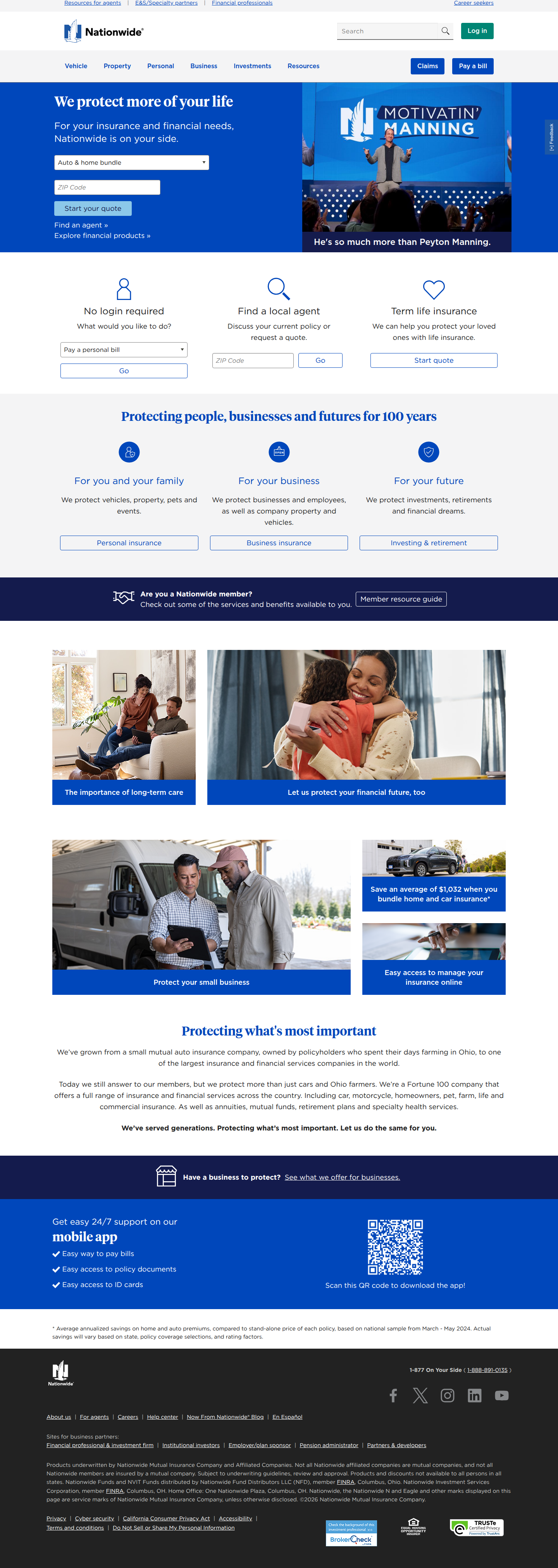
Nationwide.com is running a same-page, cross-browser experiment on one of the most valuable pieces of real estate on its homepage: the middle icon in a three-feature row just below the hero. Depending on which browser session you land in, you'll see one of two very different value props competing for that slot.
What We Caught
Our vision-AI analyser flagged the variance using same-run detection — meaning we're not comparing two dates, we're comparing simultaneous live sessions. Safari, Firefox, and one Chrome visit rendered:
"Online account access — Conveniently and securely manage your account." with a "Learn more" CTA.
Chrome (visit 2) and Edge rendered a materially different block:
"Find a local agent — Discuss your current policy or request a quote." paired with a ZIP code input field and a "Go" button.
A secondary, correlated change reinforces the split: Safari and Firefox omit the "Find an agent »" link beneath the hero form entirely, while Chrome and Edge include it. That's not noise — it's a coordinated variant. Whatever bucket a visitor lands in, the agent-finding path is either fully suppressed or doubly reinforced (feature block and hero-adjacent link). Analyst confidence on this read is 88%, high enough to treat as a deliberate test rather than a caching artifact or rendering bug.
The Strategic Question Nationwide Is Likely Asking
Insurance homepages serve two very different intents in that middle slot: existing policyholders who want self-service (login, manage, pay a bill) and prospects or lapsed customers who want a human touchpoint (agent, quote, policy discussion). You can't optimize for both with the same pixel space, so the test is effectively asking which intent deserves top billing.
The control (account access) is a retention and servicing play — it reduces support calls and reinforces "manage your policy without picking up the phone." The variant (agent finder with embedded ZIP capture) is an acquisition and quote-conversion play — it shortens the path from anonymous visitor to a warm lead by capturing intent data (ZIP code) directly in the feature block instead of requiring a scroll back to the hero form.
This is a classic Confidence-Lift-Risk tradeoff:
- Confidence: High. Nationwide almost certainly has call-center and quote-start volume data showing which entry point converts better, so this isn't a shot in the dark — it's likely validating a hypothesis already supported by directional data.
- Lift: The variant's upside is concentrated in top-of-funnel metrics — quote starts, agent contact form fills — which are easier to move than the control's target (self-service adoption, itself a slower-moving retention metric).
- Risk: Suppressing account access messaging for existing customers could quietly increase support-line volume or account-login friction, a cost that won't show up in a quote-conversion dashboard but will show up in call center staffing.
Why the Hero Link Correlation Matters
The fact that "Find an agent »" disappears below the hero form in the same variant that removes the agent-finder feature block (Safari/Firefox) — rather than being tested independently — tells us this isn't a simple single-element test. Nationwide is testing a messaging system, not a button color. That's a heavier lift operationally (more QA surface, more places for the experiment to leak between environments) but it's also more likely to produce a clean read, since you're not splitting attribution between two competing agent-focused CTAs on the same page.
For teams running their own tests, this is a useful reminder from the Contentful A/B testing playbook: isolating variables matters, but so does testing coherent experiences rather than isolated components when the underlying hypothesis is about user intent, not micro-copy.
Applying ICE to This Test
If we scored this using an ICE framework (Impact, Confidence, Ease) from Nationwide's likely internal view:
- Impact: Moderate-to-high. Quote starts are a top-line KPI for any P&C insurer, and moving even 1-2 points of homepage traffic into the quote funnel has outsized revenue impact given average policy LTV.
- Confidence: High, per the coordinated variant design suggesting this follows earlier signal, not a blind hypothesis.
- Ease: Low-to-moderate. Embedding a functional ZIP-code capture field inside a feature block (rather than just linking to a landing page) requires backend routing into the agent-locator or quoting system — more engineering lift than a copy-only test, which is worth noting since our detection method flagged it as a "copy" surface, but the input field elevates it into interaction-design territory.
That last point is worth flagging for anyone auditing this space: functional form fields embedded in feature blocks blur the line between copy tests and structural tests, and they usually indicate the team has already committed engineering resources on the belief the winning variant will ship broadly — a strong tell that this isn't a low-stakes exploratory test.
What This Means for Your Roadmap
Most B2C sites with a hybrid self-service/human-assisted model carry this same tension in a prominent homepage slot, whether it's "manage your account" vs. "talk to sales," or "self-checkout" vs. "book a consultation." Nationwide's test is a useful prompt to audit your own homepage: identify the single highest-traffic real estate slot serving two audience intents simultaneously, and ask whether you're currently forcing a single static message to serve both — likely underperforming both audiences — rather than testing a split.
This sprint, pull your homepage's top three above-the-fold CTAs and map each to a single primary intent (retain vs. acquire vs. inform). If any slot is trying to do double duty, that's your next test candidate — and per Splitbase's DTC testing framework, it's exactly the kind of test that separates teams running structured experimentation from teams guessing at homepage copy.
See more like this
ABWatcher catches A/B tests like this every day.
Watch live experiments at 1,000+ high-converting brands, complete with hypothesis and takeaway. Free forever for ten watched companies.