
MyPerfectResume Lets Visitors Demo the Product Before Signup — Smart or Risky?
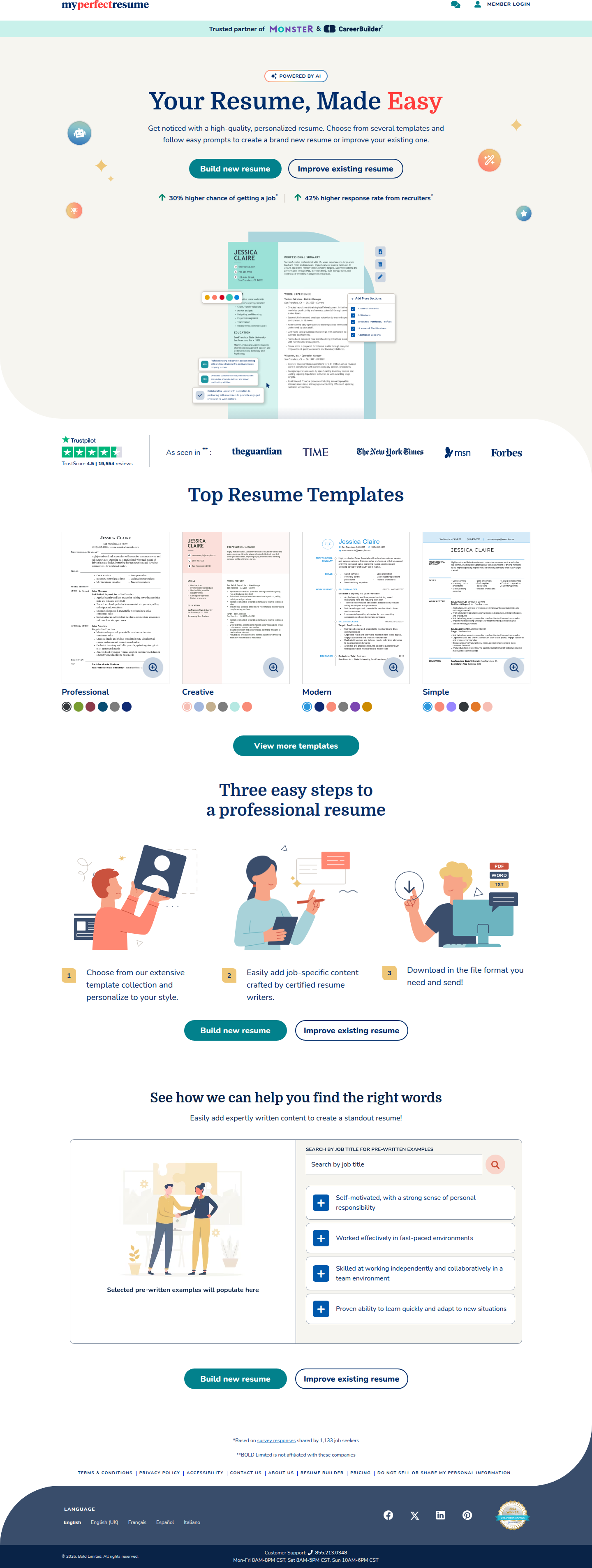
MyPerfectResume's homepage now lets visitors search their job title and preview pre-written resume bullets pre-signup. We break down the mechanics, the likely lift, and the risks.
Sam Lee
Data Analyst · · Updated
TL;DR
- Detected on the myperfectresume.com homepage, layout surface, logged as an
interactive_demopattern. - Widget copy reads: "SEARCH BY JOB TITLE FOR PRE-WRITTEN EXAMPLES / Selected pre-written examples will populate here."
- Rarity score: 65/100 — uncommon among the 1,000+ sites ABWatcher monitors daily.
- Importance score: 60/100 — meaningful but not top-tier structural change.
- Pattern type: pre-signup product demo embedded directly in the hero/layout, not gated behind an email capture.
- No confidence interval or sample size disclosed by the brand — this is a detection, not a verified lift.
What exactly did MyPerfectResume change on its homepage?
MyPerfectResume added a live search widget that populates pre-written resume bullet content by job title before any signup wall. A visitor types "Senior Product Manager" or "Line Cook," and the page returns actual example copy the product would generate — not a mockup, not a static screenshot. That's the core distinction. Most resume-builder landing pages sell the idea of personalization ("AI-powered bullet points!") behind a stock image of a resume. This page lets you taste the output first.
Functionally it's a mini interactive demo sitting in the layout where a hero image or testimonial carousel usually lives. We logged it under interactive_demo, category rarity 65%, because true pre-auth product previews are still the exception, not the rule, in this vertical. Job boards and resume tools more commonly show generic template thumbnails or "before/after" static comparisons.
Why would reducing the wall before signup actually increase conversion?
Letting users experience output before commitment front-loads perceived value, which should lower the psychological cost of the next click. This isn't a new idea — it's the same mechanic behind Canva's "try before you sign up" editor states and Grammarly's live-correction demo on its homepage. The logic: conversion rate is a function of perceived value divided by perceived effort/risk. If you can raise the numerator (show the actual bullets they'd get) without raising the denominator (no email required yet), you shift the ratio favorably.
The catch is that nobody at ABWatcher has lift data on this specific variant — we're flagging a pattern, not confirming a result. Optimizely's own guidance on landing page optimization is blunt about this: test headline and CTA language against what visitors actually search for, and don't assume a "better" experience converts better until you've measured it against a holdout. A demo widget that's genuinely useful can also become a distraction — visitors satisfy their curiosity and bounce without ever hitting the signup CTA. That's a real failure mode, not a hypothetical one, especially on a page where the primary conversion event (account creation) is still several clicks away from the point of engagement.
How would you actually test whether this widget is working?
You'd need a randomized holdout, a pre-registered primary metric, and enough traffic to detect a realistic effect size. Say MyPerfectResume's homepage sees 500,000 monthly uniques with a 12% baseline signup rate — that's 60,000 signups/month. To detect a 5% relative lift (12% → 12.6%) at 80% power and p<0.05 two-sided, you'd need roughly 60,000 visitors per arm, which a page this size clears in days, not weeks. But if the real effect is closer to 1-2% — plausible for a widget that mostly engages people who were already going to convert — you'd need 300,000+ per arm, meaning weeks of runtime and real risk of a novelty effect decaying mid-test.
That novelty effect matters here specifically because the widget is fun — job-title search with instant gratification is the kind of feature that spikes engagement in week one and regresses by week three as repeat visitors stop interacting with it. Any reported lift inside the first 7-10 days should be discounted until it's confirmed on a second cohort. Unbounce's CRO framework is explicit on this: test to statistical significance, not to the first green number, and document the result even if it reverses later.
What's the segment-level story likely to look like?
Expect the lift, if real, to concentrate in high-intent, job-title-specific traffic rather than broad organic visits. Someone arriving from a Google search for "resume examples nurse" is primed to type their exact title and see immediately relevant output — high relevance, high conversion probability. Someone landing from a generic display ad or homepage bookmark is less likely to engage with the widget at all. That means blended, page-level conversion lift could mask a much larger effect in a narrow, valuable segment (branded + job-title long-tail search) and a near-zero effect everywhere else.
A rough illustration: if 20% of traffic is job-title-intent and converts at +15% relative lift from the widget, while the other 80% sees 0% lift, your blended page-level number is only +3%. On 500,000 monthly visitors at 12% baseline and, say, a $140 average first-year customer value, +3% is about 1,800 incremental signups/month — real money, but easy to miss or dismiss if you're only looking at the topline number instead of segmenting by traffic source.
Surface and rarity context
| Attribute | Value |
|---|---|
| Page type | Home |
| Surface | Layout |
| Pattern category | Interactive demo |
| Rarity score | 65% |
| Importance score | 60% |
| Gate position | Pre-signup |
| Detection date | Logged in ABWatcher's current monitoring cycle |
For comparison, most resume/CV builder sites in our panel still rely on static "template preview" carousels — pre-auth, job-title-personalized bullet generation is a distinct minority pattern, which is why it cleared our 65% rarity threshold.
Common questions
Is this confirmed to be an A/B test, or just a shipped feature?
We detected it as a live layout pattern on the homepage, not as a running experiment with a visible control/variant split. It may be a fully shipped feature, a 50/50 test, or a holdback test — ABWatcher's detection logs the pattern's presence and rarity, not MyPerfectResume's internal test configuration, which isn't publicly observable.
Why does gating matter so much for this kind of widget?
Ungated demos raise the risk of "value leakage" — visitors get what they came for (the resume bullets) and never convert, since there's no email or account required to see the output. Gated demos capture an email first but add friction. The tradeoff is a classic CRO fork, and the right answer depends on whether your real bottleneck is top-of-funnel trust or bottom-of-funnel lead capture.
How long should a test like this run before calling a result?
Long enough to clear your pre-calculated sample size at 80% power for your minimum detectable effect, and ideally across at least two full weekly cycles to average out day-of-week traffic mix and avoid reading a novelty spike as a permanent lift. For most mid-traffic SaaS pages that's 2-4 weeks minimum.
Could this hurt conversion instead of helping it?
Yes — if the widget pulls attention and clicks away from the primary CTA, or if the pre-written examples set unrealistic expectations the paid product can't match, you could see a conversion decline that only shows up in the signup-to-paid step further down funnel, not on the homepage metric alone.
Takeaway for your roadmap this sprint
If you're sitting on gated product value — templates, calculators, personalized output — test ungating a thin slice of it on your highest-intent landing page segment first, not globally. Pre-register your primary metric, size your test against a realistic 2-5% effect rather than hoping for a double-digit swing, and segment results by traffic source before you declare a win. A page-level "it went up" without a confidence interval and a segment breakdown isn't a result — it's an anecdote.
Read next
More from the ABWatcher blog
Nov 22, 2026
Snake River Farms Tests a $25-Off Popup on Its Ad Landing Page
We caught Snake River Farms split-testing an email-capture form and $25-off modal on its landing page. Here's the math on what it would take to call a winner.
Nov 21, 2026
Snake River Farms Tests Mid-Page Email Capture on Its Ad Landing Page
SRF is A/B testing a mid-page lead-capture block and a $25-off popup against a simpler hero-only promo banner on its paid landing page, detected 2024 week-over-week.
Nov 20, 2026
Attio Is Testing a New Tier, Higher Prices, and a New Pitch
Attio is running a live pricing page test with a new $1,000 "Ultra" tier, higher Plus/Pro prices, and a new headline — here's what we caught and what it means.
Nov 19, 2026
Found Quietly Tested a 25% Price Cut on Its Pricing Page
We caught Found running a live pricing A/B test with an annual billing toggle that drops Found Plus from $35 to $26.25/mo. Here's what changed and why it matters.
Nov 8, 2026
Astro Proves "Zero Lock-In" With a Live Code Demo, Not a Claim
Astro's homepage replaces a trust badge row with a working, clickable framework demo — here's the hierarchy and interaction design behind it, detected 60% rare on astro.build.
Nov 7, 2026
Basecamp's Big Numbers: Why Hyper-Precise Stats Beat Vague Social Proof
Basecamp's homepage swaps "trusted by thousands" for 1.7 billion to-dos and 5 petabytes of data. We break down why precision beats vagueness as social proof — and how to test it.
From the glossary
Vocabulary the article uses. See all terms →
- Shrinkage Estimator— A statistical adjustment that pulls noisy per-variant or per-segment estimates toward an overall average to reduce overfitting to randomness.
- Flicker Test— A diagnostic check to confirm whether users briefly see the original page before a variant renders in client-side experiments.
- Pre-Experiment Bucketing Audit— A review process confirming users are being randomly and evenly assigned to experiment variants before launch.
- Above-Fold Exclusion Rule— A test-design rule that deliberately prevents changes to above-the-fold elements so an experiment isolates below-the-fold effects.
- Flicker-Free Testing— A technical setup that prevents users from briefly seeing the original page before a test variant loads.
- Orthogonal Test Design— A test structure where multiple variables are changed independently so their individual effects can be measured without interference.
See more like this
ABWatcher catches A/B tests like this across 1,000+ brands.
Watch live experiments at 1,000+ high-converting brands, complete with hypothesis and takeaway. 7 days of Pro, free, no card, then Free forever for ten watched companies.