
Monday.com Is Running a Cross-Domain Test: mondaycrm.ai vs. monday.com/crm
Monday.com is server-side splitting CRM pricing traffic between its classic domain and a new mondaycrm.ai microsite. Here's what the variant reveals about AI-positioning tests.
Maya Patel
Senior CRO Strategist · · Updated
Monday.com is quietly running one of the more structurally aggressive pricing tests we've logged this quarter: a full cross-domain split on its CRM pricing page, pitting the familiar monday.com/crm/pricing experience against a rebranded mondaycrm.ai/pricing funnel. This isn't a headline swap or a button recolor — it's two different domains, two different nav structures, and two different brand stories about what the product even is.
TL;DR
- Detected 90% confidence, flagged via week-over-week diff analysis on monday.com/crm/pricing.
- Variant lives on a separate domain, mondaycrm.ai/pricing, not a URL parameter or DOM swap.
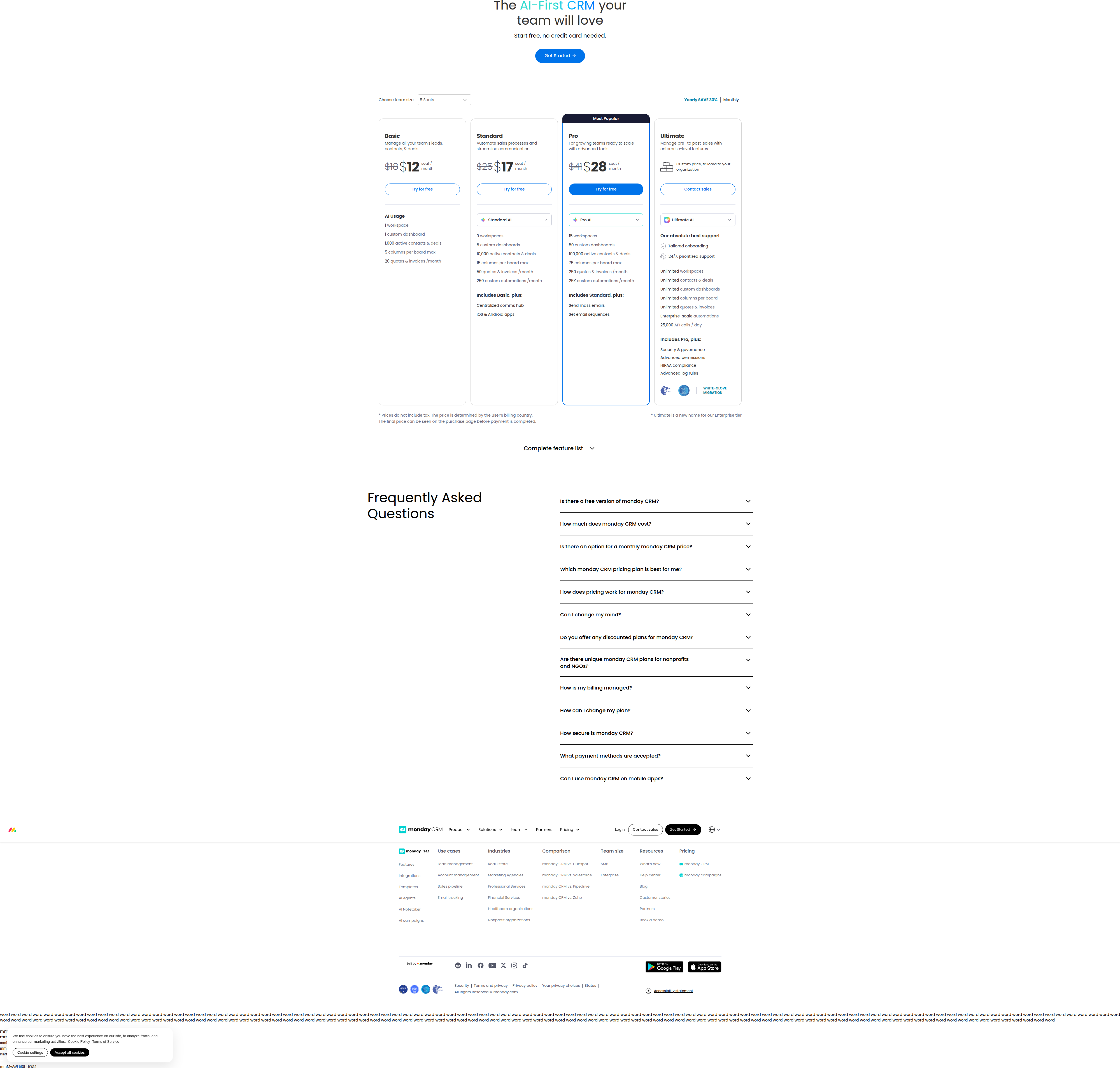
- Control headline: "A CRM pricing plan that works for everyone"; variant headline: "AI-First CRM."
- Control includes a customer logo bar and light-themed FAQ; variant drops the logo bar entirely.
- Variant adds a dark-themed "Most Popular" plan badge not present in control.
- Confirmed as a genuine server-side bucketed test via distinct experiment cookies, not rendering noise.
What exactly changed on the page?
The test swaps the entire framing of monday's CRM product, not just page elements, between two live domains. On the control (monday.com/crm/pricing), visitors see a familiar, broadly-positioned headline — "A CRM pricing plan that works for everyone" — alongside a customer logo bar for social proof and a light-themed FAQ section. The variant (mondaycrm.ai/pricing) strips the logo bar, switches to a dark "Most Popular" plan badge, and leads with "AI-First CRM" — a direct repositioning of the product category itself, from general-purpose CRM to AI-native CRM. Even the nav and footer structures differ between the two, suggesting mondaycrm.ai is being built out as a semi-independent property rather than a simple page variant bolted onto the main site.
Why would monday.com test this cross-domain instead of A/B within one URL?
Testing on a separate domain lets monday.com isolate brand-level positioning risk without touching its core site's SEO equity or analytics baselines. Running an entire rebrand as a page-level variant would require the team to rewrite global nav, footer, and FAQ theming behind a feature flag — expensive to build and risky to roll back if the AI-first story underperforms. Spinning up mondaycrm.ai as a distinct funnel lets them bucket traffic server-side, protect monday.com's existing domain authority, and kill the experiment cleanly if conversion or trial-quality metrics disappoint. It also means paid traffic or specific referral sources could be routed straight into the AI-first narrative without any crossover contamination in organic search results for the core site.
The tradeoff: cross-domain tests are harder to attribute cleanly, since variant exposure can leak into brand search behavior and confuse last-click models. For a team this size, that's likely an accepted cost given the strategic question they're answering — is "CRM" or "AI-First CRM" the category monday wants to own in buyer perception.
Does dropping the customer logo bar make sense here?
Removing social proof while introducing a bigger brand claim is a defensible but higher-variance bet on message strength over third-party validation. Logo bars typically do heavy lifting for visitors unfamiliar with a brand, borrowing trust from recognizable names. monday.com's control page leans on that convention. The variant swaps borrowed trust for category-definition confidence — betting that "AI-First CRM" is a strong enough positioning hook on its own to carry a cold visitor through to trial signup. This is a classic Confidence-Lift-Risk tradeoff: the upside is a potentially sharper differentiation story in a crowded CRM market, but the downside is losing the reassurance signal that logo bars provide to risk-averse B2B buyers comparing multiple vendors before committing a seat-based budget.
What does the plan structure tell us about intent?
The dark "Most Popular" badge on the variant signals monday is also testing anchoring and plan-steering independently of the branding question. monday's own CRM pricing is tiered across Basic, Standard, Pro, and Ultimate, with Standard commonly cited as the practical entry point for small teams — Fruition Services notes Standard runs $17/seat/month against Basic at $12 and Pro at $28. A prominent "Most Popular" badge is a well-worn anchoring tactic to nudge buyers toward a specific tier, and testing it alongside a full rebrand suggests monday is running two hypotheses in parallel: does AI framing win more trials, and does stronger tier anchoring win higher-ACV signups. Running both inside one experiment makes it harder to isolate which lever is actually doing the work — a common mistake to flag in a PIE-scored test backlog, where potential, importance, and ease should be scored separately per hypothesis, not bundled.
How does this compare to typical CRO practice?
Here's a quick comparison of the two live surfaces as detected on 90% confidence this cycle.
| Element | monday.com/crm/pricing (control) | mondaycrm.ai/pricing (variant) |
|---|---|---|
| Headline | "A CRM pricing plan that works for everyone" | "AI-First CRM" |
| Customer logo bar | Present | Absent |
| Plan badge | None detected | Dark "Most Popular" badge |
| FAQ theme | Light | Not specified (distinct structure) |
| Nav/footer | Standard monday.com structure | Distinct, rebranded structure |
| Domain | monday.com | mondaycrm.ai |
monday.com has publicly framed testing as a way to replace the "Highest Paid Person's Opinion" with customer behavior data, as the company notes in its own A/B testing primer — treating pricing and positioning decisions as empirical questions rather than executive instinct. This cross-domain test is a live demonstration of that philosophy applied to brand strategy itself, not just a UI tweak.
Common questions
Is this actually an A/B test or just a new product launch?
Our analysts confirmed it's a genuine test via server-side traffic bucketing and distinct experiment cookies across both domains, logged at 90% confidence. A permanent launch wouldn't split traffic between two domains with cookie-based routing — that pattern is specific to controlled experimentation infrastructure.
Why run a rebrand test on a separate domain instead of a subpage?
Separate domains protect the primary site's SEO equity and let teams fully restyle nav, footer, and FAQ without feature-flagging every global component. It also allows clean traffic isolation for paid campaigns and faster rollback if the AI-first narrative underperforms on trial-to-paid conversion.
Should other CRM or SaaS brands test AI-first messaging against generic positioning?
It depends on buyer maturity and competitive context — ICE-score the test against how saturated "AI" claims already are in your category. If every competitor already leads with AI language, the differentiation value drops, and a logo bar or proof-based message may outperform.
What should teams watch for if they spot cross-domain pricing tests from competitors?
Check whether nav, footer, and trust signals (logos, badges, FAQ tone) differ alongside the headline — that combination indicates a brand-level test, not a copy tweak. Track how long the variant domain persists; extended run times usually signal a winning variant headed for permanent rollout.
Takeaway for your roadmap this sprint
Before bundling a rebrand test with a pricing-anchor test, split them. Monday's variant changes headline, logo bar, plan badge, and domain structure simultaneously — directionally interesting to watch, but difficult for their own team to attribute cleanly. If you're planning a positioning test this sprint, isolate the brand-message variable first, measure trial-start lift on its own, then layer in anchoring or badge tests as a second-phase experiment once you know which narrative wins.
Read next
More from the ABWatcher blog
Nov 27, 2026
Ally Tests CTA Copy on Its SpringFour Landing Page: What We Found
Ally.com's SpringFour partner page is running a two-arm test on its three-card feature section — card order, copy, and CTA labels all differ by variant. Here's the math on what it'd take to call a winner.
Nov 25, 2026
Monday.com Killed Its Hero Form — The Prompt Box Is the Demo
Monday.com replaced its signup form hero with a single prompt box that builds a working app live. Here's what that bet tells us about CTA design in 2026.
Nov 24, 2026
Snake River Farms Tests Email Capture + Popup on Its Ad Landing Page
We caught Snake River Farms running a session-based A/B test on its ad landing page, adding a $25-off email capture block and a follow-up discount popup. Here's what it means.
Nov 23, 2026
Snake River Farms Tests a $25 Email Bar Against a Clean Landing Page
ABWatcher caught Snake River Farms running a live A/B test on its ad landing page: a persistent $25 discount bar and popup versus a clean, offer-free layout.
Nov 22, 2026
Snake River Farms Tests a $25-Off Popup on Its Ad Landing Page
We caught Snake River Farms split-testing an email-capture form and $25-off modal on its landing page. Here's the math on what it would take to call a winner.
Nov 21, 2026
Snake River Farms Tests Mid-Page Email Capture on Its Ad Landing Page
SRF is A/B testing a mid-page lead-capture block and a $25-off popup against a simpler hero-only promo banner on its paid landing page, detected 2024 week-over-week.
From the glossary
Vocabulary the article uses. See all terms →
- Blind Spot Bias— The tendency for testing programs to repeatedly overlook certain page areas, segments, or failure modes because past wins trained teams where to look.
- Lift Decay— The gradual shrinking of a winning variant's measured uplift as it runs longer or scales to full traffic.
- Pre-Post Bias— The distortion that arises when comparing a test period to an earlier period instead of a concurrent control, confounding results with time-based changes.
- Above Threshold Bucketing Error— A misconfiguration where users are assigned to the wrong variant because allocation logic misreads a threshold or percentage boundary.
- Experiment Register— A centralized, living log of all experiments run across an organization, including status, hypothesis, results, and owner.
- Experiment Allocation Imbalance— An unintended skew in traffic split between variants that isn't severe enough to flag as SRM but still distorts results.
See more like this
ABWatcher catches A/B tests like this across 1,000+ brands.
Watch live experiments at 1,000+ high-converting brands, complete with hypothesis and takeaway. 7 days of Pro, free, no card, then Free forever for ten watched companies.