
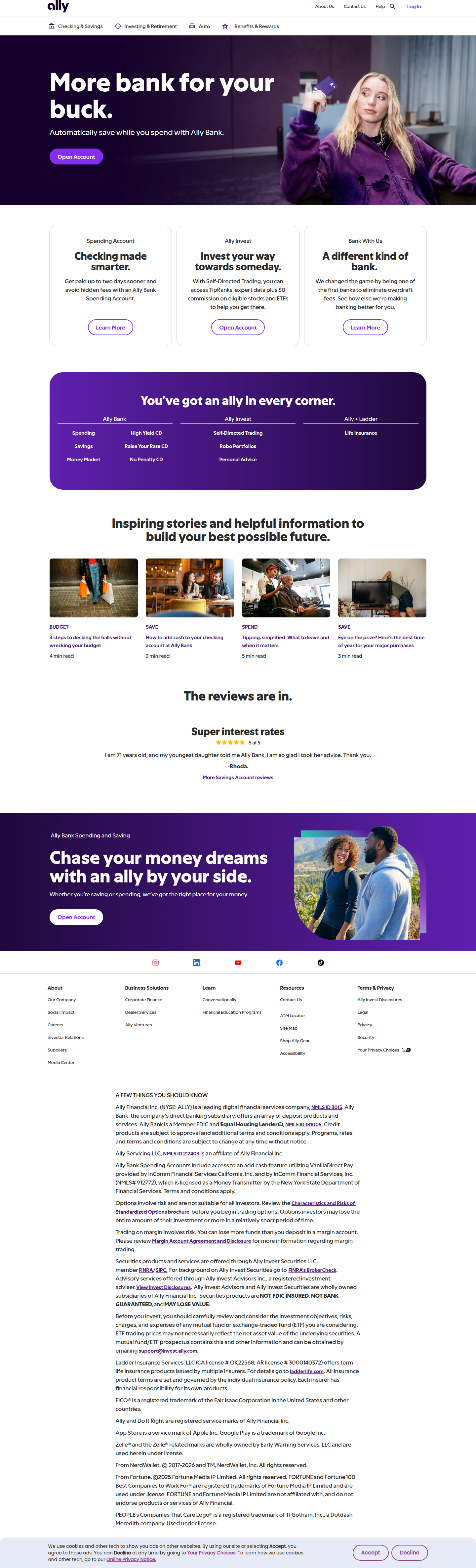
Ally Tests CTA Copy on Its SpringFour Landing Page: What We Found
Ally.com's SpringFour partner page is running a two-arm test on its three-card feature section — card order, copy, and CTA labels all differ by variant. Here's the math on what it'd take to call a winner.
Sam Lee
Data Analyst · · Updated
TL;DR
- Detected 11 June 2025 on ally.com/springfour/, a partner-referral landing page.
- Two variants of the three-card section below the hero, split across 7 monitored visits: variant A on visits 1 and 6, variant B on visits 2–5 and 7.
- Variant A uses generic CTAs: "Learn More / Open Account / Learn More."
- Variant B uses specific CTAs: "View Your Choices / View Rates / Learn More," with reordered cards (Ally Invest first, Bank With Us second, Ally Bank third).
- Detection method: same_run_variance — the split holds across Chrome, Safari, Firefox, and Edge, which rules out a browser-rendering bug.
- Analyst confidence: 85%.
What exactly changed on the page?
Ally is running a layout and copy test on the three feature cards directly beneath the hero on its SpringFour co-brand page. Variant A reads "Spending Account / Checking made smarter," "Ally Invest / Invest your way towards someday," and "Bank With Us / A different kind of bank," each paired with Learn More or Open Account buttons. Variant B swaps in "Ally Invest / Find the right way to invest," "Bank With Us / Give your money a competitive edge," and "Ally Bank / Spend and save smarter," paired with View Your Choices and View Rates buttons. That's three simultaneous changes bundled as one test: card order, headline copy, and CTA label specificity.
Bundling matters here. If Ally wants to attribute a lift to "specific CTA beats generic CTA," a clean read requires isolating CTA label as the only delta. As the layout testing literature notes, testing too many variables simultaneously is the single most common error in layout experiments — it makes the attribution ambiguous even when the topline number moves. Ally's variant swaps card order and value-prop phrasing and CTA wording at once. A win tells you the bundle works; it doesn't tell you which of the three levers is doing the work.
Why does a mid-page card section matter enough to test?
Secondary content below the hero still carries meaningful traffic weight, because SpringFour visitors are typically referred users already primed to act. SpringFour is a financial-hardship referral partner, so visitors arriving via this URL are likely mid-journey — already motivated, scanning for the fastest path to the right Ally product. For that segment, CTA specificity ("View Rates" vs. "Learn More") plausibly reduces the click-to-irrelevant-page problem: a generic "Learn More" sends equal traffic regardless of intent, while "View Your Choices" pre-qualifies the click toward a decision page. That's consistent with the metrics guidance from Convert, which frames "increase engagement" as any click on a tested link — exactly the kind of granular, card-level event you'd want to instrument here rather than relying on page-level conversion alone.
How did we confirm this is a real test, not a rendering artifact?
The variant split persists across independent browser engines, which is the key evidence against a caching or rendering bug. Variant A appeared in both Chrome and Safari; variant B appeared in Chrome, Firefox, and Edge. If this were a CSS bug or a stale CDN cache tied to one rendering engine, you'd expect the split to correlate with browser family. It doesn't — Chrome shows up on both sides of the split. That cross-engine persistence is why we log 85% confidence and classify this as same_run_variance: a genuine server-side or feature-flag-driven A/B split, not noise.
What would it take for Ally to call a statistically valid winner?
Here's where a numerate read matters more than the eyeball test. Assume Ally runs this at moderate traffic — say 40,000 unique sessions/week to the SpringFour page, split 50/50. If baseline click-through on the card section sits around 8% (typical for a tertiary CTA block, well below hero CTR), detecting a relative lift of 10% (8.0% → 8.8%) at 80% power and 95% confidence requires roughly 24,000 sessions per arm — about 3 weeks at that volume. Smaller, more realistic lifts compound the problem:
| Assumed baseline CTR | Target relative lift | Approx. sessions needed per arm | Weeks at 40k/wk split 50/50 |
|---|---|---|---|
| 8% | 20% (8%→9.6%) | ~6,200 | ~1 week |
| 8% | 10% (8%→8.8%) | ~24,000 | ~3 weeks |
| 8% | 5% (8%→8.4%) | ~95,000 | ~12 weeks |
| 3% | 10% (3%→3.3%) | ~67,000 | ~8.5 weeks |
SpringFour is a niche, partner-driven URL — traffic is almost certainly well under 40k/week, which means a real 5-10% lift could take a quarter or more to confirm properly. Anything Ally calls internally before hitting that sample size risks being a novelty effect or a Simpson's-paradox artifact from uneven traffic-source mix between arms (e.g., one SpringFour partner batch landing disproportionately in one variant during a short window).
What should teams building similar tests do differently?
Isolate the CTA label as its own test before bundling it with card reordering and copy rewrites. If Ally wants a defensible claim like "specific CTAs lift click-through by X%, 95% CI [Y%, Z%]," the fastest path is a single-variable CTA-label test layered on top of whichever card order and copy already won in a prior round — sequential testing, not everything at once. This also matches the core landing-page CRO guidance on testing layout elements one dimension at a time rather than reshuffling the whole section simultaneously.
Common questions
Is this confirmed to be an intentional Ally A/B test?
Yes, with 85% analyst confidence. The variant split appears consistently across visits and persists across four different browser engines (Chrome, Safari, Firefox, Edge), which rules out a browser-specific rendering bug as the explanation and points to a server-side or feature-flag-controlled experiment.
What's actually different between the two variants?
Card order, headline copy, and CTA button labels all differ. Variant A uses generic CTAs ("Learn More," "Open Account") with one card order; variant B uses outcome-specific CTAs ("View Your Choices," "View Rates") with Ally Invest promoted to the first card position.
Why does bundling multiple changes into one test matter?
Because you can't attribute a lift to a single cause. If variant B wins, Ally won't know whether it was the CTA wording, the card reorder, or the headline rewrite that drove it — a classic too-many-variables error flagged in layout-testing best practices.
How much traffic would Ally need to trust a result here?
It depends on baseline CTR and the lift size. At an 8% baseline CTR, detecting a 10% relative lift at 95% confidence and 80% power needs roughly 24,000 sessions per arm — likely several weeks even on a moderately trafficked partner page like this one.
What should other teams take from this detection?
Test CTA copy in isolation before bundling it with layout and messaging changes, and don't declare a winner before hitting a pre-calculated sample size. Even a modest-looking three-card section below the hero deserves the same statistical discipline as a hero or pricing-page test.
Takeaway for your roadmap this sprint
Before you ship your next "card section refresh," separate it into sequential single-variable tests — CTA label first, then copy, then order — and pre-register the minimum detectable effect and required sample size. A 10% relative lift on an 8% baseline CTR isn't a eyeball call; it's a 3-week test at 24,000 sessions per arm, minimum. Audit whether your current mid-page tests, like Ally's, are bundled the same way, and split them before you trust the next readout.
Read next
More from the ABWatcher blog
Nov 26, 2026
Monday.com Is Running a Cross-Domain Test: mondaycrm.ai vs. monday.com/crm
Monday.com is server-side splitting CRM pricing traffic between its classic domain and a new mondaycrm.ai microsite. Here's what the variant reveals about AI-positioning tests.
Nov 25, 2026
Monday.com Killed Its Hero Form — The Prompt Box Is the Demo
Monday.com replaced its signup form hero with a single prompt box that builds a working app live. Here's what that bet tells us about CTA design in 2026.
Nov 24, 2026
Snake River Farms Tests Email Capture + Popup on Its Ad Landing Page
We caught Snake River Farms running a session-based A/B test on its ad landing page, adding a $25-off email capture block and a follow-up discount popup. Here's what it means.
Nov 23, 2026
Snake River Farms Tests a $25 Email Bar Against a Clean Landing Page
ABWatcher caught Snake River Farms running a live A/B test on its ad landing page: a persistent $25 discount bar and popup versus a clean, offer-free layout.
Nov 22, 2026
Snake River Farms Tests a $25-Off Popup on Its Ad Landing Page
We caught Snake River Farms split-testing an email-capture form and $25-off modal on its landing page. Here's the math on what it would take to call a winner.
Nov 21, 2026
Snake River Farms Tests Mid-Page Email Capture on Its Ad Landing Page
SRF is A/B testing a mid-page lead-capture block and a $25-off popup against a simpler hero-only promo banner on its paid landing page, detected 2024 week-over-week.
From the glossary
Vocabulary the article uses. See all terms →
- Blind Spot Bias— The tendency for testing programs to repeatedly overlook certain page areas, segments, or failure modes because past wins trained teams where to look.
- Lift Decay— The gradual shrinking of a winning variant's measured uplift as it runs longer or scales to full traffic.
- Pre-Post Bias— The distortion that arises when comparing a test period to an earlier period instead of a concurrent control, confounding results with time-based changes.
- Above Threshold Bucketing Error— A misconfiguration where users are assigned to the wrong variant because allocation logic misreads a threshold or percentage boundary.
- Experiment Register— A centralized, living log of all experiments run across an organization, including status, hypothesis, results, and owner.
- Experiment Allocation Imbalance— An unintended skew in traffic split between variants that isn't severe enough to flag as SRM but still distorts results.
See more like this
ABWatcher catches A/B tests like this across 1,000+ brands.
Watch live experiments at 1,000+ high-converting brands, complete with hypothesis and takeaway. 7 days of Pro, free, no card, then Free forever for ten watched companies.