
Miro's Signup Test: "Your Board Is Ready" vs. "Sign Up for Free"
Miro is A/B testing a fake-done-for-you headline against standard signup copy. We caught the split, the cookie, and what it means for your onboarding copy.
Diego Hernandez
Growth Marketer · Jul 22, 2026
Miro is testing whether lying to you (nicely) converts better than asking you.
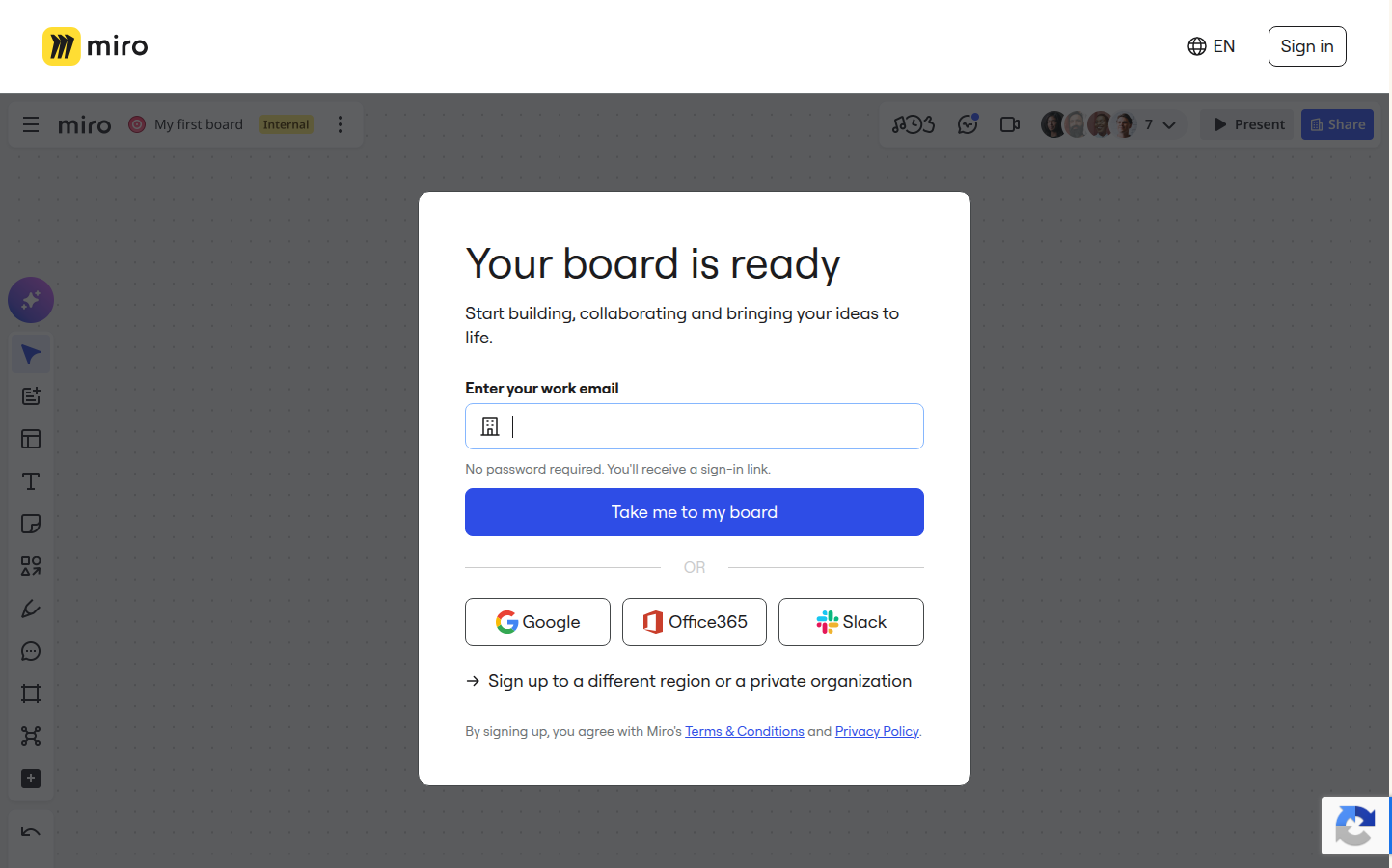
We caught a live split on miro.com/signup. Control is boring and honest: "Sign up for free" with a CTA that says "Continue with email." Variant skips the ask entirely: "Your board is ready" with a CTA that says "Take me to my board." Variant also adds an "OR" divider before the SSO buttons that control doesn't have.
Same page. Same funnel. Two completely different psychological plays. Let's break it down.
What we actually saw
This wasn't a rendering quirk or a stale cache. We tracked it across six visits. Chrome visits 2 and 6 got the variant. Chrome visit 5 got control. Safari, Firefox, and Edge all got control.
That pattern rules out browser-engine bugs. It's a cookie-based split — WEBSITE-1461-signup-copies — doing exactly what it's supposed to do. Our analyst confidence on this one sits at 90%. This is a real, intentional experiment, not noise.
Takeaway: if your variance shows up across the same browser on repeat visits, stop blaming rendering. Check for a bucketing cookie first.
The copy strategy: presumptive close on a signup page
"Sign up for free" is a request. It puts the user in "should I do this?" mode. Every hesitation lives right there.
"Your board is ready" is a presumptive close. It skips the decision entirely and acts like the account already exists. The CTA "Take me to my board" reinforces it — you're not signing up, you're just walking into a room that's already set up for you.
This is the same trick used in sales scripts for decades: assume the close, don't ask for it. Miro is running it on a top-of-funnel signup page, which is a bolder move than it looks. Most brands are scared to mess with signup headlines because it's the highest-stakes real estate in the funnel. Miro's testing anyway.
Takeaway: audit your own signup headline. Are you asking permission or assuming the outcome? Test both — the difference in framing costs you nothing to ship.
Why the "OR" divider matters more than it looks
Small detail, big implication. Variant adds an explicit "OR" divider before SSO options (Google, Slack, etc.). Control doesn't have it — presumably because "Continue with email" reads as one option among several, so the divider felt redundant.
But once you swap the top CTA to "Take me to my board," the page needs a visual reset before offering SSO. Without the divider, "Take me to my board" and "Continue with Google" would read like two unrelated actions competing for attention. The divider re-establishes hierarchy: primary path up top, alternate paths below a clear line.
This is a good reminder that copy tests aren't just copy tests. Change one headline and you often have to adjust the surrounding UI to keep the page coherent. Workshop Digital's breakdown of CRO testing makes this point well — the highest-value learnings usually come from the ripple effects of a change, not the headline swap itself.
Takeaway: when you test primary CTA copy, budget time to re-check secondary elements around it. A divider, a spacing tweak, a button color — these aren't afterthoughts, they're part of the same test.
The risk Miro is clearly betting against
There's an obvious downside to "Your board is ready": it can read as manipulative or just confusing if the user doesn't understand what "board" means yet. Miro's entire product is built around boards, so their existing user base gets the reference instantly. But a first-time visitor who landed from a generic "team collaboration tool" search ad might pause and think "ready for what?"
That confusion tax is the real cost of presumptive-close copy. It works great for warm traffic that already knows your product vocabulary. It can backfire on cold traffic that doesn't.
This is probably why Miro is running this as a genuine 50/50 test with cookie-based bucketing instead of just shipping the new copy. They're not sure yet. Neither should you be, about your own version of this. Optimizely's list of testing ideas is a good reminder that headline and CTA copy sit near the top of highest-leverage, lowest-cost tests you can run — but "highest leverage" cuts both ways when your copy assumes context the visitor doesn't have.
Takeaway: if you're testing presumptive or urgency-driven copy, segment your traffic sources in the results. What converts warm brand-search traffic might tank paid cold traffic. Don't average those together.
What this means if you're not Miro
You don't need Miro's traffic volume to learn from this. The mechanics are copyable:
- Reframe the ask as already-done. Instead of "Create your account," try "Your workspace is set up." Test it against your current CTA.
- Watch what breaks visually when you swap copy. New CTA length, new tone, new hierarchy — check dividers, spacing, button width.
- Segment traffic before you declare a winner. A presumptive-close headline plays differently for brand-aware visitors than for cold paid traffic. Don't let one bucket's win mask another bucket's loss.
Most teams treat signup headline copy as fixed furniture — set it once during onboarding design and never touch it again. Miro is treating it as an active lever, mid-funnel, on their highest-value page. That's the real signal here, more than which variant wins.
The sprint-ready takeaway
Don't wait for a full redesign to test signup copy. Pick one framing — presumptive vs. requestive — run it as a cheap copy-only A/B this sprint, and segment results by traffic source before you call a winner. The lift, if there is one, will show up fast. And if it doesn't, you've learned something about your audience's tolerance for assumed-close language that's worth more than the test itself.
See more like this
ABWatcher catches A/B tests like this every day.
Watch live experiments at 1,000+ high-converting brands, complete with hypothesis and takeaway. Free forever for ten watched companies.