
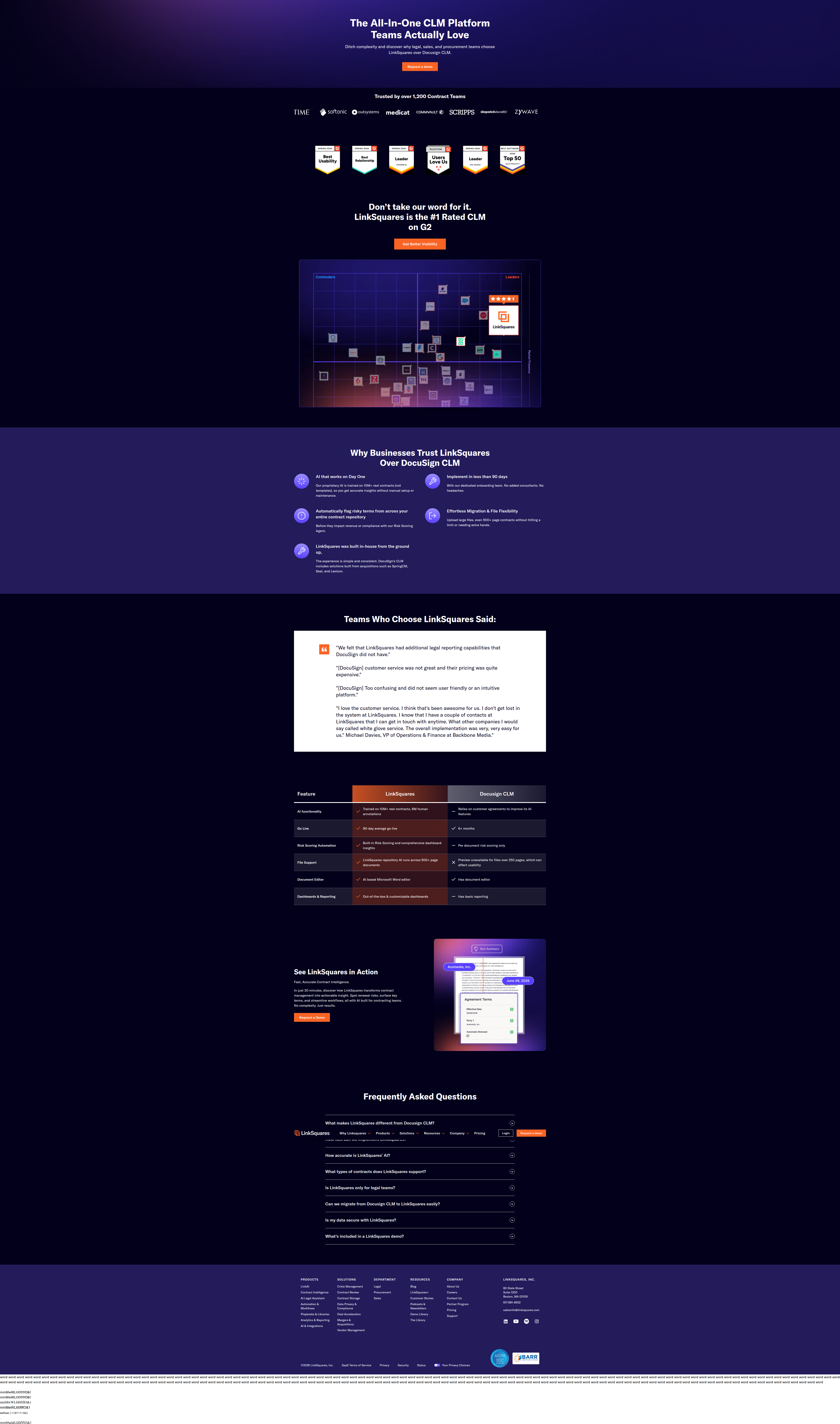
LinkSquares Quotes DocuSign Complaints Right on Its Landing Page
LinkSquares is testing verbatim negative G2 quotes about DocuSign as social proof. Here's why trashing-by-quoting might out-convert generic praise.
Diego Hernandez
Growth Marketer · · Updated
LinkSquares put a real customer complaint about DocuSign on its own landing page. Not a competitor comparison chart. Not a subtweet. A direct quote: "[DocuSign] Too confusing and did not seem user friendly or an intuitive platform." We caught this on the social proof block of their landing page, and it's one of the sharper plays we've logged this quarter.
TL;DR
- Detected on LinkSquares' landing page, social proof surface, logged by ABWatcher.
- Rarity score: 65% — an uncommon pattern across the 1,000+ sites we monitor.
- Importance score: 55% — moderate-to-high signal for conversion impact.
- Quote pulled appears sourced from G2 switcher reviews, not brand-authored copy.
- Testimonial frames the complaint as "reason for switching," not a direct attack ad.
- Zero competitor comparison table needed — the quote does the positioning work alone.
What exactly did LinkSquares do with this testimonial block?
LinkSquares built its social proof section around verbatim negative quotes about DocuSign, lifted from real switcher reviews instead of writing generic five-star praise. The copy reads like a review snippet, not marketing copy: "did not seem user friendly or an intuitive platform." That phrasing is too specific, too human, to be written by a copywriter trying to sell you something. It reads like someone venting on G2 after a bad renewal call. That's the point.
Most B2B SaaS social proof sections are interchangeable. "Game changer." "Couldn't imagine our workflow without it." You could swap the logo and nobody would notice. LinkSquares skipped that script entirely and let an unhappy DocuSign user do the selling.
Takeaway: generic praise is wallpaper. A specific complaint about a named competitor is a pattern interrupt.
Why does a negative quote about a competitor convert better than a positive quote about yourself?
Negative, specific complaints read as more credible than generic praise because readers assume you can't fabricate someone else's pain point. This is basic trust psychology. When a brand says "we're the best," skepticism kicks in immediately. When a brand quotes someone else saying "the other guy was confusing," the reader's brain treats it as evidence, not advertising, because the complaint is oddly specific and unflattering to a third party — which no marketer would invent on command.
Unbounce's landing page research has flagged for years that clear, compelling copy outperforms vague claims — and there's no copy clearer than a frustrated user naming the exact thing that broke. "Too confusing" is a sentence a procurement lead has said out loud in a meeting. That's the whole trick.
Compare that to standard testimonial copy:
| Approach | Example | Perceived credibility |
|---|---|---|
| Generic praise (self) | "LinkSquares transformed our workflow" | Low — sounds scripted |
| Comparison chart | "LinkSquares vs DocuSign: feature X ✓/✗" | Medium — feels like a sales deck |
| Verbatim negative quote (switcher) | "[DocuSign] Too confusing..." | High — reads as unsolicited, specific, third-party |
Is this risky? What happens when a competitor pushes back?
Yes, it's a legal and brand risk, but LinkSquares mitigated it by sourcing language directly from public G2 reviews rather than authoring the claims themselves. There's a meaningful difference between "DocuSign is bad" (a brand claim, legally exposed) and "a verified customer on G2 said DocuSign felt confusing" (a reported fact, much harder to challenge). This is the same defensive logic review-mining tools use when building comparison pages — attribute the opinion, don't own it.
The tradeoff: this only works if the quotes are real, sourced, and attributable. If a visitor can click through to the original G2 review and verify it, the tactic holds up. If it ever looks fabricated or cherry-picked without context, the whole credibility play collapses and takes trust in the rest of the page with it.
Takeaway: if you borrow competitor pain points as social proof, keep receipts. Link to the source review if you can.
Does this fit standard social proof best practice, or break it?
It extends standard social proof practice by applying the same "real customer language" principle to pain points instead of only to praise. Leadfeeder's landing page guidance lists social proof and clear value props as two separate best practices — testimonials build trust, value props communicate benefits. LinkSquares' move quietly merges both into one block. The "complaint quote" simultaneously builds trust (it's real, specific, unscripted) and communicates the value prop (we're the opposite of confusing) without LinkSquares having to say either thing directly.
That's efficient copywriting. One quote doing two jobs is better than two sections doing one job each.
Who should actually try this, and who should stay away?
This tactic works best for challenger brands with a clear incumbent to displace — it's weaker for category creators with no obvious "old way" to contrast against. LinkSquares is selling against DocuSign and other legacy e-signature/CLM tools with well-known friction points (clunky UI, poor support, confusing contract workflows). If you're the market leader, quoting complaints about a smaller competitor makes you look insecure, not confident. If you're the challenger, borrowing the frustration your prospect already feels is one of the cheapest trust signals you can build.
Rarity on this pattern sits at 65% across the brands we track — most companies default to safer, brand-authored comparison copy instead. That gap is the opportunity.
Common questions
Is quoting a competitor's negative reviews legal?
Generally yes, if the quote is accurate, attributed to a real source, and not altered to misrepresent the original reviewer's meaning. Problems arise with fabricated quotes, missing context, or defamatory framing. Most legal risk comes from accuracy, not from the act of quoting a competitor at all.
Where did LinkSquares likely source the quote?
The phrasing and tone strongly suggest it was pulled from G2 reviews written by users who switched from DocuSign to LinkSquares. G2 and Capterra reviews are common sourcing grounds for this kind of switcher-testimonial copy because reviewers already write in that complaint/resolution structure.
Does this replace the need for a feature comparison page?
No. Comparison pages still serve bottom-funnel researchers who want a feature-by-feature breakdown. This testimonial tactic works earlier in the funnel, on the landing page, to build initial emotional credibility before someone clicks through to a deeper comparison.
Will this tactic get stale if more brands copy it?
Likely, yes — social proof patterns lose power once visitors recognize the format. The specificity of the quote is what makes it work today. Brands that copy the structure with vague or obviously manufactured complaints will see diminishing returns fast.
What's the easiest way to test this on my own site?
Pull your actual G2, Capterra, or Trustpilot reviews from users who mention switching from a named competitor, isolate the specific complaint sentence, and A/B test it against your current testimonial block this sprint — don't rewrite it, just attribute it.
Read next
More from the ABWatcher blog
Nov 22, 2026
Snake River Farms Tests a $25-Off Popup on Its Ad Landing Page
We caught Snake River Farms split-testing an email-capture form and $25-off modal on its landing page. Here's the math on what it would take to call a winner.
Nov 21, 2026
Snake River Farms Tests Mid-Page Email Capture on Its Ad Landing Page
SRF is A/B testing a mid-page lead-capture block and a $25-off popup against a simpler hero-only promo banner on its paid landing page, detected 2024 week-over-week.
Nov 20, 2026
Attio Is Testing a New Tier, Higher Prices, and a New Pitch
Attio is running a live pricing page test with a new $1,000 "Ultra" tier, higher Plus/Pro prices, and a new headline — here's what we caught and what it means.
Nov 19, 2026
Found Quietly Tested a 25% Price Cut on Its Pricing Page
We caught Found running a live pricing A/B test with an annual billing toggle that drops Found Plus from $35 to $26.25/mo. Here's what changed and why it matters.
Nov 8, 2026
Astro Proves "Zero Lock-In" With a Live Code Demo, Not a Claim
Astro's homepage replaces a trust badge row with a working, clickable framework demo — here's the hierarchy and interaction design behind it, detected 60% rare on astro.build.
Nov 7, 2026
Basecamp's Big Numbers: Why Hyper-Precise Stats Beat Vague Social Proof
Basecamp's homepage swaps "trusted by thousands" for 1.7 billion to-dos and 5 petabytes of data. We break down why precision beats vagueness as social proof — and how to test it.
From the glossary
Vocabulary the article uses. See all terms →
- Shrinkage Estimator— A statistical adjustment that pulls noisy per-variant or per-segment estimates toward an overall average to reduce overfitting to randomness.
- Flicker Test— A diagnostic check to confirm whether users briefly see the original page before a variant renders in client-side experiments.
- Pre-Experiment Bucketing Audit— A review process confirming users are being randomly and evenly assigned to experiment variants before launch.
- Above-Fold Exclusion Rule— A test-design rule that deliberately prevents changes to above-the-fold elements so an experiment isolates below-the-fold effects.
- Flicker-Free Testing— A technical setup that prevents users from briefly seeing the original page before a test variant loads.
- Orthogonal Test Design— A test structure where multiple variables are changed independently so their individual effects can be measured without interference.
See more like this
ABWatcher catches A/B tests like this across 1,000+ brands.
Watch live experiments at 1,000+ high-converting brands, complete with hypothesis and takeaway. 7 days of Pro, free, no card, then Free forever for ten watched companies.