
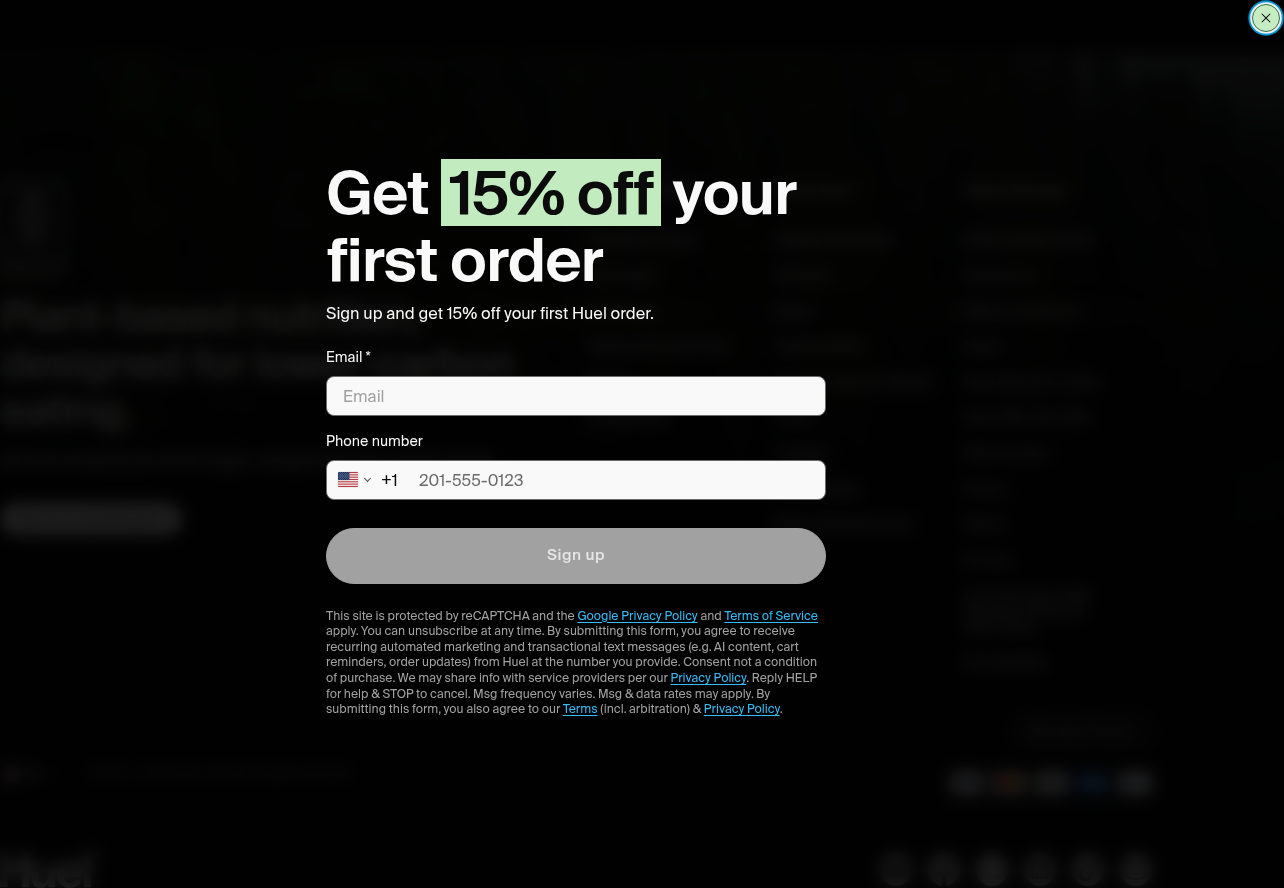
Huel Tests a 2-Field Discount Modal Against Its Full Signup Form
Huel is running a live A/B test on /register, swapping its 4-field account creation form for a 2-field "15% off" modal. Here's what our detection caught and what it means for signup CRO.
Maya Patel
Senior CRO Strategist · · Updated
TL;DR
- Huel is running a live A/B test on huel.com/register, detected 80% confidence via same-run variance.
- Variant A: full "Create an account" form with Email, First Name, Last Name, Phone, Password (4 fields).
- Variant B: lightweight "Get 15% off your first order" modal with only Email and Phone (2 fields).
- Detected across 7 visits, with the modal variant appearing in visits 2, 5, and 6, all on Chrome.
- Divergent experimentation cookies from Optimizely, VWO, ABTasty, and Statsig confirmed this is a genuine test, not a rendering glitch.
- Likely hypothesis: field reduction plus a discount incentive lifts signup completion versus full account creation up front.
What did ABWatcher actually catch on Huel's registration page?
Our vision-AI analyser flagged two structurally different signup experiences served to the same browser environment across repeated visits to huel.com/register. Visits 1, 3, 4, and 7 rendered Huel's standard registration form — Email, First Name, Last Name, Phone, and Password, the classic full account-creation pattern. Visits 2, 5, and 6, all on Chrome, instead surfaced a modal headlined "Get 15% off your first order," asking only for Email and Phone.
This is a same_run_variance detection, meaning the variance showed up within a single monitoring pass rather than across separate days — the strongest signal our system has for catching a live split test in progress, as opposed to a redesign that rolled out sequentially. Our analyst logged 80% confidence, and the reproducibility across three separate visits (not just one anomaly) is what pushed this past the noise threshold.
Why does the diverging cookie data matter here?
Four separate experimentation platforms firing different cookie IDs across visits rules out caching or rendering artifacts as the explanation. When we see Optimizely, VWO, ABTasty, and Statsig cookies all diverging in lockstep with the UI change, it tells us Huel's stack is either running parallel tests across tools or one tool is the system of record and the others are legacy/parked scripts still executing. Either way, the consistent pairing of "modal variant present" with "alternate cookie state" is the strongest evidence available short of pulling Huel's internal experiment log directly. This is why our detection methodology weights cross-tool cookie divergence more heavily than a single visual diff.
What's the likely hypothesis behind the two-field modal?
Huel appears to be testing whether reducing signup friction, paired with a discount hook, outperforms upfront full account creation on completion rate. The full form asks for five pieces of information before a visitor gets anything in return. The modal asks for two and leads with a tangible incentive — 15% off — before the transaction even starts. This is a textbook field-reduction test, and it maps cleanly onto a Confidence-Lift-Risk framework:
- Confidence: High that fewer fields will lift form-start and form-completion rates. Field-count reduction is one of the most replicated findings in signup CRO literature, and Splitbase's breakdown of A/B testing hypotheses makes the case that defaulting to "best practice" simplification still needs a controlled test to confirm the lift is real and not just a vanity metric.
- Lift: Uncertain magnitude. Removing Name and Password fields typically helps top-of-funnel conversion, but Huel still needs Password (or a magic-link equivalent) downstream, and First/Last Name for shipping and personalization. If those fields get deferred to a second screen, Huel may be testing a two-step signup rather than a true field elimination — the modal could be step one of a longer flow.
- Risk: Data quality and downstream friction. A phone-and-email-only capture is easier to abandon-and-return from, but it defers name and password collection to a moment when purchase intent may have already peaked and cooled. If checkout later re-demands the missing fields, net completion could stay flat while top-of-funnel metrics look artificially improved.
How does this compare to standard signup-form testing patterns?
Reducing required fields at signup is one of the most common ecommerce experiments we track, and Huel's version follows the pattern closely while adding a discount lever most brands don't combine with it.
| Element | Full Form (Variant A) | Modal (Variant B) |
|---|---|---|
| Fields required | Email, First Name, Last Name, Phone, Password | Email, Phone |
| Incentive messaging | None visible | "Get 15% off your first order" |
| Visits observed | 1, 3, 4, 7 | 2, 5, 6 |
| Browser | Mixed | Chrome only (observed) |
| Password collected at this step | Yes | No |
The Chrome-only pattern in the modal visits is worth flagging rather than over-interpreting. It could reflect a browser-targeted rollout percentage, or simply be a sampling artifact of which visits our crawler happened to run in Chrome during the test window. We don't have enough visits to say Huel is deliberately excluding other browsers, and per Kameleoon's A/B testing primer, most consumer-brand tests run by traffic allocation, not browser, unless there's a known rendering issue being isolated.
What should CRO teams take from this before their next sprint?
Field-reduction-plus-incentive is a low-risk, well-understood test to run, but the real question isn't whether the modal wins the top-of-funnel metric — it almost always will. The question is whether Huel is measuring all the way through to completed purchase and repeat-order rate, not just form-fill rate. If your team is running a similar simplified-capture test this sprint, instrument the full funnel from modal submission through first checkout before declaring a winner, and treat any password/name fields you deferred as a second experiment, not a solved problem.
Common questions
What is same_run_variance detection?
Same_run_variance is a detection method where our system observes structurally different page experiences served to the same browser configuration within a single monitoring pass. It's a stronger signal of a live, active A/B test than variance detected across separate days, since it rules out sequential redesigns or seasonal content swaps.
Why does Huel show four different experimentation cookies?
Divergent cookies from Optimizely, VWO, ABTasty, and Statsig across visits typically mean multiple testing tools are active on the same page, either running parallel experiments or with some scripts left over from prior test cycles. This pattern is one of the clearest non-visual signals that a genuine split test is in progress rather than a caching artifact.
Is reducing signup fields always a safe test to run?
Reducing fields reliably improves top-of-funnel completion rates in most benchmark studies, but the risk is deferring necessary data collection to a later, lower-intent moment in the funnel. Teams should measure full-funnel conversion, not just form completion, before generalizing the win, as outlined in Digital Applied's CRO testing guide.
How confident is ABWatcher in this specific detection?
Our analyst logged 80% confidence based on the modal appearing consistently across three separate visits (2, 5, and 6) paired with diverging experimentation cookie states across four platforms. That combination of visual reproducibility and backend cookie evidence is our standard bar for flagging a live test rather than a one-off anomaly.
Does a discount incentive change how this test should be evaluated?
Yes — pairing a field reduction with a 15%-off offer introduces a confound, since improved conversion could come from either the simpler form or the discount messaging alone. A clean read on this test requires Huel to isolate which lever is driving the lift, ideally via a follow-up multivariate pass.
Read next
More from the ABWatcher blog
Nov 22, 2026
Snake River Farms Tests a $25-Off Popup on Its Ad Landing Page
We caught Snake River Farms split-testing an email-capture form and $25-off modal on its landing page. Here's the math on what it would take to call a winner.
Nov 21, 2026
Snake River Farms Tests Mid-Page Email Capture on Its Ad Landing Page
SRF is A/B testing a mid-page lead-capture block and a $25-off popup against a simpler hero-only promo banner on its paid landing page, detected 2024 week-over-week.
Nov 20, 2026
Attio Is Testing a New Tier, Higher Prices, and a New Pitch
Attio is running a live pricing page test with a new $1,000 "Ultra" tier, higher Plus/Pro prices, and a new headline — here's what we caught and what it means.
Nov 19, 2026
Found Quietly Tested a 25% Price Cut on Its Pricing Page
We caught Found running a live pricing A/B test with an annual billing toggle that drops Found Plus from $35 to $26.25/mo. Here's what changed and why it matters.
Nov 8, 2026
Astro Proves "Zero Lock-In" With a Live Code Demo, Not a Claim
Astro's homepage replaces a trust badge row with a working, clickable framework demo — here's the hierarchy and interaction design behind it, detected 60% rare on astro.build.
Nov 7, 2026
Basecamp's Big Numbers: Why Hyper-Precise Stats Beat Vague Social Proof
Basecamp's homepage swaps "trusted by thousands" for 1.7 billion to-dos and 5 petabytes of data. We break down why precision beats vagueness as social proof — and how to test it.
From the glossary
Vocabulary the article uses. See all terms →
- Shrinkage Estimator— A statistical adjustment that pulls noisy per-variant or per-segment estimates toward an overall average to reduce overfitting to randomness.
- Flicker Test— A diagnostic check to confirm whether users briefly see the original page before a variant renders in client-side experiments.
- Pre-Experiment Bucketing Audit— A review process confirming users are being randomly and evenly assigned to experiment variants before launch.
- Above-Fold Exclusion Rule— A test-design rule that deliberately prevents changes to above-the-fold elements so an experiment isolates below-the-fold effects.
- Flicker-Free Testing— A technical setup that prevents users from briefly seeing the original page before a test variant loads.
- Orthogonal Test Design— A test structure where multiple variables are changed independently so their individual effects can be measured without interference.
See more like this
ABWatcher catches A/B tests like this across 1,000+ brands.
Watch live experiments at 1,000+ high-converting brands, complete with hypothesis and takeaway. 7 days of Pro, free, no card, then Free forever for ten watched companies.