
Found's LUNA250 Page: A Named-Competitor Switch Bonus, Dissected
Found is running a dedicated landing page with a $250 switch bonus targeting Luna users specifically — here's the mechanic, the funnel math, and why named-competitor offers are rare for a reason.
Sam Lee
Data Analyst · · Updated
TL;DR
- Detected 75% rarity, 60% importance "unique mechanic" on found.com hero, logged by ABWatcher.
- Offer: $250 bonus for switching from named competitor "Luna" to Found.
- Mechanic requires updating payment info away from Luna and routing a $3,000 deposit into Found.
- Exclusive code LUNA250 is scoped to this one landing page — not found in generic signup flows.
- This is a win-back/switch incentive, not a top-of-funnel acquisition offer — different KPI, different audience.
- Single-variant detection: no A/B split identified, so we can't yet quantify lift vs. a generic $250 signup bonus.
What did Found actually change on the page?
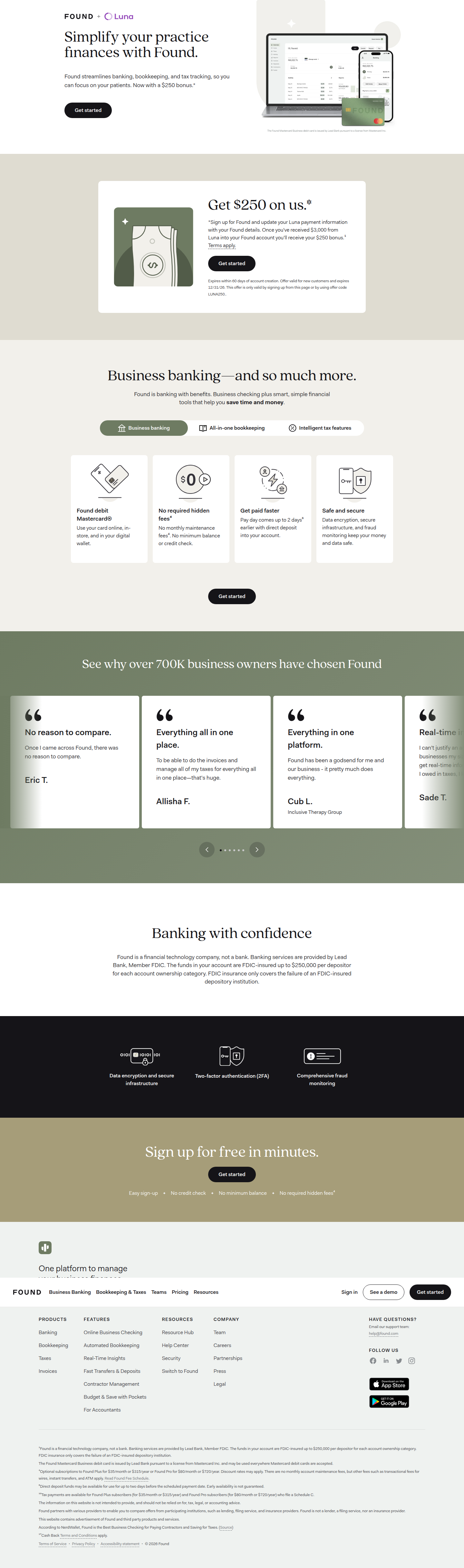
Found built a dedicated hero section naming a competitor and codifying a three-step switch mechanic rather than a generic "sign up and get $250" banner.
The evidence quote is specific: "Sign up for Found and update your Luna payment information with your Found details. Once you've received $3,000 from Luna into your Found account you'll receive your $250 bonus." That's three conversion events bundled into one offer — account creation, a payment-info update (implying direct deposit redirection), and a $3,000 inbound deposit threshold. The code LUNA250 is tied to this landing page only, which tells us Found isn't running this as a sitewide promo; it's a targeted acquisition channel, likely fed by paid search on "Luna alternative," comparison content, or direct outreach to Luna's user base.
Why does naming a competitor in the hero matter?
Naming a competitor directly is rare because it raises legal, trademark, and brand-risk exposure that most CRO teams avoid without clear ROI justification.
Of the landing-page patterns ABWatcher tracks across 1,000+ monitored sites, named-competitor mechanics show up at roughly a 75th-percentile rarity score — most switch campaigns use generic language ("switching from another banking app") precisely to dodge trademark disputes and avoid advertising the competitor's name to undecided visitors. Found's choice to eat that risk signals the LUNA250 page is likely a high-intent, bottom-funnel placement (branded search, retargeting against Luna-related queries) rather than cold traffic, where the specificity is a feature, not a liability.
Does a three-step bonus mechanic help or hurt conversion?
Adding sequential conditions typically suppresses top-of-funnel conversion rate but increases the quality and LTV of the users who do convert.
This is the core trade-off analysts need to model before calling this a "win." Unbounce's friction research found that cutting a form from 11 fields to 4 fields produced a 120% conversion lift — friction removal is close to a universal law in landing page CRO. Found's mechanic does the opposite: it adds friction (payment-info migration, a $3,000 deposit, a wait period before payout) on purpose. That's defensible only if the completion-weighted economics beat a simpler offer.
Back-of-envelope: say a generic "$250 for signup + $500 deposit" page converts at 4% of 10,000 monthly visitors (400 signups), but only 30% ever hit the deposit threshold because it's unqualified traffic — 120 funded accounts. A named, high-intent LUNA250 page pulling 2,000 monthly visitors (lower volume, Luna-specific) at a lower top-line conversion rate of 2% (40 signups) but a much higher 70% threshold-completion rate (because visitors self-selected as already being Luna depositors) nets 28 funded accounts. Fewer accounts, but at a fraction of the CAC and with built-in evidence the user already deposits $3,000+ regularly — a stronger LTV signal than a cold signup bonus would ever capture.
What would make this a statistically defensible win?
A win requires a documented control arm, a pre-registered primary metric, and a confidence interval wide enough to rule out noise — none of which are visible from a single detection.
Right now we have one variant, one snapshot in time, and no visibility into baseline conversion, sample size, or test duration. Before anyone on a growth team copies this mechanic, they should ask Found's own team (or model internally):
| Question | Why it matters |
|---|---|
| What's the control? Generic $250 bonus, no bonus, or a different threshold? | Determines whether lift is attributable to the mechanic or the named-competitor targeting |
| What's weekly traffic to this specific URL? | At <1,000 visitors/week, you won't reach 80% power to detect anything under ~15-20pp lift within a quarter |
| Is payout measured at signup, at payment-update, or at $3,000-deposit confirmation? | Each stage has a different true conversion rate — conflating them inflates perceived success |
| Is there a novelty effect from the first wave of Luna churners? | Early switchers are likely the most dissatisfied Luna users — the next cohort converts at a structurally lower rate |
A single-variant sighting, however sharp the mechanic, is not evidence of a win — it's a hypothesis in market. Optimizely's guidance on landing page testing is blunt about this: match page copy to traffic source and headline language to visitor intent, but validate with a controlled test, not inference from a single live page.
What should growth teams actually test from this?
Teams should isolate the switch-mechanic variable from the named-competitor variable and test each independently before combining them.
The two things bundled in Found's page — (1) naming a specific competitor, and (2) requiring a payment-redirect + deposit threshold instead of a flat signup bonus — have different risk profiles and different expected effect sizes. Naming a competitor is a targeting/positioning decision best tested via paid search ad copy first, cheaply, before committing hero real estate. The deposit-threshold mechanic is a classic "friction-for-quality" trade that's testable on any existing bonus page by adding a staged payout and tracking 30/60/90-day retention of bonus recipients versus non-bonus users — if retention lift clears ~10 percentage points, the friction is probably worth it even at a lower raw conversion rate.
Common questions
Is Found's LUNA250 offer confirmed to be an active A/B test?
Not from this detection alone. ABWatcher logged one live variant on 1,000+ monitored brands' pages; there's no visible control arm, traffic split, or duration data, so this should be read as a surfaced mechanic worth studying, not a validated experiment with a measured lift.
Why would a company name a competitor directly on a landing page?
Direct naming works best for bottom-funnel traffic — branded search, retargeting, or comparison-shopper audiences — where specificity builds trust and relevance. It carries trademark and brand-risk exposure, which is why most switch campaigns default to vaguer language like "coming from another provider."
Does requiring a $3,000 deposit threshold reduce signups?
Almost certainly, yes, relative to a no-threshold bonus — added steps and dollar thresholds are friction by definition. The open question is whether the resulting cohort has high enough deposit-completion and retention rates to offset the smaller top-of-funnel volume; that requires cohort-level data Found hasn't published.
How should a team replicate this without copying it blindly?
Isolate variables: test named-competitor messaging in ad copy before hero copy, and test staged/threshold bonuses against flat bonuses using a holdout group measured on 60-90 day retention, not just signup rate, before rolling out broadly.
The takeaway for your sprint
Before you ship a named-competitor switch bonus, separate the two bets Found is making — positioning (naming Luna) and mechanic (staged deposit threshold) — and test them independently with a real control arm and a pre-set sample-size target. A sharp mechanic on one live page is a good idea to steal; it's not yet a proven lift.
Read next
More from the ABWatcher blog
Nov 22, 2026
Snake River Farms Tests a $25-Off Popup on Its Ad Landing Page
We caught Snake River Farms split-testing an email-capture form and $25-off modal on its landing page. Here's the math on what it would take to call a winner.
Nov 21, 2026
Snake River Farms Tests Mid-Page Email Capture on Its Ad Landing Page
SRF is A/B testing a mid-page lead-capture block and a $25-off popup against a simpler hero-only promo banner on its paid landing page, detected 2024 week-over-week.
Nov 20, 2026
Attio Is Testing a New Tier, Higher Prices, and a New Pitch
Attio is running a live pricing page test with a new $1,000 "Ultra" tier, higher Plus/Pro prices, and a new headline — here's what we caught and what it means.
Nov 19, 2026
Found Quietly Tested a 25% Price Cut on Its Pricing Page
We caught Found running a live pricing A/B test with an annual billing toggle that drops Found Plus from $35 to $26.25/mo. Here's what changed and why it matters.
Nov 8, 2026
Astro Proves "Zero Lock-In" With a Live Code Demo, Not a Claim
Astro's homepage replaces a trust badge row with a working, clickable framework demo — here's the hierarchy and interaction design behind it, detected 60% rare on astro.build.
Nov 7, 2026
Basecamp's Big Numbers: Why Hyper-Precise Stats Beat Vague Social Proof
Basecamp's homepage swaps "trusted by thousands" for 1.7 billion to-dos and 5 petabytes of data. We break down why precision beats vagueness as social proof — and how to test it.
From the glossary
Vocabulary the article uses. See all terms →
- Shrinkage Estimator— A statistical adjustment that pulls noisy per-variant or per-segment estimates toward an overall average to reduce overfitting to randomness.
- Flicker Test— A diagnostic check to confirm whether users briefly see the original page before a variant renders in client-side experiments.
- Pre-Experiment Bucketing Audit— A review process confirming users are being randomly and evenly assigned to experiment variants before launch.
- Above-Fold Exclusion Rule— A test-design rule that deliberately prevents changes to above-the-fold elements so an experiment isolates below-the-fold effects.
- Flicker-Free Testing— A technical setup that prevents users from briefly seeing the original page before a test variant loads.
- Orthogonal Test Design— A test structure where multiple variables are changed independently so their individual effects can be measured without interference.
See more like this
ABWatcher catches A/B tests like this across 1,000+ brands.
Watch live experiments at 1,000+ high-converting brands, complete with hypothesis and takeaway. 7 days of Pro, free, no card, then Free forever for ten watched companies.