
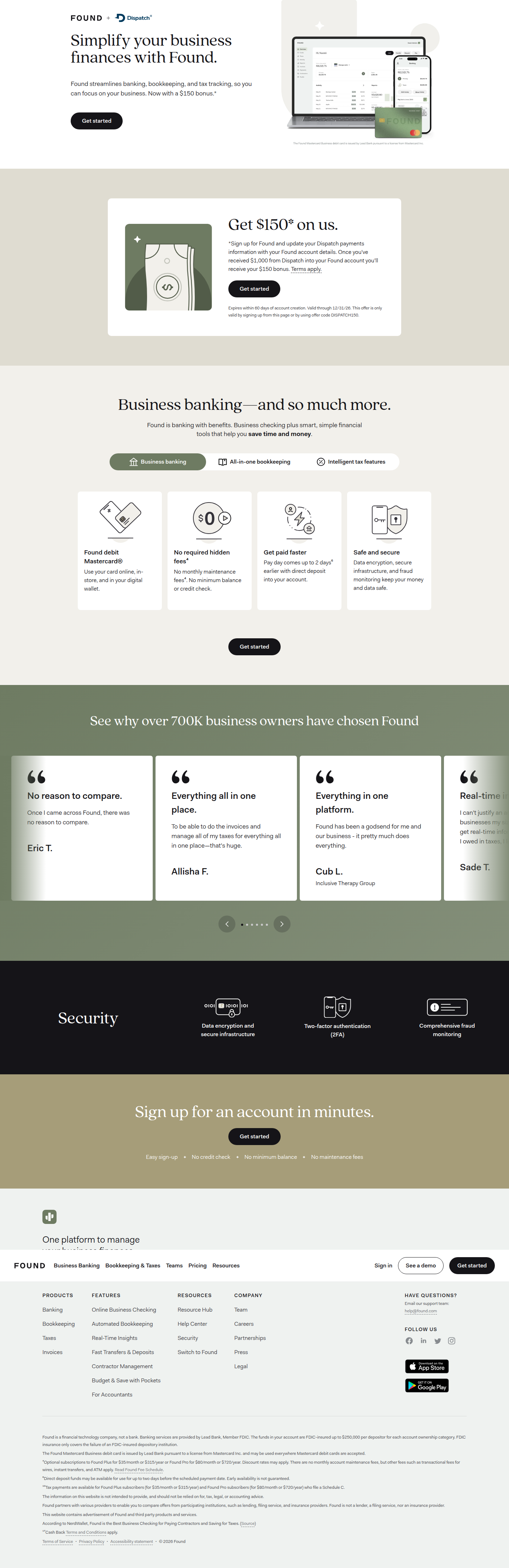
Found's Hero Section Hides a Conditional $150 Partner Bonus
Found tucked a $150 Dispatch-linked referral bonus into its hero—one that only pays out after $1,000 in real deposits. Here's the design teardown.
Aiko Tanaka
Design Director · · Updated
TL;DR
- Found (found.com) runs a conditional co-branded bonus offer in its landing page hero, detected by ABWatcher.
- Offer requires signing up for Found and updating Dispatch payment info with Found account details.
- Payout of $150 only triggers after the account receives $1,000 in deposits from Dispatch.
- ABWatcher classified this as a unique_mechanic pattern with 75% rarity and 55% importance.
- Mechanic rewards sustained product usage, not a single signup click — a rare incentive structure for a hero module.
What exactly is Found testing?
Found is running a partner-conditioned referral bonus in its hero section, gating a $150 reward behind real deposit activity rather than account creation. The evidence quote is blunt about the bar: "Sign up for Found and update your Dispatch payments information with your Found account details. Once you've received $1,000 from Dispatch into your Found account you'll receive your $150 bonus." That's three discrete actions — signup, a settings change inside a partner product, and a deposit threshold — stacked into what most teams would treat as a single top-of-funnel CTA.
The hero is the highest-attention real estate on any landing page. It's where the eye lands first, before scroll, before scanning the F-pattern down the left rail of body copy. Most teams spend that space on a headline and a single verb-first CTA: "Start free," "Get started," "Try it now." Found is spending hero real estate on a compound offer with a dollar figure, a partner brand name, and a conditional clause. That's a hierarchy risk — three ideas competing for one glance — but it's also a rarity signal. Conditional, usage-gated incentives are uncommon in hero copy precisely because they require more cognitive parsing than a typical value prop.
Why gate a bonus behind $1,000 in deposits instead of signup?
Because signup-gated bonuses attract bounty hunters, while deposit-gated bonuses filter for users who will actually route real payment volume through the product. A flat "$150 for signing up" offer is cheap to game and expensive to pay out on users who churn in week one. By requiring the user to update Dispatch payment info — a real integration, not a form field — and then wait for $1,000 to flow through, Found is functionally using the bonus as an activation mechanic. The reward isn't for intent, it's for integration depth. This aligns with a principle Optimizely's landing page guide makes about matching offer language to visitor intent: the copy has to carry the actual mechanics of the deal, not a softened marketing gloss, or the conversion event downstream won't match what the user expected.
From a craft standpoint, this creates a contrast problem the design team has to solve on the page: how do you keep a three-step conditional offer legible in a hero that's supposed to be skimmed in under five seconds? The likely answer, based on the pattern we see elsewhere in fintech heroes, is numeral emphasis — making "$150" and "$1,000" the highest-contrast elements on the module, using size or weight to let those two numbers anchor the read even if the surrounding clause gets skimmed rather than fully parsed. That's a Gestalt figure-ground move: the dollar amounts become figure, the conditional logic becomes ground, absorbed later if the user cares enough to read the fine print.
How rare is this kind of co-branded conditional mechanic?
At 75% rarity, this pattern sits well outside the standard referral-bonus playbook most SaaS and fintech teams reach for. Most referral or signup incentives we track are single-condition: refer a friend, get $X; sign up, get $X off. A two-party conditional bonus — naming a specific partner integration (Dispatch) and requiring a deposit threshold before payout — is a materially more complex mechanic to both design for and legally structure. It signals Found is optimizing for a specific partner funnel (Dispatch users who need a payments/banking layer) rather than running a generic acquisition offer.
| Attribute | Detail |
|---|---|
| Brand | Found (found.com) |
| Surface | Landing page hero |
| Mechanic | Partner co-branded referral bonus, conditional payout |
| Bonus amount | $150 |
| Trigger threshold | $1,000 in Dispatch deposits |
| Rarity score | 75% |
| Importance score | 55% |
What should this mean for your own roadmap?
If you're testing incentive copy in a hero, the lesson isn't "add more conditions" — it's that conditional, usage-based bonuses can outperform flat signup bonuses on retention economics, provided the hero can still carry the clause without burying the headline. Unbounce's CRO best practices make the broader point that friction reduction wins most of the time — fewer form fields, fewer steps — but Found's bet here is the inverse: friction in the offer structure is acceptable when it's filtering for commitment, not when it's blocking signup itself. The signup step stays frictionless; the complexity lives entirely in the reward mechanic, after the user has already converted. That's the distinction worth stealing — keep your primary conversion event as simple as ever, and push any conditional complexity into the post-signup incentive layer where it won't tank top-of-funnel numbers.
Common questions
What is Found's $150 bonus actually for?
It's a conditional referral-style bonus tied to the Dispatch integration. Users sign up for Found, update their Dispatch payment details to point at their Found account, and receive $150 only after Found has received $1,000 in deposits originating from Dispatch — not simply for creating an account.
Why would a company gate a bonus behind deposit volume instead of signup?
Gating behind deposits filters for users who integrate deeply and generate real transaction volume, rather than users chasing a quick signup bounty. It aligns the cost of the incentive with actual product usage and reduces payout to accounts that would otherwise churn immediately after claiming a reward.
Is this kind of mechanic common in fintech landing pages?
No — ABWatcher scored this detection at 75% rarity, meaning it's well outside standard referral or signup bonus patterns most fintech and SaaS brands run. Most incentive copy we track is single-condition (refer, signup, or purchase), not multi-step and partner-specific like this one.
What design risk does a conditional offer create in a hero section?
Hero sections are typically scanned in seconds, so stacking three ideas — signup, partner integration, and deposit threshold — into one module risks diluting the primary call to action. The fix is usually visual hierarchy: making the dollar figures the highest-contrast elements so they anchor the skim even if the clause is read later.
When was this detection logged?
ABWatcher logged this detection on Found's live landing page hero as part of ongoing monitoring across 1,000+ high-converting brand sites, flagging it as a unique_mechanic pattern worth a closer teardown.
Read next
More from the ABWatcher blog
Nov 22, 2026
Snake River Farms Tests a $25-Off Popup on Its Ad Landing Page
We caught Snake River Farms split-testing an email-capture form and $25-off modal on its landing page. Here's the math on what it would take to call a winner.
Nov 21, 2026
Snake River Farms Tests Mid-Page Email Capture on Its Ad Landing Page
SRF is A/B testing a mid-page lead-capture block and a $25-off popup against a simpler hero-only promo banner on its paid landing page, detected 2024 week-over-week.
Nov 20, 2026
Attio Is Testing a New Tier, Higher Prices, and a New Pitch
Attio is running a live pricing page test with a new $1,000 "Ultra" tier, higher Plus/Pro prices, and a new headline — here's what we caught and what it means.
Nov 19, 2026
Found Quietly Tested a 25% Price Cut on Its Pricing Page
We caught Found running a live pricing A/B test with an annual billing toggle that drops Found Plus from $35 to $26.25/mo. Here's what changed and why it matters.
Nov 8, 2026
Astro Proves "Zero Lock-In" With a Live Code Demo, Not a Claim
Astro's homepage replaces a trust badge row with a working, clickable framework demo — here's the hierarchy and interaction design behind it, detected 60% rare on astro.build.
Nov 7, 2026
Basecamp's Big Numbers: Why Hyper-Precise Stats Beat Vague Social Proof
Basecamp's homepage swaps "trusted by thousands" for 1.7 billion to-dos and 5 petabytes of data. We break down why precision beats vagueness as social proof — and how to test it.
From the glossary
Vocabulary the article uses. See all terms →
- Shrinkage Estimator— A statistical adjustment that pulls noisy per-variant or per-segment estimates toward an overall average to reduce overfitting to randomness.
- Flicker Test— A diagnostic check to confirm whether users briefly see the original page before a variant renders in client-side experiments.
- Pre-Experiment Bucketing Audit— A review process confirming users are being randomly and evenly assigned to experiment variants before launch.
- Above-Fold Exclusion Rule— A test-design rule that deliberately prevents changes to above-the-fold elements so an experiment isolates below-the-fold effects.
- Flicker-Free Testing— A technical setup that prevents users from briefly seeing the original page before a test variant loads.
- Orthogonal Test Design— A test structure where multiple variables are changed independently so their individual effects can be measured without interference.
See more like this
ABWatcher catches A/B tests like this across 1,000+ brands.
Watch live experiments at 1,000+ high-converting brands, complete with hypothesis and takeaway. 7 days of Pro, free, no card, then Free forever for ten watched companies.