
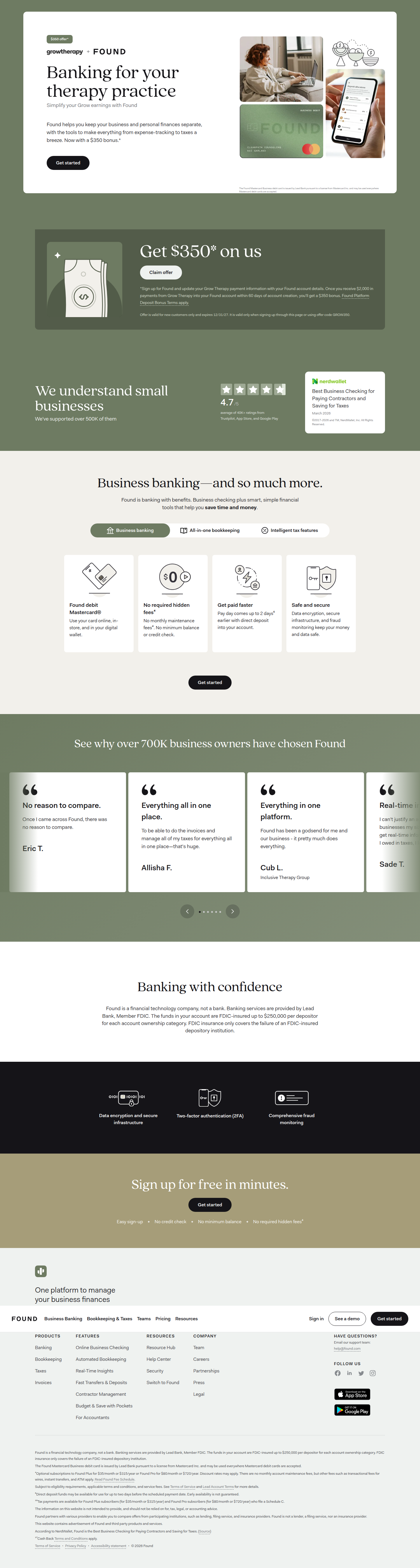
Found's $350 Bonus Is Behavior-Gated, Not Signup-Gated — Here's Why That Matters
Found ties its $350 bonus to receiving $2,000 in real payments within 60 days, not account creation. We break down why behavior-gated incentives are a rare, high-leverage CRO pattern.
Maya Patel
Senior CRO Strategist · · Updated
TL;DR
- Found (found.com) gates a $350 bonus behind receiving $2,000 in Grow Therapy payments within 60 days of account creation, not signup.
- Detection logged on the hero surface of Found's public landing page, category unique_mechanic.
- ABWatcher rarity score: 75% — this pattern appears in a small minority of monitored fintech landing pages.
- Importance score: 60%, reflecting meaningful but not top-tier roadmap urgency.
- The mechanic swaps a one-time acquisition incentive for a usage-locked incentive tied to real transaction volume.
- No multivariate test was visible — this reads as a shipped, permanent mechanic rather than an active A/B split.
What exactly did Found change on its landing page?
Found replaced the standard "sign up and get a bonus" hook with a bonus that only pays out after a real financial behavior occurs. The evidence quote is explicit: "Once you receive $2,000 in payments from Grow Therapy into your Found account within 60 days of account creation, you'll get a $350 bonus." This isn't a discount code or a deposit-matching gimmick — it's a conditional reward tied to a third-party payment flow (Grow Therapy, a teletherapy platform Found's target users likely already bill through). The bonus only exists for users who actually route real income through the product.
Why is a behavior-gated bonus rare in CRO testing?
Most acquisition bonuses are gated on low-friction actions — email capture, account creation, first deposit — because marketers optimize for top-of-funnel conversion rate, not downstream retention. A bonus gated on $2,000 of verified third-party payments within a 60-day window is structurally different: it requires the product to already have payment-processing infrastructure, a named integration partner, and enough confidence in activation timelines to commit to a 60-day window. That's a heavier lift than a typical landing page test, which is likely why ABWatcher's detection engine flagged this as a 75% rarity pattern rather than a common hero-section variant.
Most landing page experimentation guidance focuses on reducing friction at the point of conversion — Unbounce notes that cutting form fields from 11 to 4 lifted conversions by 120%, reinforcing the industry default of "remove barriers, don't add them." Found's mechanic runs counter to that instinct on the surface — it adds a real-world barrier (routing $2,000 in payments) between signup and payout. The bet is that the added barrier filters for quality rather than suppressing volume.
Does this actually convert better than a signup bonus?
We don't have Found's internal lift data, so this is a structural read, not a confirmed result. Applying a Confidence-Lift-Risk lens:
Confidence — Medium. The mechanic is logical for a fintech targeting therapists who bill through Grow Therapy; it pre-qualifies for exactly the usage behavior Found needs (deposits, active banking relationship) rather than vanity signups.
Lift — Likely modest on raw signup conversion, but potentially strong on quality-adjusted conversion. A bonus that requires $2,000 in real payments will deter casual sign-ups who were only there for free money — the classic "bonus hunter" segment that inflates CAC without retention value.
Risk — The 60-day conditional window adds comprehension friction at the exact moment hero copy needs to be unambiguous. If users don't understand the mechanic in under five seconds, it can suppress top-of-funnel conversion more than intended. Optimizely's landing page guidance stresses articulating the value proposition "quickly" — a conditional, third-party-dependent bonus is inherently harder to compress into a single scannable line than "$50 when you sign up."
How should teams weigh gated incentives against simple signup bonuses?
Run it through an ICE-style filter before committing engineering and legal resources to a conditional bonus structure.
| Factor | Simple signup bonus | Behavior-gated bonus (Found's model) |
|---|---|---|
| Time to implement | Low — flag + payout trigger | High — requires payment-event tracking, partner integration |
| CAC quality | Lower — attracts bonus hunters | Higher — filters for real usage |
| Hero copy complexity | Low (1 condition) | Higher (amount + partner + time window) |
| Fraud/gaming risk | Higher | Lower — hard to fake $2,000 in real payments |
| Attribution clarity | Immediate | Delayed up to 60 days |
For most consumer apps, the simple bonus still wins on sheer top-of-funnel velocity. For fintech and marketplace products where activation is the real conversion event — not the signup — a gated mechanic like Found's directly optimizes for the metric that matters.
What should teams test before copying this mechanic?
Before porting Found's approach, isolate the two variables independently: the gate condition and the copy clarity. Test whether users understand the conditional payout in a five-second scan (classic comprehension testing, not just click-through testing). Then test whether the specific dollar threshold ($2,000) and time window (60 days) are calibrated to your actual activation curve — too aggressive a threshold kills conversion, too lenient and you're back to a vanity-metric bonus. Wingify's guidance on continual landing page iteration applies directly here: treat the gate parameters as a tunable variable, not a one-shot decision.
Common questions
Is Found's $350 bonus an active A/B test or a permanent feature?
Based on the detection, this reads as a shipped landing page mechanic rather than a live split test. ABWatcher logs it under unique_mechanic with no variant-pairing data, suggesting it's the default experience for all hero traffic as of the detection date.
Why gate a bonus on a third-party payment platform like Grow Therapy?
Found's target users are likely therapists or healthcare providers who already invoice through Grow Therapy. Gating the bonus on real payments received through that platform ensures the bonus only pays out for genuinely active, revenue-generating accounts — not dormant signups.
Would this mechanic work for a non-fintech landing page?
Only if your product has a comparable "real usage" event to gate against — a purchase, a verified transaction, a completed booking. Without payment or usage infrastructure, replicating the gate adds engineering cost without the retention benefit that makes it worthwhile for Found.
What's the biggest conversion risk with this pattern?
Comprehension friction. A conditional bonus with a dollar threshold, named partner, and time window is harder to parse in a five-second hero scan than a flat signup bonus, which can suppress initial click-through even if it improves downstream quality.
Takeaway for your roadmap this sprint
If your bonus or incentive mechanic is currently gated only on signup, audit whether it's attracting the behavior you actually need or just inflating top-of-funnel numbers. Pick one high-value in-product action — a deposit, a completed transaction, a verified usage event — and prototype a conditional incentive copy test against your current flat bonus, measuring 60-day retention and CAC quality, not just conversion rate, as the primary success metric.
Read next
More from the ABWatcher blog
Nov 22, 2026
Snake River Farms Tests a $25-Off Popup on Its Ad Landing Page
We caught Snake River Farms split-testing an email-capture form and $25-off modal on its landing page. Here's the math on what it would take to call a winner.
Nov 21, 2026
Snake River Farms Tests Mid-Page Email Capture on Its Ad Landing Page
SRF is A/B testing a mid-page lead-capture block and a $25-off popup against a simpler hero-only promo banner on its paid landing page, detected 2024 week-over-week.
Nov 20, 2026
Attio Is Testing a New Tier, Higher Prices, and a New Pitch
Attio is running a live pricing page test with a new $1,000 "Ultra" tier, higher Plus/Pro prices, and a new headline — here's what we caught and what it means.
Nov 19, 2026
Found Quietly Tested a 25% Price Cut on Its Pricing Page
We caught Found running a live pricing A/B test with an annual billing toggle that drops Found Plus from $35 to $26.25/mo. Here's what changed and why it matters.
Nov 8, 2026
Astro Proves "Zero Lock-In" With a Live Code Demo, Not a Claim
Astro's homepage replaces a trust badge row with a working, clickable framework demo — here's the hierarchy and interaction design behind it, detected 60% rare on astro.build.
Nov 7, 2026
Basecamp's Big Numbers: Why Hyper-Precise Stats Beat Vague Social Proof
Basecamp's homepage swaps "trusted by thousands" for 1.7 billion to-dos and 5 petabytes of data. We break down why precision beats vagueness as social proof — and how to test it.
From the glossary
Vocabulary the article uses. See all terms →
- Shrinkage Estimator— A statistical adjustment that pulls noisy per-variant or per-segment estimates toward an overall average to reduce overfitting to randomness.
- Flicker Test— A diagnostic check to confirm whether users briefly see the original page before a variant renders in client-side experiments.
- Pre-Experiment Bucketing Audit— A review process confirming users are being randomly and evenly assigned to experiment variants before launch.
- Above-Fold Exclusion Rule— A test-design rule that deliberately prevents changes to above-the-fold elements so an experiment isolates below-the-fold effects.
- Flicker-Free Testing— A technical setup that prevents users from briefly seeing the original page before a test variant loads.
- Orthogonal Test Design— A test structure where multiple variables are changed independently so their individual effects can be measured without interference.
See more like this
ABWatcher catches A/B tests like this across 1,000+ brands.
Watch live experiments at 1,000+ high-converting brands, complete with hypothesis and takeaway. 7 days of Pro, free, no card, then Free forever for ten watched companies.