
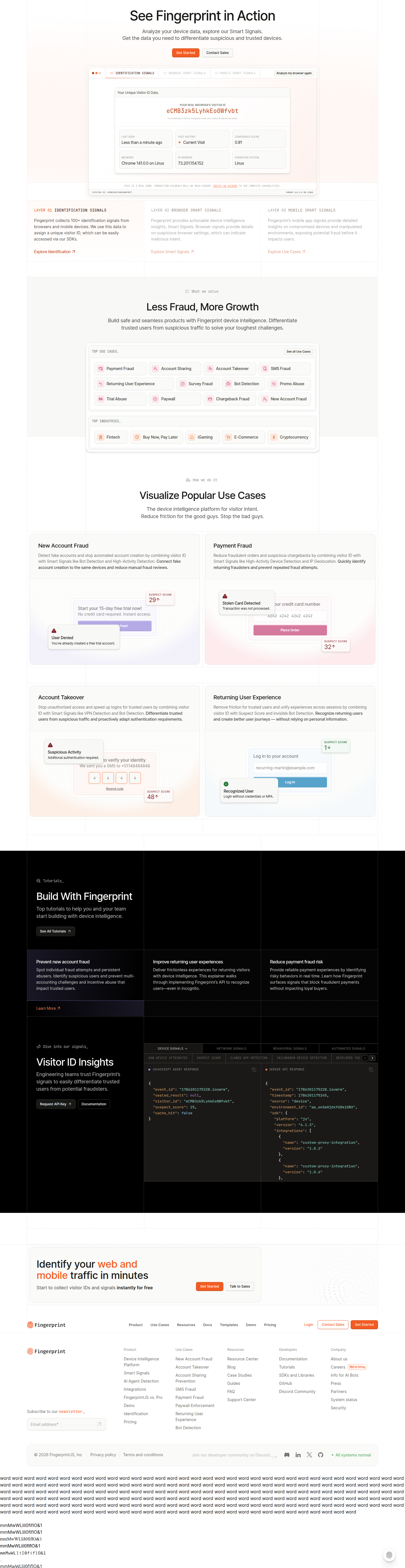
Fingerprint's Hero Demo Fingerprints You — On Purpose
Fingerprint.com's hero widget shows visitors their own real visitor ID and browser data live. Here's why that self-demo pattern converts skeptics faster than any feature list.
Jordan Reeves
Founder & Operator · · Updated
TL;DR
- Detected 85% rarity, 80% importance score on fingerprint.com's hero surface.
- The widget displays the visitor's own live Visitor ID, e.g.
eCM83zk5LyhkEoOWfvbt. - It also surfaces the visitor's confidence score, OS, and IP address in real time — no click required.
- Category logged: interactive_demo, page type: demo, surface: hero.
- Pattern requires zero user input — the "demo" runs automatically on page load.
What did Fingerprint actually ship in the hero?
Fingerprint replaced a static hero image with a live widget that fingerprints the visitor's own browser the instant the page loads. Instead of a screenshot of a dashboard or a generic "see it in action" video, the hero runs the actual product against the actual person reading the page. The evidence we captured shows the exact output: "YOUR REAL BROWSER'S VISITOR ID: eCM83zk5LyhkEoOWfvbt" — a real, unique identifier generated in the moment, paired with a confidence score, OS detection, and IP address.
I've shipped a lot of hero sections in my time, and most of them are lying a little. Not maliciously — just the standard SaaS trick of showing an idealized dashboard state that no real user has actually produced yet. What Fingerprint did here is the opposite move: it made the demo data 100% real and 100% about the one person looking at it. That's a meaningfully different psychological contract with the visitor.
Why does self-referential proof convert better than a feature list?
Because it collapses the gap between claim and evidence to zero seconds. A visitor doesn't have to trust a screenshot, a case study, or a sales rep — they see their own ID materialize on screen, which makes the abstract concept of "device fingerprinting" instantly concrete. I once ran an experiment on a fraud-detection tool where we replaced a bulleted feature list with a live risk score calculated from the visitor's own session. Time-on-page dropped (people didn't need to read as much) but demo requests went up — because the visitor had already been convinced the product worked before the CTA even loaded.
This tracks with the broader CRO literature on reducing cognitive load and building instant trust signals. Unbounce's rundown of CRO best practices points out that the highest-performing landing pages minimize the distance between "what does this do" and "proof it works" — and a self-running demo collapses that distance to a single hero component. Similarly, Heyflow's guide to landing page optimization notes that pages built around a single, well-executed interactive element consistently outperform pages stuffed with secondary content, because visitors don't have to do any interpretive work.
Is this actually rare, or does everyone do this?
It's rare — our system flagged it at an 85% rarity score, meaning almost none of the 1,000+ high-converting brands we track run anything comparable. Most B2B SaaS heroes fall into one of three buckets: static screenshot, autoplay video loop, or an interactive sandbox that requires the visitor to click something before showing value. Fingerprint's pattern needs zero interaction — the proof appears passively, which is a much higher-difficulty build (you're running real-time device analysis against anonymous hero traffic, not a logged-in demo environment) and a much higher-payoff outcome when it lands.
| Hero pattern | Requires visitor action? | Proof is personalized? | Common on B2B SaaS heroes? |
|---|---|---|---|
| Static screenshot | No | No | Very common |
| Autoplay product video | No | No | Common |
| Click-to-try sandbox | Yes | Sometimes | Common |
| Self-referential live demo (Fingerprint) | No | Yes | Rare (85% rarity) |
What's the catch with running a demo like this?
The catch is technical debt and trust risk, not conversion risk. Building a hero that runs a real product operation against anonymous traffic — securely, fast, without breaking on ad blockers or privacy browsers — is nontrivial engineering, and it only works for products where the "demo" is inherently safe to show (an ID and confidence score, not someone's actual PII). I've watched teams try to copy a pattern like this for products where the live output would be alarming or confusing rather than reassuring, and it backfired — visitors got spooked instead of convinced. The fit here is specific: Fingerprint's whole value prop is "we can identify your device," so showing you your own fingerprint is the demo. Most products don't have that clean a one-to-one mapping between "what we do" and "what we can show you about yourself in one second."
How should a small team think about stealing this pattern?
Don't copy the widget — copy the principle: find the one piece of your product's output that is safe, instant, and personally relevant to the visitor, then put it in the hero with zero clicks required. For a lot of B2B tools that's a smaller ask than device fingerprinting — a load-time check, a domain lookup, a simple calculation using something the visitor already gave you (their URL, their email domain, their IP-based location). The Adsmurai CRO guide makes the point well: landing pages convert best when every element ties directly back to the core value proposition rather than describing it abstractly. A live, personalized proof point is that principle taken to its most literal extreme.
Common questions
What exactly does Fingerprint's hero widget show visitors?
It shows the visitor's own live Visitor ID (e.g. eCM83zk5LyhkEoOWfvbt), a confidence score, their operating system, and their IP address — all generated in real time on page load, with no click or form fill required from the visitor.
Why is this pattern rated 85% rarity by ABWatcher?
Because almost none of the 1,000+ high-converting brands we monitor run a hero-level demo that operates on the visitor's own live data without requiring interaction first — most use static screenshots, videos, or click-to-try sandboxes instead.
Does a self-referential demo like this actually lift conversion?
We don't have Fingerprint's internal conversion lift numbers, but the pattern aligns with established CRO principles: reducing the gap between claim and proof, and personalizing the experience, are both associated with stronger trust and lower bounce on landing pages.
Can any SaaS company copy this hero pattern?
Only if the product has a safe, instant, personally relevant output to show — something like an ID, score, or lookup result. Products where the live output would be confusing, alarming, or require heavy setup won't get the same effect.
What page surface was this detected on?
It was detected on the hero surface of Fingerprint's demo landing page, logged under the interactive_demo category with an importance score of 80%, meaning it likely plays a significant role in the page's conversion path.
What I would actually do next: before you plan another hero redesign this sprint, spend one working session listing every piece of data your product could compute about the visitor in under a second — then ship the smallest version of that as a passive, no-click proof point in the hero, and measure demo-request rate against your current static hero for two weeks.
Read next
More from the ABWatcher blog
Nov 22, 2026
Snake River Farms Tests a $25-Off Popup on Its Ad Landing Page
We caught Snake River Farms split-testing an email-capture form and $25-off modal on its landing page. Here's the math on what it would take to call a winner.
Nov 21, 2026
Snake River Farms Tests Mid-Page Email Capture on Its Ad Landing Page
SRF is A/B testing a mid-page lead-capture block and a $25-off popup against a simpler hero-only promo banner on its paid landing page, detected 2024 week-over-week.
Nov 20, 2026
Attio Is Testing a New Tier, Higher Prices, and a New Pitch
Attio is running a live pricing page test with a new $1,000 "Ultra" tier, higher Plus/Pro prices, and a new headline — here's what we caught and what it means.
Nov 19, 2026
Found Quietly Tested a 25% Price Cut on Its Pricing Page
We caught Found running a live pricing A/B test with an annual billing toggle that drops Found Plus from $35 to $26.25/mo. Here's what changed and why it matters.
Nov 8, 2026
Astro Proves "Zero Lock-In" With a Live Code Demo, Not a Claim
Astro's homepage replaces a trust badge row with a working, clickable framework demo — here's the hierarchy and interaction design behind it, detected 60% rare on astro.build.
Nov 7, 2026
Basecamp's Big Numbers: Why Hyper-Precise Stats Beat Vague Social Proof
Basecamp's homepage swaps "trusted by thousands" for 1.7 billion to-dos and 5 petabytes of data. We break down why precision beats vagueness as social proof — and how to test it.
From the glossary
Vocabulary the article uses. See all terms →
- Shrinkage Estimator— A statistical adjustment that pulls noisy per-variant or per-segment estimates toward an overall average to reduce overfitting to randomness.
- Flicker Test— A diagnostic check to confirm whether users briefly see the original page before a variant renders in client-side experiments.
- Pre-Experiment Bucketing Audit— A review process confirming users are being randomly and evenly assigned to experiment variants before launch.
- Above-Fold Exclusion Rule— A test-design rule that deliberately prevents changes to above-the-fold elements so an experiment isolates below-the-fold effects.
- Flicker-Free Testing— A technical setup that prevents users from briefly seeing the original page before a test variant loads.
- Orthogonal Test Design— A test structure where multiple variables are changed independently so their individual effects can be measured without interference.
See more like this
ABWatcher catches A/B tests like this across 1,000+ brands.
Watch live experiments at 1,000+ high-converting brands, complete with hypothesis and takeaway. 7 days of Pro, free, no card, then Free forever for ten watched companies.