
Faire Tests Multi-Step Signup: Credentials First, Business Info Later
Faire is A/B testing a multi-step signup flow that leads with personal credentials instead of business details. Here's what the variant reveals about sequencing friction in B2B onboarding.
Maya Patel
Senior CRO Strategist · Jul 14, 2026
Faire's wholesale marketplace signup page at faire.com/apply is running a live split test that reorders one of the more consequential decisions in B2B onboarding: what you ask for first. We caught it via same-run variance across five visits — two on the control, three on the variant — spanning Safari, Chrome, Firefox, and Edge, with 95% confidence this is an intentional test rather than a rendering artifact.
What the Control Shows
The control is a single-step form under the headline "Sign up to sell on Faire." It asks for Brand name, Email, Website, Country of tax residence, wholesale product count, store count, and Primary category — seven fields before a single "Sign up" CTA. This is a classic business-qualification form: it front-loads the fields Faire's sales and merchandising teams presumably want for segmentation and lead scoring. Store count and product count in particular look like they're feeding a routing or tiering logic downstream.
What the Variant Changes
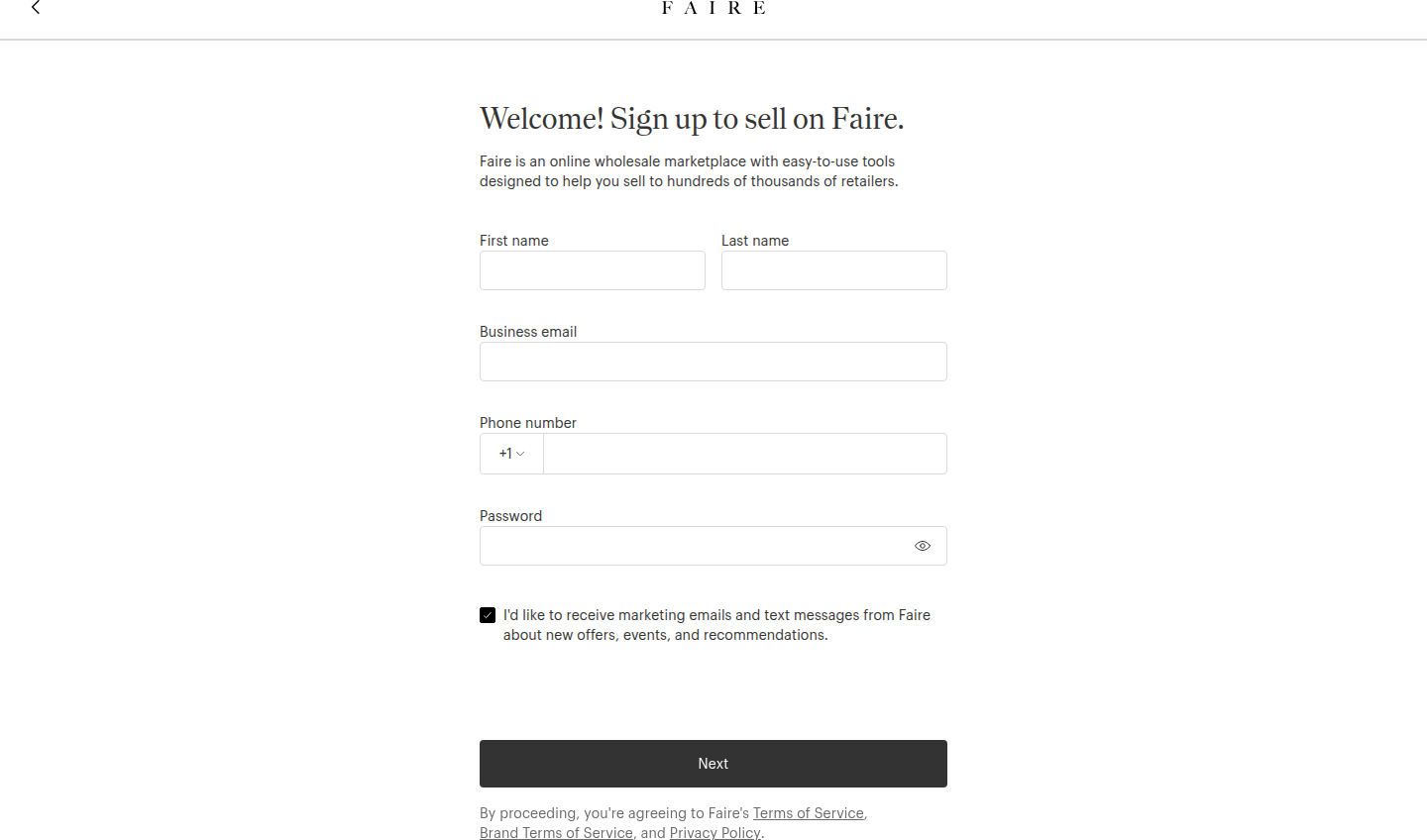
The variant, seen across Chrome, Firefox, and Edge, greets users with a warmer headline — "Welcome! Sign up to sell on Faire." — and swaps the business-qualification fields for personal account credentials: First name, Last name, Business email, Phone number, and Password, plus a marketing opt-in checkbox. The CTA changes too, from "Sign up" to "Next," signaling a multi-step flow where business details (brand, website, country, product count, category) presumably get collected in later steps rather than upfront.
This is a sequencing test, not a field-reduction test. Total data collected is likely similar or even greater once you account for phone number and password — the bet is on order, not volume.
The Friction Argument, Stated Plainly
The hypothesis is straightforward: asking a prospective seller for personal information (name, email, phone, password) feels lower-commitment than asking them to characterize their entire business on the first screen. Country of tax residence and wholesale product count are the kind of fields that invite hesitation — they imply the visitor needs to have answers ready, which they may not on a first visit. Multi-step forms have a well-documented pattern of lifting top-of-funnel completion by breaking a single cognitively heavy step into several lighter ones, a principle covered in FormAssembly's form conversion guidance, which stresses sequencing and progressive disclosure as levers distinct from field count alone.
The counter-argument is worth stating before endorsing the variant. Multi-step flows can lift starts while doing nothing for, or even hurting, full completions — you're often just moving the drop-off point later in the funnel rather than removing it. If Faire's north star is verified, qualified sellers (not just signup starts), a form that defers business-qualification data risks admitting more low-intent or wrong-fit applicants into step two, which raises downstream review costs for their merchant operations team. This is a real tradeoff, not a formality: reducing perceived friction and improving lead quality frequently pull in opposite directions.
Applying an ICE Lens
Running this through Impact, Confidence, Ease is useful for anyone weighing a similar test:
- Impact: Potentially high on top-of-funnel starts, uncertain on full-funnel completions and lead quality. Faire should be watching step-2 and step-3 abandonment closely, not just the first-click conversion.
- Confidence: Moderate. The pattern (credentials-first, multi-step) has enough precedent in SaaS onboarding to justify testing, but B2B marketplace signup — where qualifying the business, not just the person, matters for platform trust and supply quality — is a different animal than a typical SaaS trial signup.
- Ease: Low-to-moderate. This isn't a copy or button-color test; it's a form architecture change touching validation logic, step routing, and likely backend lead-scoring rules that previously fired off business fields collected step one.
That last point matters. Teams running A/B tests should account for downstream dependencies before committing engineering time — a lesson Contentful's CRO guide reinforces by stressing that a real hypothesis, not just a UI tweak, should anchor the test design, since the analysis needs to trace effects through the full funnel, not just the first metric that moves.
What to Watch as This Test Plays Out
A few signals will determine which variant wins on Faire's actual decision criteria, not just directional lift:
- Step-level drop-off in the variant. If completion craters between step one (credentials) and step two (business info), the "reduced friction" story is really just "delayed friction," and the net conversion gain could be a wash or worse.
- Lead quality downstream. Faire's sales and merchandising teams will care whether variant signups convert to active, verified sellers at the same rate as control signups. A higher top-of-funnel number with a lower qualified-seller rate isn't a win.
- Cross-browser consistency. The control appeared on Safari and Chrome; the variant on Chrome, Firefox, and Edge. Overlapping Chrome traffic in both arms suggests this is a proper randomized split rather than a browser-specific rendering issue, but it's worth confirming the split isn't confounded by device or acquisition channel.
The Takeaway for Your Roadmap
If you're running a business-qualification signup flow — marketplace seller onboarding, B2B trial signup, partner applications — don't test field count in isolation from field sequence. The Faire test is a reminder that moving low-commitment fields to the front and business-qualification fields to later steps can lift starts, but the real metric to pre-register before you launch is full-funnel qualified completion, not step-one conversion. Define that metric now, instrument every step boundary, and you'll avoid mistaking a shifted drop-off point for a genuine friction reduction.
See more like this
ABWatcher catches A/B tests like this every day.
Watch live experiments at 1,000+ high-converting brands, complete with hypothesis and takeaway. Free forever for ten watched companies.