
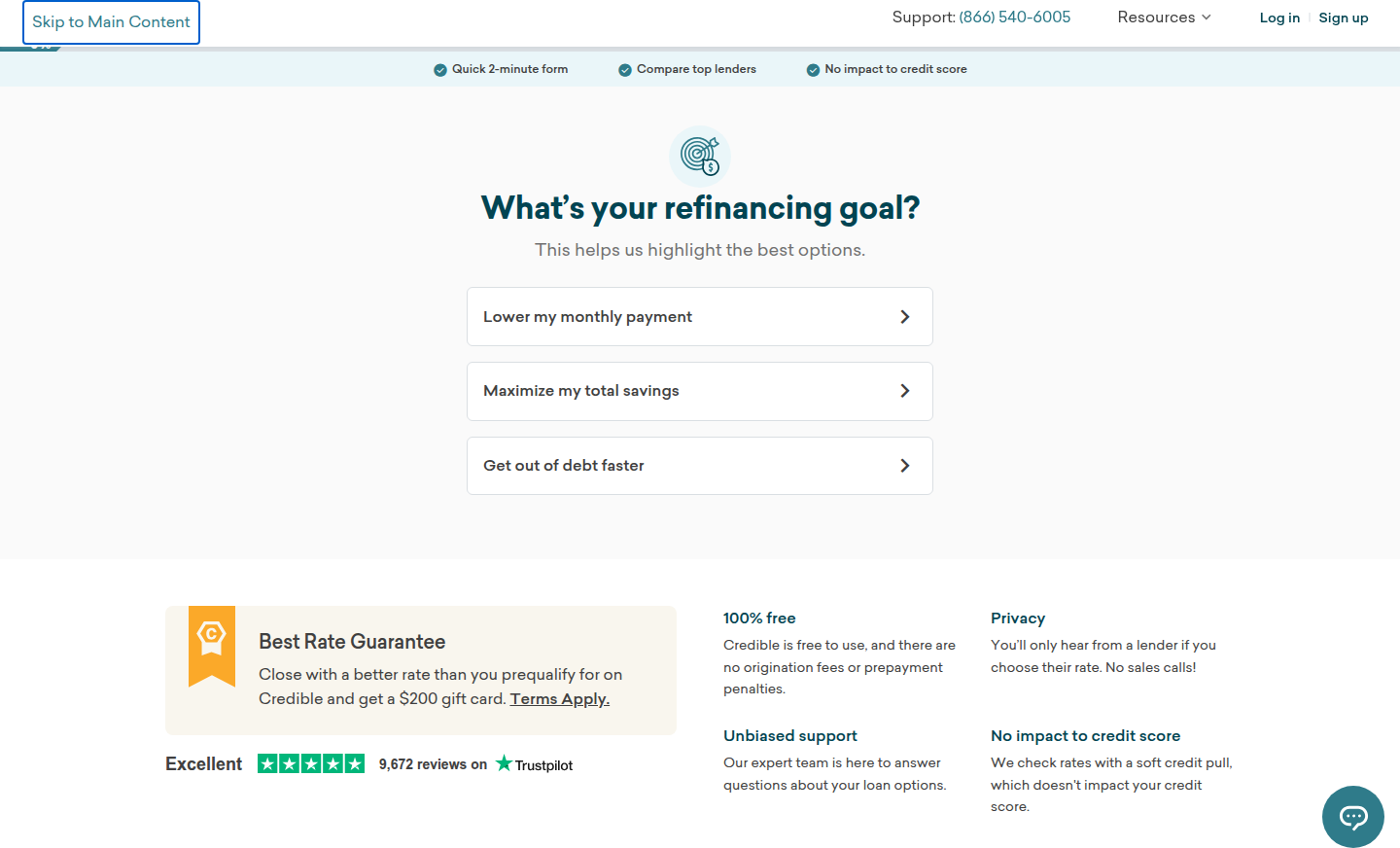
Credible's $200 Gift Card: A Cash-Backed Risk Reversal on a Rate Page
Credible tested a $200 gift-card guarantee against its own rate quotes — a rare, monetized risk-reversal pattern. Here's what it signals for fintech CRO roadmaps.
Maya Patel
Senior CRO Strategist · · Updated
TL;DR
- Detected on credible.com, landing page, social-proof surface, logged as a risk_reversal pattern.
- Rarity score: 75% — this pattern shows up infrequently across the 1,000+ sites ABWatcher monitors daily.
- Importance score: 70%, reflecting high potential funnel impact for lending/marketplace pages.
- Offer copy: "Close with a better rate than you prequalify for on Credible and get a $200 gift card. Terms Apply."
- Mechanism: a specific dollar-denominated guarantee rather than generic "money-back" or "satisfaction guaranteed" language.
- Category context: student loan and mortgage refinance marketplaces routinely compete on rate confidence, making this a category-relevant risk-reversal test.
What did Credible actually test?
Credible ran a landing page variant that pairs its rate-comparison tool with a monetary guarantee: a $200 gift card if a user closes elsewhere at a better rate than Credible prequalified them for. The copy sits on the social-proof surface of the page — the zone typically reserved for testimonials, trust badges, or lender logos — but instead of a soft trust signal, it inserts a hard financial commitment. That placement choice matters. Social proof usually works by borrowing credibility from other users ("thousands have refinanced with us"). Here, Credible is generating its own credibility signal by putting cash behind the claim, which is a materially different psychological lever.
Why does a cash-backed guarantee outperform typical trust copy?
A dollar-specific guarantee reduces perceived decision risk more effectively than vague reassurance language because it gives users a concrete, quantifiable downside protection. In risk-reversal frameworks, the strength of the reversal is proportional to its specificity and enforceability. "We guarantee the best rate" is a claim. "$200 gift card, terms apply" is a contract. For a lending marketplace — where the core anxiety is "am I getting a worse deal by comparing here instead of going direct to a bank" — this directly neutralizes the single biggest objection standing between a prequalified lead and a closed loan. That's a sharper hypothesis than most social-proof tests, which tend to optimize for trust rather than for removing a named objection.
How rare is this pattern compared to standard risk-reversal tests?
At a 75% rarity score, this is one of the less common risk-reversal executions ABWatcher detects across daily-monitored landing pages, most of which stick to refund or satisfaction language. Money-back guarantees, free trials, and "cancel anytime" copy dominate the risk-reversal category. A cash-value competitive guarantee tied to a third-party outcome (the user closing with another lender) is structurally harder to implement — it requires proof-of-close verification, fraud controls, and legal terms — which likely explains why it's rare. The complexity tax is real, but so is the differentiation payoff for a category where every competitor claims to have "the best rates."
| Guarantee type | Typical category use | Specificity level | Estimated adoption frequency* |
|---|---|---|---|
| "Money-back" / refund | SaaS, ecommerce | Low-medium | Common |
| "Satisfaction guaranteed" | DTC, subscriptions | Low | Common |
| Price-match (credit) | Retail, travel | Medium | Occasional |
| Cash/gift-card competitive guarantee | Lending, fintech marketplaces | High | Rare (this detection: 75% rarity) |
*Adoption frequency is a qualitative read based on ABWatcher's cross-category detection volume, not a precise count.
What's the tradeoff CRO teams should weigh before copying this?
Before running a similar test, teams should weigh legal and margin exposure against expected lift, since a cash guarantee carries real payout risk unlike copy-only trust signals. Using an ICE-style filter: Impact is plausibly high (removes a named objection at the point of rate comparison, a classic drop-off moment in lending funnels), Confidence is moderate (no public lift data is available for Credible's specific variant, so this reads as a hypothesis worth testing, not a proven benchmark), and Ease is low-to-medium — legal review, terms drafting, and a verification process for "better rate elsewhere" claims all add implementation cost that a simple headline test wouldn't require. Teams should also model worst-case payout rate: if even 2-3% of closers claim the $200 credit, does the reduced funnel drop-off still clear the marginal acquisition cost?
The broader lesson connects to a point made in Unbounce's CRO best practices guide: structure the hypothesis before you test, and treat results — including a "no-lift" result — as evidence rather than a referendum on the idea. A guarantee like this should be framed explicitly: "Adding a monetized competitive guarantee will reduce comparison-shopping abandonment because it removes the fear of leaving money on the table by not shopping further." That's testable, falsifiable, and specific enough to design a clean experiment around. It also lines up with the proactive posture recommended in Apexure's landing page optimization guide — testing trust and risk elements before conversion rates show a problem, not after.
Common questions
Is a cash-value guarantee always better than a money-back guarantee?
Not universally. Cash guarantees work best when the core objection is comparative ("is this the best deal") rather than transactional risk ("will this product work"). For ecommerce or SaaS, refund-based guarantees usually address the right objection more directly and cost less to administer than a competitive cash offer.
What kind of businesses should consider testing this pattern?
Marketplaces and comparison-driven categories — lending, insurance, travel booking — are the best fit, since the core user hesitation is often "could I get a better deal elsewhere" rather than product doubt. Categories with subjective satisfaction (software, services) usually see more lift from trial extensions or refund terms instead.
How should teams estimate payout risk before launching a similar guarantee?
Model the guarantee against historical claim/redemption rates for similar offers, then run a small-traffic pilot with capped budget before a full rollout. Track claim rate, verification friction, and net funnel lift together, not conversion rate alone, since a cash guarantee's true ROI depends on the payout ratio staying below the incremental value it unlocks.
Does placing this on the social-proof surface change how it performs versus a hero section placement?
Likely yes, though this specific comparison wasn't in the detection data. Social-proof zones prime users who are already evaluating trust signals, which may make a concrete guarantee land more credibly there than in a hero, where users are still forming their first impression of the offer.
Takeaway for this sprint
If your landing page relies on generic risk-reversal language, audit whether your category's core objection is actually addressable with a specific, quantifiable guarantee rather than soft reassurance copy. Before building one, write the ICE score down on paper — impact, confidence, ease — and separately model the payout exposure the way you'd model any new pricing lever. Even if a full cash guarantee is out of scope this quarter, testing a more specific, dollar-anchored risk-reversal statement against your current copy is a low-lift experiment worth queuing this sprint.
Read next
More from the ABWatcher blog
Nov 22, 2026
Snake River Farms Tests a $25-Off Popup on Its Ad Landing Page
We caught Snake River Farms split-testing an email-capture form and $25-off modal on its landing page. Here's the math on what it would take to call a winner.
Nov 21, 2026
Snake River Farms Tests Mid-Page Email Capture on Its Ad Landing Page
SRF is A/B testing a mid-page lead-capture block and a $25-off popup against a simpler hero-only promo banner on its paid landing page, detected 2024 week-over-week.
Nov 20, 2026
Attio Is Testing a New Tier, Higher Prices, and a New Pitch
Attio is running a live pricing page test with a new $1,000 "Ultra" tier, higher Plus/Pro prices, and a new headline — here's what we caught and what it means.
Nov 19, 2026
Found Quietly Tested a 25% Price Cut on Its Pricing Page
We caught Found running a live pricing A/B test with an annual billing toggle that drops Found Plus from $35 to $26.25/mo. Here's what changed and why it matters.
Nov 8, 2026
Astro Proves "Zero Lock-In" With a Live Code Demo, Not a Claim
Astro's homepage replaces a trust badge row with a working, clickable framework demo — here's the hierarchy and interaction design behind it, detected 60% rare on astro.build.
Nov 7, 2026
Basecamp's Big Numbers: Why Hyper-Precise Stats Beat Vague Social Proof
Basecamp's homepage swaps "trusted by thousands" for 1.7 billion to-dos and 5 petabytes of data. We break down why precision beats vagueness as social proof — and how to test it.
From the glossary
Vocabulary the article uses. See all terms →
- Shrinkage Estimator— A statistical adjustment that pulls noisy per-variant or per-segment estimates toward an overall average to reduce overfitting to randomness.
- Flicker Test— A diagnostic check to confirm whether users briefly see the original page before a variant renders in client-side experiments.
- Pre-Experiment Bucketing Audit— A review process confirming users are being randomly and evenly assigned to experiment variants before launch.
- Above-Fold Exclusion Rule— A test-design rule that deliberately prevents changes to above-the-fold elements so an experiment isolates below-the-fold effects.
- Flicker-Free Testing— A technical setup that prevents users from briefly seeing the original page before a test variant loads.
- Orthogonal Test Design— A test structure where multiple variables are changed independently so their individual effects can be measured without interference.
See more like this
ABWatcher catches A/B tests like this across 1,000+ brands.
Watch live experiments at 1,000+ high-converting brands, complete with hypothesis and takeaway. 7 days of Pro, free, no card, then Free forever for ten watched companies.