
Codebuff Names Claude and Shows the Scoreboard: A Rare Social Proof Play
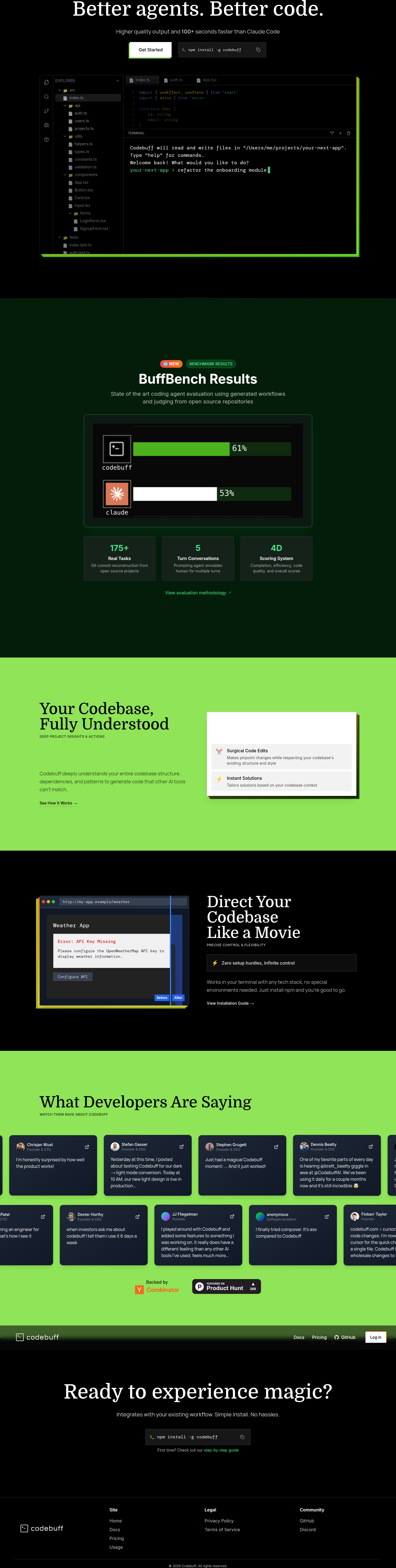
Codebuff's homepage ditches vague "best-in-class" claims for a live, named benchmark against Claude — 61% vs 53%, methodology linked. Here's the design breakdown.
Aiko Tanaka
Design Director · · Updated
TL;DR
- Detected 12 June 2026 on Codebuff's homepage (codebuff.com), page type: home, surface: other
- Social proof module names a specific competitor — Claude — rather than an anonymous rival
- Scoreboard shows a quantified head-to-head: Codebuff 61% vs Claude 53%
- A "View evaluation methodology" link sits directly beneath the score, inviting scrutiny
- Rarity score: 75/100. Importance score: 70/100 — an uncommon, high-signal pattern
- Category: social_proof — but built on comparative data, not testimonials or logos
What is Codebuff actually showing on its homepage?
Codebuff displays a live benchmark called "BuffBench" that pits its own score directly against Claude's, with both numbers visible and a link to the underlying methodology. The module reads simply: "BuffBench Results — codebuff 61% / claude 53%." No adjectives, no superlatives — just two numbers and a named opponent.
That's the detail worth pausing on. Most B2B homepages hide behind "industry-leading" or "best-in-class" language precisely because it can't be fact-checked. Codebuff does the opposite: it puts a competitor's name in lights on its own landing page, which only works if the number underneath is defensible. The presence of the methodology link is the tell — it signals the team expects visitors to click through and verify, not just skim and nod.
Why does naming Claude specifically change the hierarchy?
Naming a known competitor gives the eye an immediate anchor, turning an abstract claim into a comparison the visitor can evaluate in under two seconds. In an F-pattern scan, most homepage modules lose visitors after the headline — eyes drift down the left margin, skimming for the next bolded number or proper noun. A generic stat like "94% accuracy" asks the visitor to supply their own frame of reference. "61% vs Claude's 53%" supplies the frame for you. The competitor's name does cognitive work that a percentage alone cannot: it converts an isolated data point into a ranked comparison, which is a much stickier mental object.
This is basic Gestalt proximity at work — the two scores are grouped tightly enough that the brain reads them as one unit, a scoreboard, rather than two disconnected facts. Put codebuff and claude on separate cards, or separate the numbers with more whitespace than label, and the comparative punch evaporates. The tight grouping is doing as much persuasive work as the numbers themselves.
Where does this sit in the page, and does the fold weight support it?
BuffBench appears as a dedicated proof module rather than buried in a footnote, which gives it enough visual weight to survive past the initial headline scan. Social proof placed too far from the primary CTA loses its persuasive momentum by the time a visitor reaches the button — a point Lovable's landing page guide makes explicitly when it argues that generic claims like "thousands of satisfied customers" underperform specific, quantified results positioned "mid-page after introducing your solution but before the final CTA." Codebuff's benchmark follows that logic almost exactly: it's specific (61% vs 53%), it's positioned as a proof beat rather than a hero claim, and it precedes the ask rather than trailing after it as an afterthought.
Apexure's 2026 landing page research also flags "place social proof near your CTA" as one of five highest-leverage changes they see across client tests — reinforcing that proximity to the conversion moment, not just the presence of proof, is what moves the needle.
How rare is a named, quantified competitor comparison in the wild?
Across the landing pages ABWatcher monitors daily, most social proof leans on testimonial quotes, customer logos, or unlabeled percentage claims — a direct, named competitor scoreboard is uncommon enough to score 75/100 on our rarity index.
| Social proof type | Typical specificity | Comparative to named competitor? |
|---|---|---|
| Customer logo wall | Low (implies trust by association) | No |
| Testimonial quote | Medium (often vague outcomes) | No |
| Aggregate stat ("94% satisfaction") | Medium (no baseline given) | No |
| Codebuff's BuffBench module | High (linked methodology) | Yes — named, scored |
Most teams avoid naming competitors outright for legal and brand-safety reasons, which is exactly why this pattern carries a 70/100 importance score in our detection — it's rare, it's replicable, and when a company has a genuine numeric edge, it's a much stronger trust signal than a testimonial.
What should design and growth teams borrow from this?
The lesson isn't "call out your competitor by name." It's that specificity plus verifiability outperforms vague superiority claims, and that pairing a bold number with a way to check it costs little and earns disproportionate trust. As Unbounce's CRO research puts it, the strongest claims make a visitor think "this was made specifically for someone like me" — a named benchmark does that by speaking directly to the exact comparison a technical buyer is already running in their head.
Common questions
Why did ABWatcher flag this as rare rather than routine?
Most social proof patterns we track — logo walls, testimonial carousels, review-star widgets — appear across hundreds of monitored pages weekly. A named, quantified, methodology-linked competitor comparison is uncommon: it requires legal comfort naming a rival and a number good enough to defend publicly, which is why it scored 75/100 on rarity.
Does linking a methodology page actually increase conversions?
There's no isolated A/B test data confirming lift from the methodology link alone, but it aligns with established CRO logic: specific, checkable claims build more trust than unverifiable ones. The link functions as a credibility signal for technical buyers who would otherwise dismiss the stat as marketing copy.
Is naming a competitor risky for other brands to copy?
It carries legal and brand-risk considerations most teams should clear with counsel first, especially around trademark use and comparative advertising rules. It works best when the underlying number is real, sourced, and defensible — a weak or cherry-picked stat invites reputational backlash rather than trust.
Where should teams place comparative social proof on their own page?
Position it after the value proposition and before the primary CTA, mirroring where Codebuff placed BuffBench. Research from Lovable and Apexure both point to mid-page placement, close to the conversion action, as outperforming proof buried in a footer or separate page.
Takeaway for your sprint
If your product has a real, favorable number against a named competitor, this sprint is a good time to test surfacing it — with a link to methodology — instead of another testimonial carousel. Specificity, proximity to the CTA, and a checkable source are the three ingredients worth prototyping first.
Read next
More from the ABWatcher blog
Nov 22, 2026
Snake River Farms Tests a $25-Off Popup on Its Ad Landing Page
We caught Snake River Farms split-testing an email-capture form and $25-off modal on its landing page. Here's the math on what it would take to call a winner.
Nov 21, 2026
Snake River Farms Tests Mid-Page Email Capture on Its Ad Landing Page
SRF is A/B testing a mid-page lead-capture block and a $25-off popup against a simpler hero-only promo banner on its paid landing page, detected 2024 week-over-week.
Nov 20, 2026
Attio Is Testing a New Tier, Higher Prices, and a New Pitch
Attio is running a live pricing page test with a new $1,000 "Ultra" tier, higher Plus/Pro prices, and a new headline — here's what we caught and what it means.
Nov 19, 2026
Found Quietly Tested a 25% Price Cut on Its Pricing Page
We caught Found running a live pricing A/B test with an annual billing toggle that drops Found Plus from $35 to $26.25/mo. Here's what changed and why it matters.
Nov 8, 2026
Astro Proves "Zero Lock-In" With a Live Code Demo, Not a Claim
Astro's homepage replaces a trust badge row with a working, clickable framework demo — here's the hierarchy and interaction design behind it, detected 60% rare on astro.build.
Nov 7, 2026
Basecamp's Big Numbers: Why Hyper-Precise Stats Beat Vague Social Proof
Basecamp's homepage swaps "trusted by thousands" for 1.7 billion to-dos and 5 petabytes of data. We break down why precision beats vagueness as social proof — and how to test it.
From the glossary
Vocabulary the article uses. See all terms →
- Shrinkage Estimator— A statistical adjustment that pulls noisy per-variant or per-segment estimates toward an overall average to reduce overfitting to randomness.
- Flicker Test— A diagnostic check to confirm whether users briefly see the original page before a variant renders in client-side experiments.
- Pre-Experiment Bucketing Audit— A review process confirming users are being randomly and evenly assigned to experiment variants before launch.
- Above-Fold Exclusion Rule— A test-design rule that deliberately prevents changes to above-the-fold elements so an experiment isolates below-the-fold effects.
- Flicker-Free Testing— A technical setup that prevents users from briefly seeing the original page before a test variant loads.
- Orthogonal Test Design— A test structure where multiple variables are changed independently so their individual effects can be measured without interference.
See more like this
ABWatcher catches A/B tests like this across 1,000+ brands.
Watch live experiments at 1,000+ high-converting brands, complete with hypothesis and takeaway. 7 days of Pro, free, no card, then Free forever for ten watched companies.