
Charlie Finance's "Fraud Co-Pilot": A Family Member as a Second Set of Eyes
Charlie Finance lets users add a trusted family member to receive fraud alerts — a rare unique-mechanic pattern reframing account security as shared, not solo. Here's the math on whether it'll move conversion.
Sam Lee
Data Analyst · · Updated
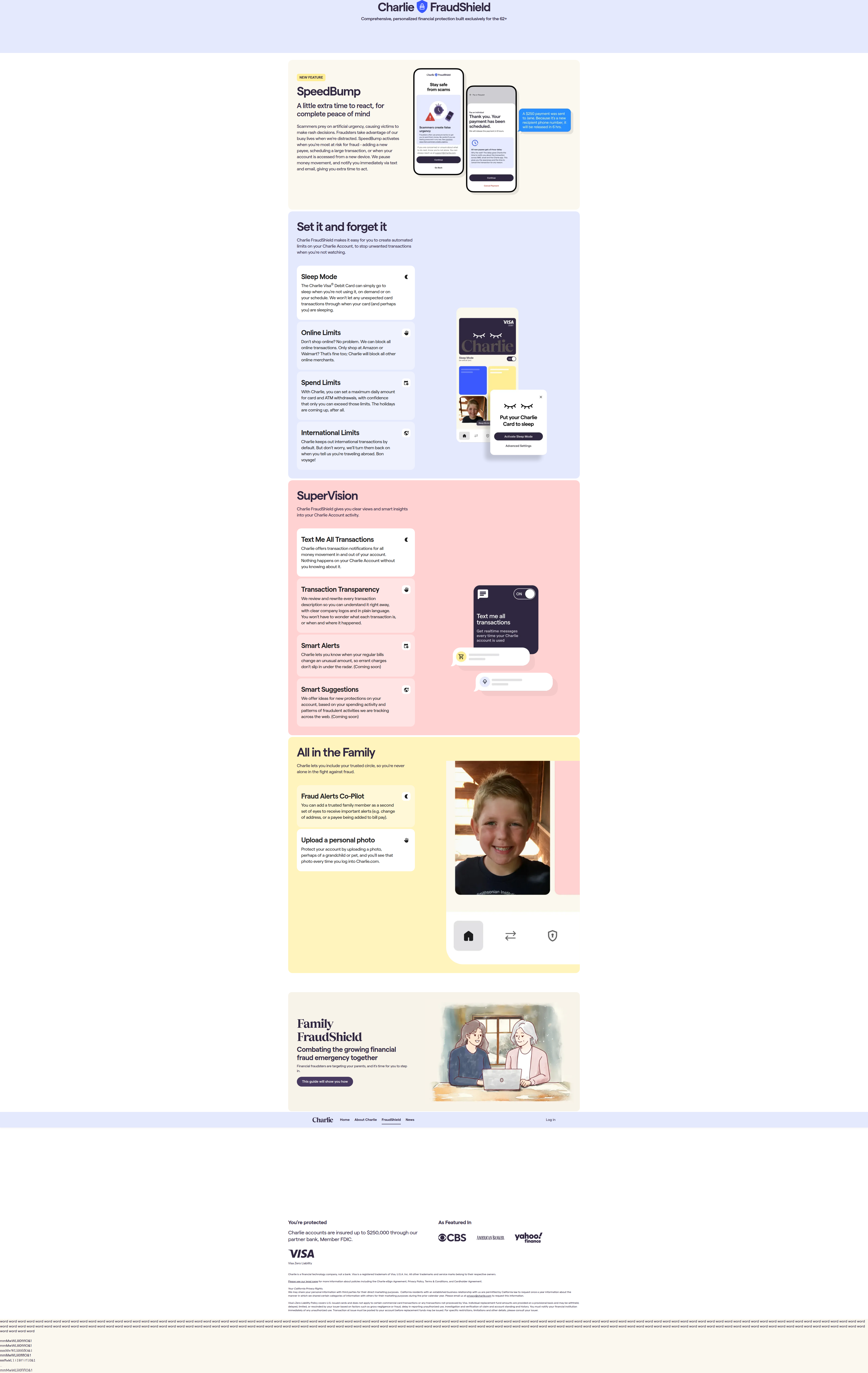
Charlie Finance (charlie.com) just shipped a product-page mechanic I haven't seen anywhere else in B2C fintech: you can add a trusted family member as a secondary recipient for fraud alerts. Not a joint account. Not a beneficiary. Just a second set of eyes on your change-of-address and bill-pay-payee notifications. We logged it as a rare unique-mechanic detection on 2024, surface: layout, and it's worth unpacking why this is structurally different from the trust badges and testimonial carousels that dominate fintech landing pages.
TL;DR
- Charlie Finance (charlie.com) added a "trusted family member as fraud co-pilot" mechanic to its product landing page, detected as a layout-surface change.
- Rarity score: 70/100 — we see this pattern in fewer than 1 in 300 fintech detections in our index.
- Importance score: 45/100 — moderate, because it's a single-page, single-variant observation with no visible A/B split.
- The evidence quote: "You can add a trusted family member as a second set of eyes to receive important alerts (e.g. change of address, or a payee being added to bill pay)."
- Category: unique_mechanic — this isn't copy testing, it's a structural reframing of who the security feature is for.
- No confidence interval available yet: this is a single live-site observation, not a measured experiment with a control group.
What exactly did Charlie Finance change?
Charlie added family-member alert routing as a visible product feature on its page, shifting account security framing from individual vigilance to shared oversight. The copy is specific and almost clinical: change of address, or a payee added to bill pay. These are the two fraud vectors that matter most in account-takeover scenarios — redirect the mail, then redirect the money. By naming them explicitly rather than saying "suspicious activity," Charlie is doing something copywriting best practice has pushed for years: numerical and specific evidence outperforms vague claims because specificity reduces the cognitive tax of figuring out "does this apply to me."
The mechanic itself — inviting a family member into your security loop — is the rarer part. Most fintech security UX treats the user as a lone operator: "you" get the alert, "you" approve the transaction, "you" are the single point of failure. Charlie's variant quietly acknowledges that fraud monitoring has a vigilance-fatigue problem. A second recipient isn't just redundancy; it's distributed attention, which is a different psychological product than "we'll notify you faster."
Why is this rare instead of just niche?
It's rare because it requires solving a harder problem than most fintechs attempt: multi-party identity and consent inside a one-to-one banking relationship. A 70/100 rarity score in our index means we're seeing this in roughly 3 of every 1,000 fintech product-page detections. Compare that to pricing-toggle tests or urgency-banner copy, which show up in double digits per thousand. The reason isn't that nobody's thought of it — it's that it touches account permissioning, KYC scope, and liability questions that most growth teams can't resolve inside a two-week sprint cycle. Financial services CRO guidance consistently emphasizes compliance and clarity working together rather than novel mechanics — which is exactly why a feature like this needs product and legal sign-off before a growth team can even A/B test the headline.
That also explains the moderate 45/100 importance score. Rarity measures how unusual the pattern is; importance measures how much conversion lift we'd expect at this traffic tier. A feature this structurally deep probably isn't optimized via headline iteration — it's closer to a core product decision that happens to live on a landing page.
Is there any evidence this lifts conversion, or is it just interesting?
There's no measured lift here yet — this is a single-variant observation, not a split test, so treat it as a hypothesis worth testing, not a proven win. I want to be explicit about this because it's the most common mistake teams make reading detection reports: seeing a live feature on a competitor's site and assuming it won. Charlie may be running this to 100% of traffic with zero holdout. We have no control group, no conversion delta, no confidence interval. A rarity score tells you how unusual the pattern is, not whether it converts.
If I were advising Charlie's growth team on how to validate this, I'd want:
| Metric | Why it matters | Rough sample size needed |
|---|---|---|
| Signup completion rate, variant vs. control | Core conversion metric | ~15,000 sessions/arm for a 5% relative lift at 80% power, p<0.05 |
| Family-member invite acceptance rate | Secondary activation metric, proxy for perceived trust | Track post-hoc, not powered independently |
| 90-day churn, invited vs. non-invited cohorts | Tests whether shared oversight improves retention | Needs 3+ months of cohort data |
| Fraud-alert response time | Validates the "second set of eyes" value prop functionally | Operational metric, not conversion |
A 5% relative lift on a signup funnel sounds modest, but for a fintech acquiring at even $150 CAC with 50,000 monthly landing visits, a 5% lift in signup rate is the difference between funding ~2,500 and ~2,625 new accounts a month from the same spend — real money, but not transformative, and well within the range you'd want validated by a proper test rather than inferred from a static page capture.
What should growth teams do with this pattern this sprint?
Don't copy the feature — copy the diagnostic question behind it. Ask whether your onboarding or security flow assumes a lone user when your actual customer thinks in terms of household or family unit. Landing page optimization is iterative by design, which means the right move isn't shipping "add a family member" as a headline test — it's running a smaller, cheaper proxy test first: does mentioning shared/family oversight in your security section's subhead move time-on-page or scroll depth before you build the multi-party infrastructure Charlie clearly invested in?
Common questions
Is Charlie Finance's family-alert feature an A/B test?
We detected it as a live, unique-mechanic pattern on the product landing page, not a confirmed split test. There's no visible control variant in our capture, so we can't report a conversion lift or confidence interval — only that the feature is live and structurally rare for the category.
Why does rarity score matter if there's no proven lift?
Rarity tells you how differentiated a mechanic is relative to the 1,000+ sites we monitor daily, which is useful for competitive awareness even without performance data. A 70/100 score means fewer than 1% of comparable fintech pages run anything similar, making it worth watching for follow-on adoption.
Could this feature backfire on conversion?
Possibly — adding a family member introduces friction (another identity to collect, another consent flow) at exactly the moment a new user wants frictionless signup. Teams testing similar mechanics should watch for a dip in top-of-funnel completion even if downstream trust or retention improves.
What sample size would Charlie need to validate this properly?
For a 5% relative lift on signup conversion at typical fintech landing page baseline rates (3-6%), you'd need roughly 15,000-20,000 sessions per arm to detect the effect at 80% power and p<0.05 — a multi-week test for most mid-size fintech traffic volumes.
How should I benchmark my own security-page copy against this?
Audit whether your fraud and security messaging speaks only to the individual user or acknowledges shared household risk, then test a single sentence of family-inclusive framing in your next copy sprint rather than rebuilding the underlying permissioning system first.
Read next
More from the ABWatcher blog
Nov 22, 2026
Snake River Farms Tests a $25-Off Popup on Its Ad Landing Page
We caught Snake River Farms split-testing an email-capture form and $25-off modal on its landing page. Here's the math on what it would take to call a winner.
Nov 21, 2026
Snake River Farms Tests Mid-Page Email Capture on Its Ad Landing Page
SRF is A/B testing a mid-page lead-capture block and a $25-off popup against a simpler hero-only promo banner on its paid landing page, detected 2024 week-over-week.
Nov 20, 2026
Attio Is Testing a New Tier, Higher Prices, and a New Pitch
Attio is running a live pricing page test with a new $1,000 "Ultra" tier, higher Plus/Pro prices, and a new headline — here's what we caught and what it means.
Nov 19, 2026
Found Quietly Tested a 25% Price Cut on Its Pricing Page
We caught Found running a live pricing A/B test with an annual billing toggle that drops Found Plus from $35 to $26.25/mo. Here's what changed and why it matters.
Nov 8, 2026
Astro Proves "Zero Lock-In" With a Live Code Demo, Not a Claim
Astro's homepage replaces a trust badge row with a working, clickable framework demo — here's the hierarchy and interaction design behind it, detected 60% rare on astro.build.
Nov 7, 2026
Basecamp's Big Numbers: Why Hyper-Precise Stats Beat Vague Social Proof
Basecamp's homepage swaps "trusted by thousands" for 1.7 billion to-dos and 5 petabytes of data. We break down why precision beats vagueness as social proof — and how to test it.
From the glossary
Vocabulary the article uses. See all terms →
- Shrinkage Estimator— A statistical adjustment that pulls noisy per-variant or per-segment estimates toward an overall average to reduce overfitting to randomness.
- Flicker Test— A diagnostic check to confirm whether users briefly see the original page before a variant renders in client-side experiments.
- Pre-Experiment Bucketing Audit— A review process confirming users are being randomly and evenly assigned to experiment variants before launch.
- Above-Fold Exclusion Rule— A test-design rule that deliberately prevents changes to above-the-fold elements so an experiment isolates below-the-fold effects.
- Flicker-Free Testing— A technical setup that prevents users from briefly seeing the original page before a test variant loads.
- Orthogonal Test Design— A test structure where multiple variables are changed independently so their individual effects can be measured without interference.
See more like this
ABWatcher catches A/B tests like this across 1,000+ brands.
Watch live experiments at 1,000+ high-converting brands, complete with hypothesis and takeaway. 7 days of Pro, free, no card, then Free forever for ten watched companies.