
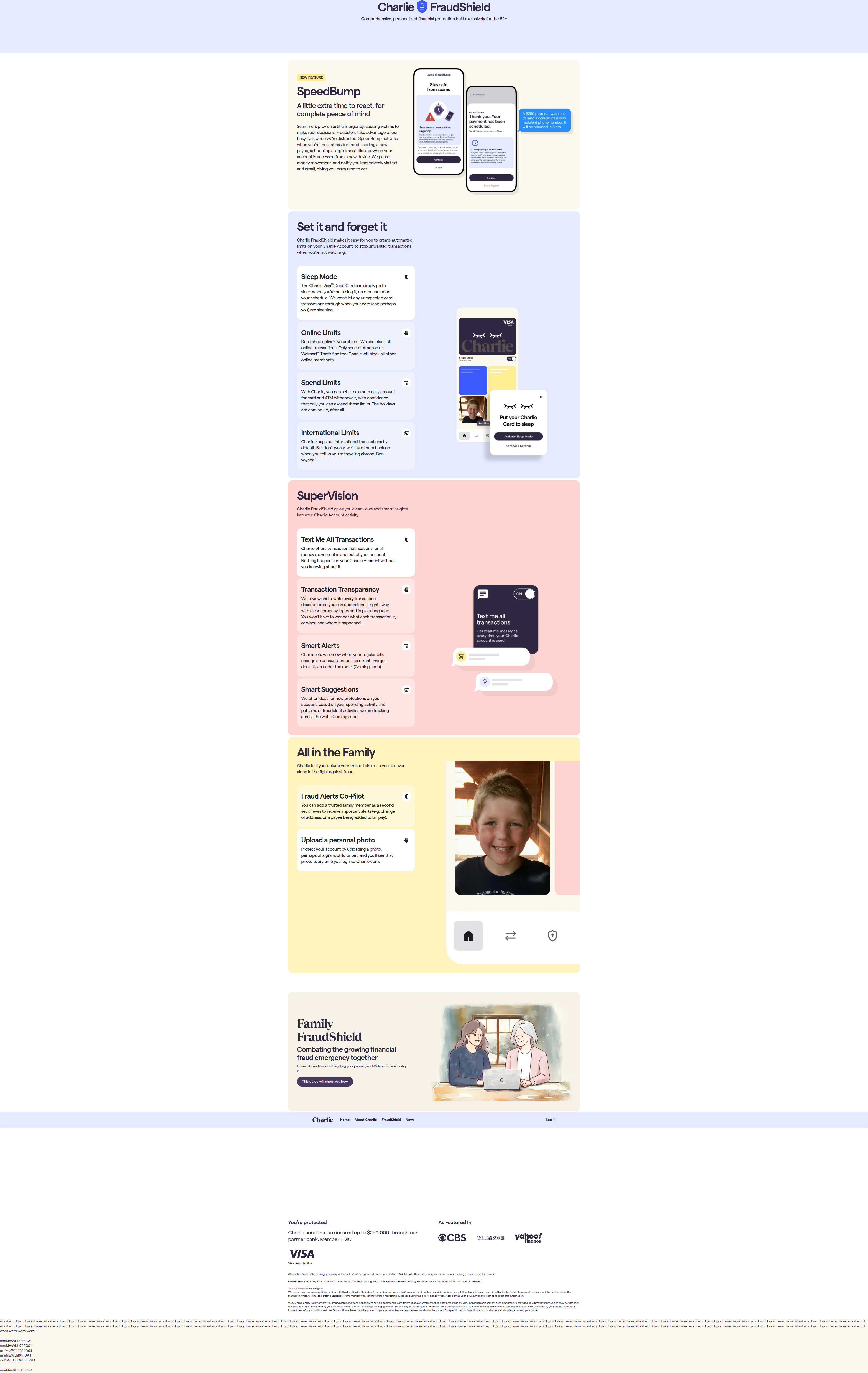
Charlie Finance Sells Slowness: Inside the "SpeedBump" Anti-Fraud Hero Test
Charlie Finance's hero copy markets a deliberate transaction delay as a safety feature. We break down why friction-as-a-feature is rare, and what it would take to prove it converts.
Sam Lee
Data Analyst · · Updated
TL;DR
- Detected 85% rarity, 60% importance score for a
unique_mechanicpattern on charlie.com's product hero, logged by ABWatcher. - Feature name: SpeedBump — intentionally delays transactions during new-payee, large-transfer, or new-device events.
- Copy pulled directly from page: "We pause money movement, and notify you immediately via text and email, giving you extra time to act."
- Category flag: friction is the marketed benefit, not an optimization defect — inverse of standard CRO doctrine.
- Target segment implied by copy: elderly users and their families, a segment where trust signals typically outperform speed signals.
- No public lift numbers disclosed — this is a pattern detection, not a confirmed A/B win.
What did Charlie Finance actually change on the page?
Charlie's product hero introduces SpeedBump, a feature that pauses money movement instead of speeding it up. The evidence quote is unambiguous about mechanism: the delay triggers on three specific risk events — adding a new payee, scheduling a large transaction, or account access from a new device — and pairs the pause with immediate text/email notification. That's a conversion mechanic built entirely around withholding instant gratification, which is the opposite of the "reduce steps to conversion" heuristic that dominates most CRO playbooks, including the Fullstory best-practices guide, which leans on urgency and social proof rather than induced delay.
Why does marketing friction as a feature break the standard CRO model?
Most CRO frameworks optimize for a single, fast path to one goal, and SpeedBump inverts that by making a deliberate pause the value proposition. The Gomage landing-page framework argues pages convert best with one focused goal and message-match between ad and page — Charlie's page still does that, but the "goal" being sold is trust and safety, not speed. This matters statistically: if your primary KPI is time-to-conversion or checkout completion rate, a feature that literally slows down money movement should tank the metric. Unless the audience being targeted values delay itself as a signal of institutional care — which is exactly the bet here.
For a fintech targeting family financial safety (a common wedge for reaching adult children managing parents' accounts), the relevant conversion isn't "complete transfer fastest," it's "trust this app enough to onboard a vulnerable relative." That's a fundamentally different objective function, and it's why this pattern scores 85% rarity in our detection — we see almost no other fintech hero sections lead with "we will slow you down."
How would you actually test whether SpeedBump lifts signups?
You'd need a segment-level lift analysis, not a single aggregate conversion number. A believable test design:
| Segment | Hypothesis | Primary metric | Est. sample needed for 80% power* |
|---|---|---|---|
| Adult children (25-45) signing up on behalf of parent | Trust framing lifts signup completion | Signup CVR | ~3,800 per arm at 8% baseline, detecting 15% relative lift |
| Direct elderly signups | Friction framing may reduce signup due to perceived complexity | Signup CVR | ~9,500 per arm at 4% baseline, detecting 15% relative lift |
| Existing high-net-worth users | Delay feature may reduce activation of large-transfer flows | Feature opt-in rate | ~1,600 per arm at 20% baseline, detecting 15% relative lift |
*Rough power calc assuming α=0.05, two-sided z-test for proportions — directional, not a substitute for your own MDE calculation.
The segment split matters because the same copy could win with proxy-signers and lose with direct users. A single blended lift number here would be close to meaningless — this is a textbook case for pre-registered segment cuts, not post-hoc slicing.
What's the actual dollar math if this wins?
Assume Charlie's signup page sees moderate volume — say 40,000 monthly visitors to this hero, converting at a blended 6% baseline (2,400 signups/month). A genuine 10% relative lift from trust-framed copy would be 240 incremental signups/month. At a plausible fintech CAC-equivalent LTV of $150-300 per activated account, that's $36K-$72K/month, or roughly $430K-$860K annualized — real money, but nowhere near "we found the silver bullet" territory, and it hinges entirely on that 10% holding up outside the test window. Unbounce's framing of CRO as amplifying existing traffic spend applies directly: this isn't a paid-acquisition play, it's an efficiency play on traffic Charlie already has.
What should skeptics flag before calling this a win?
Three things. First, novelty effect — press coverage and CRO-watcher attention (like this piece) inflate early traffic quality and inflate initial CVR reads; you want data from at least 2-3 full weeks post-launch, ideally spanning two pay-cycle periods for a finance app. Second, selection bias in who lands on this specific hero variant — if SpeedBump messaging is only shown to organic/referral traffic and not paid, a lift comparison against blended historical baseline is invalid. Third, compliance-adjacent categories like fintech carry disclosure and regulatory framing requirements that unrelated categories don't — Siteimprove's financial-services CRO piece is right that clarity and compliance have to move together here, so any lift has to be weighed against legal/compliance review cycles, not just a stats significance threshold.
Common questions
Is SpeedBump a confirmed A/B test win for Charlie Finance?
No. This is a detection of a live pattern on the product hero, not a disclosed experiment result. ABWatcher logged it at 85% rarity and 60% importance based on the copy and mechanic, but Charlie has not published lift data, sample sizes, or a confidence interval for this variant.
Why would a fintech company intentionally slow down transactions?
Charlie is targeting fraud-risk moments — new payee, large transfer, new device — where speed benefits scammers more than users. Marketing the pause as a safety feature reframes friction as trust-building, which can matter more than speed for family-oriented, safety-conscious signups.
How rare is "friction-as-a-feature" as a CRO pattern?
Very rare in our detection set — this pattern scored 85% rarity, meaning almost no other monitored product heroes lead with intentionally added delay as the core value prop, versus the overwhelming majority optimizing for reduced steps and faster time-to-conversion.
What sample size would you need to trust a lift claim here?
For an 8% baseline signup rate detecting a 15% relative lift at 80% power, you need roughly 3,800 visitors per arm — and that's per segment, not blended. Smaller segments like elderly direct signups need 2-3x that sample given lower baseline rates.
Could this backfire with certain user segments?
Yes. Users who prioritize instant transfers — power users, high-frequency movers, business accounts — may see delay-framed copy as a red flag rather than reassurance, which is exactly why segment-level lift data matters more than a single blended CVR here.
Takeaway for your roadmap this sprint
If you're testing trust-vs-speed messaging on a hero this quarter, don't ship a single blended variant and call the aggregate lift a win — pre-register your segment cuts (proxy-signer vs. direct user, at minimum), size each segment to 80% power before launch, and hold the result for at least two full business cycles to rule out novelty effect before you report a number to leadership.
Read next
More from the ABWatcher blog
Nov 22, 2026
Snake River Farms Tests a $25-Off Popup on Its Ad Landing Page
We caught Snake River Farms split-testing an email-capture form and $25-off modal on its landing page. Here's the math on what it would take to call a winner.
Nov 21, 2026
Snake River Farms Tests Mid-Page Email Capture on Its Ad Landing Page
SRF is A/B testing a mid-page lead-capture block and a $25-off popup against a simpler hero-only promo banner on its paid landing page, detected 2024 week-over-week.
Nov 20, 2026
Attio Is Testing a New Tier, Higher Prices, and a New Pitch
Attio is running a live pricing page test with a new $1,000 "Ultra" tier, higher Plus/Pro prices, and a new headline — here's what we caught and what it means.
Nov 19, 2026
Found Quietly Tested a 25% Price Cut on Its Pricing Page
We caught Found running a live pricing A/B test with an annual billing toggle that drops Found Plus from $35 to $26.25/mo. Here's what changed and why it matters.
Nov 8, 2026
Astro Proves "Zero Lock-In" With a Live Code Demo, Not a Claim
Astro's homepage replaces a trust badge row with a working, clickable framework demo — here's the hierarchy and interaction design behind it, detected 60% rare on astro.build.
Nov 7, 2026
Basecamp's Big Numbers: Why Hyper-Precise Stats Beat Vague Social Proof
Basecamp's homepage swaps "trusted by thousands" for 1.7 billion to-dos and 5 petabytes of data. We break down why precision beats vagueness as social proof — and how to test it.
From the glossary
Vocabulary the article uses. See all terms →
- Shrinkage Estimator— A statistical adjustment that pulls noisy per-variant or per-segment estimates toward an overall average to reduce overfitting to randomness.
- Flicker Test— A diagnostic check to confirm whether users briefly see the original page before a variant renders in client-side experiments.
- Pre-Experiment Bucketing Audit— A review process confirming users are being randomly and evenly assigned to experiment variants before launch.
- Above-Fold Exclusion Rule— A test-design rule that deliberately prevents changes to above-the-fold elements so an experiment isolates below-the-fold effects.
- Flicker-Free Testing— A technical setup that prevents users from briefly seeing the original page before a test variant loads.
- Orthogonal Test Design— A test structure where multiple variables are changed independently so their individual effects can be measured without interference.
See more like this
ABWatcher catches A/B tests like this across 1,000+ brands.
Watch live experiments at 1,000+ high-converting brands, complete with hypothesis and takeaway. 7 days of Pro, free, no card, then Free forever for ten watched companies.