
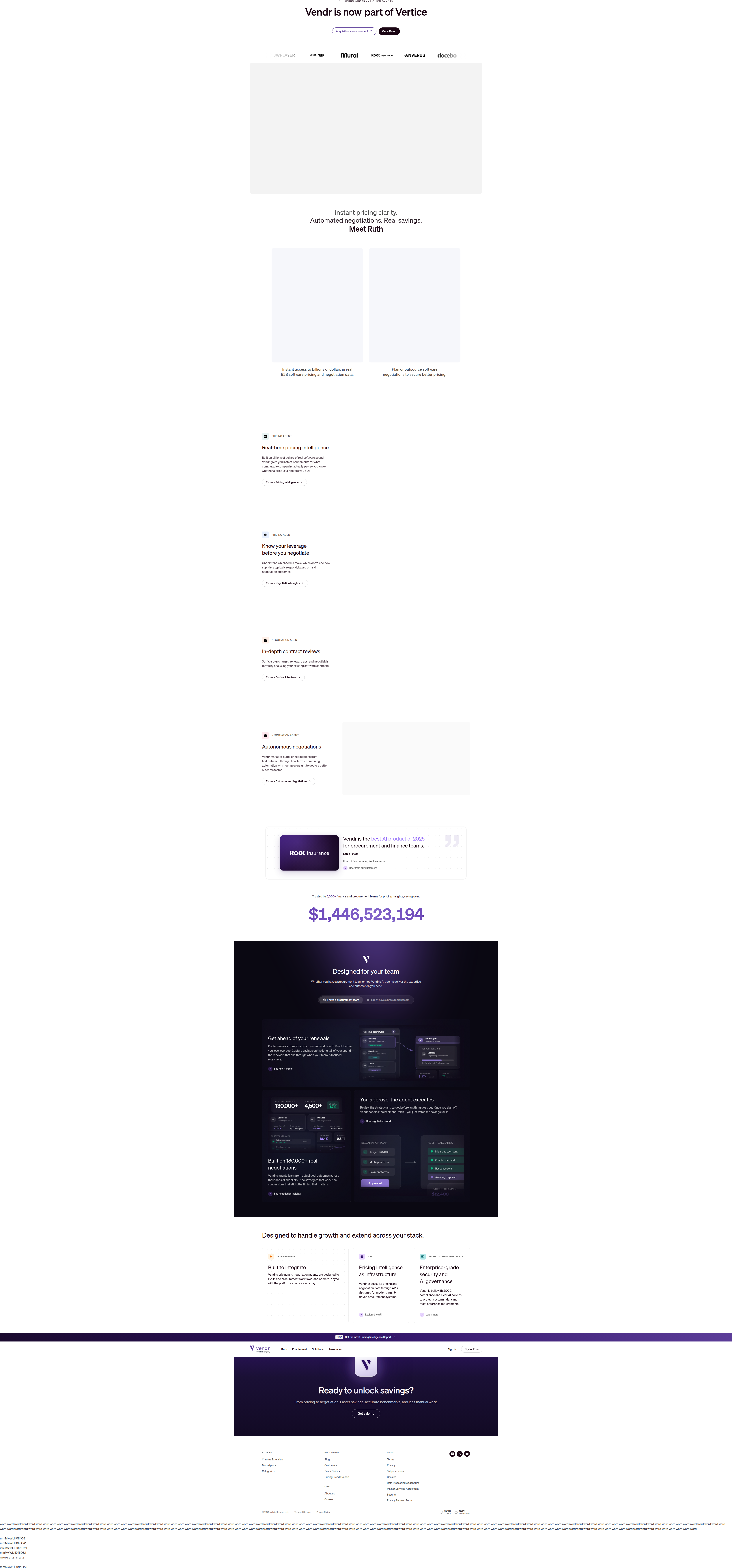
Blissfully's Hero CTA Splits Visitors by Procurement Maturity
Blissfully's homepage hero replaces the single CTA with a two-path self-segmentation question. Here's the math on why that's a smart branching move — and where it can backfire.
Sam Lee
Data Analyst · · Updated
Blissfully (blissfully.com) is running a hero CTA that doesn't ask you to "Get Started." It asks you to pick a side: "I have a procurement team" or "I don't have a procurement team." We flagged this as a rare unique-mechanic pattern — a 70% rarity score across our monitored set of 1,000+ live tests — and it's worth breaking down why a binary self-segmentation question in the hero is a sharper move than it looks.
TL;DR
- Detected on blissfully.com home page hero, logged under category
unique_mechanic - Rarity score: 70% · Importance score: 55% in ABWatcher's detection scoring
- Evidence copy: "I have a procurement team / I don't have a procurement team"
- Mechanic: binary self-selection CTA replacing a single generic CTA, branching downstream messaging by buyer sophistication
- No visible A/B test wrapper detected — appears shipped as a permanent page element, not a live split test
- Pattern sits adjacent to "progressive profiling" and conditional-flow UX, not classic multivariate copy testing
What exactly is Blissfully testing in the hero?
Blissfully isn't running a copy test — it's running a routing decision disguised as a CTA. Instead of one headline and one button serving all traffic, the hero asks visitors to self-identify as procurement-mature or not, and the implication (per our page capture) is that downstream messaging, product framing, or even the demo flow adapts to that answer. This is a branching mechanic, not a wording variant, which is why it scored high on rarity (70%) relative to the thousands of hero sections we scan daily — most of which are still testing headline A vs. headline B.
The segmentation logic maps to a real buyer bifurcation in SaaS management tooling: a mid-market IT lead with no procurement function cares about shadow IT discovery and spend visibility, while an enterprise buyer with a procurement team cares about vendor risk workflows and integration with existing P2P systems. Collapsing both personas into one hero headline forces a lowest-common-denominator message. Splitting them lets Blissfully speak fluently to each from word one — which is exactly the value-prop-matching principle Optimizely's landing page guide flags as step three of landing page optimization: test headline and CTA language that matches the words your visitor already uses to describe their problem.
Is this actually an A/B test, or a permanent UX decision?
Based on our capture, this reads as a shipped design pattern rather than an active split test — we found no variant-swap evidence, which matters for how you interpret it. Unlike the pricing-page tests we typically log with a control/variant pair and a measurable date range, this looks like a committed IA decision: Blissfully chose to permanently fork the hero rather than run it as a 50/50 split. That's a meaningfully different claim than "Blissfully tested this and it won." It means we can't hand you a lift percentage or a confidence interval, because there isn't a reported experiment behind it — only a design choice that implies someone, at some point, validated the idea.
That distinction matters more than it sounds. A permanent branching CTA assumes the segmentation question itself doesn't introduce enough friction to offset the relevance gain. If 1 in 5 visitors bounces at the fork because "I don't know, are we procurement-led or not?" is a harder question than it looks, that's a real tax nobody's measuring without a proper test. Before you ship this on your own hero, the honest move is to A/B the forked version against your current single-CTA hero and watch both overall conversion rate and the bounce rate at the question itself.
What does the research say about self-segmentation CTAs?
Interactive, conditional landing page elements outperform static ones when the segmentation question is low-friction and the payoff is immediate. Heyflow's CRO guide specifically calls out conditional questions and interactive flow as mechanisms to keep visitors engaged rather than let a static page go ignored — the logic being that a static hero is easy to skim past, while a question forces a micro-commitment that increases completion downstream. That's the same psychological lever behind progressive profiling forms and quiz-style lead gen: get a small "yes" early, and larger asks later convert better.
The risk is sample dilution if you're testing this with anything less than solid traffic volume. A binary fork effectively halves your downstream sample per path. If Blissfully's hero sees, say, 20,000 monthly sessions, a clean 50/50 split means each branch is independently optimizing against roughly 10,000 sessions — still enough for a well-powered test at typical SaaS conversion rates (2-5%) to detect a meaningful effect size within 4-6 weeks, but tight enough that under-trafficked clones of this pattern will take months to reach significance on either arm individually.
How does this compare to standard hero CTA patterns?
| Pattern | Mechanic | Typical use case | Rarity in our index |
|---|---|---|---|
| Single generic CTA | "Get Started" / "Book a Demo" | Default for ~85%+ of SaaS homepages we track | Common |
| Headline A/B variant | Same CTA, different value prop copy | Classic multivariate test | Common |
| Segmented CTA (Blissfully) | Visitor self-selects persona, page branches | B2B tools with bifurcated buyer sophistication | 70% rarity |
| Progressive quiz/form | Multi-step conditional questions | Lead-gen heavy funnels (insurance, fintech onboarding) | Moderate |
The takeaway from the table: Blissfully's pattern sits in a thin slice of the distribution. Most teams default to the top row because it's zero-risk; few are confident enough in their persona split to fork the hero itself.
Common questions
Is Blissfully's two-path CTA proven to lift conversion?
No. We have no reported lift percentage, confidence interval, or test duration attached to this detection — it was logged as a design pattern, not a measured experiment. Treat it as a well-reasoned hypothesis worth testing on your own traffic, not a proven win to copy blindly.
Why would a company fork its hero CTA by procurement maturity?
Because buyer sophistication changes what messaging resonates — a procurement-led enterprise buyer and a scrappy IT lead have different vocabularies and pain points. Branching early lets each segment see relevant framing immediately instead of a diluted, average-case headline built to not offend either group.
What's the risk of adding a segmentation question to a hero?
Added friction at the decision point. If visitors don't confidently know which bucket they're in, you introduce a bounce opportunity that didn't exist with a single CTA. Any team testing this should track bounce rate at the fork, not just downstream conversion, to isolate the cost.
How much traffic do you need to test a pattern like this reliably?
Rule of thumb: for a baseline 3% conversion rate and a minimum detectable effect of 15% relative lift, each arm needs roughly 8,000-10,000 sessions for 80% power at p<0.05. Because this pattern forks traffic into two downstream paths, double that if you want each path independently well-powered.
Does this pattern show up anywhere else in CRO research?
It's closely related to interactive, conditional-flow landing pages, which Heyflow's optimization guide and quiz-funnel literature both associate with higher engagement than static pages — though neither source quantifies lift specifically for B2B persona-forking CTAs like Blissfully's.
The takeaway for your roadmap
If your product serves two buyer personas with genuinely different vocabularies and objections, don't just A/B the headline — test whether a branching question at the hero outperforms your single best headline, with bounce-at-the-fork as a guardrail metric alongside downstream conversion. Run it for at least 4 weeks or until each arm clears ~8,000 sessions, whichever is longer, before calling it. A segmentation CTA that looks clever in a screenshot is only a win once you can show the interval around the lift — not before.
Read next
More from the ABWatcher blog
Nov 22, 2026
Snake River Farms Tests a $25-Off Popup on Its Ad Landing Page
We caught Snake River Farms split-testing an email-capture form and $25-off modal on its landing page. Here's the math on what it would take to call a winner.
Nov 21, 2026
Snake River Farms Tests Mid-Page Email Capture on Its Ad Landing Page
SRF is A/B testing a mid-page lead-capture block and a $25-off popup against a simpler hero-only promo banner on its paid landing page, detected 2024 week-over-week.
Nov 20, 2026
Attio Is Testing a New Tier, Higher Prices, and a New Pitch
Attio is running a live pricing page test with a new $1,000 "Ultra" tier, higher Plus/Pro prices, and a new headline — here's what we caught and what it means.
Nov 19, 2026
Found Quietly Tested a 25% Price Cut on Its Pricing Page
We caught Found running a live pricing A/B test with an annual billing toggle that drops Found Plus from $35 to $26.25/mo. Here's what changed and why it matters.
Nov 8, 2026
Astro Proves "Zero Lock-In" With a Live Code Demo, Not a Claim
Astro's homepage replaces a trust badge row with a working, clickable framework demo — here's the hierarchy and interaction design behind it, detected 60% rare on astro.build.
Nov 7, 2026
Basecamp's Big Numbers: Why Hyper-Precise Stats Beat Vague Social Proof
Basecamp's homepage swaps "trusted by thousands" for 1.7 billion to-dos and 5 petabytes of data. We break down why precision beats vagueness as social proof — and how to test it.
From the glossary
Vocabulary the article uses. See all terms →
- Shrinkage Estimator— A statistical adjustment that pulls noisy per-variant or per-segment estimates toward an overall average to reduce overfitting to randomness.
- Flicker Test— A diagnostic check to confirm whether users briefly see the original page before a variant renders in client-side experiments.
- Pre-Experiment Bucketing Audit— A review process confirming users are being randomly and evenly assigned to experiment variants before launch.
- Above-Fold Exclusion Rule— A test-design rule that deliberately prevents changes to above-the-fold elements so an experiment isolates below-the-fold effects.
- Flicker-Free Testing— A technical setup that prevents users from briefly seeing the original page before a test variant loads.
- Orthogonal Test Design— A test structure where multiple variables are changed independently so their individual effects can be measured without interference.
See more like this
ABWatcher catches A/B tests like this across 1,000+ brands.
Watch live experiments at 1,000+ high-converting brands, complete with hypothesis and takeaway. 7 days of Pro, free, no card, then Free forever for ten watched companies.