
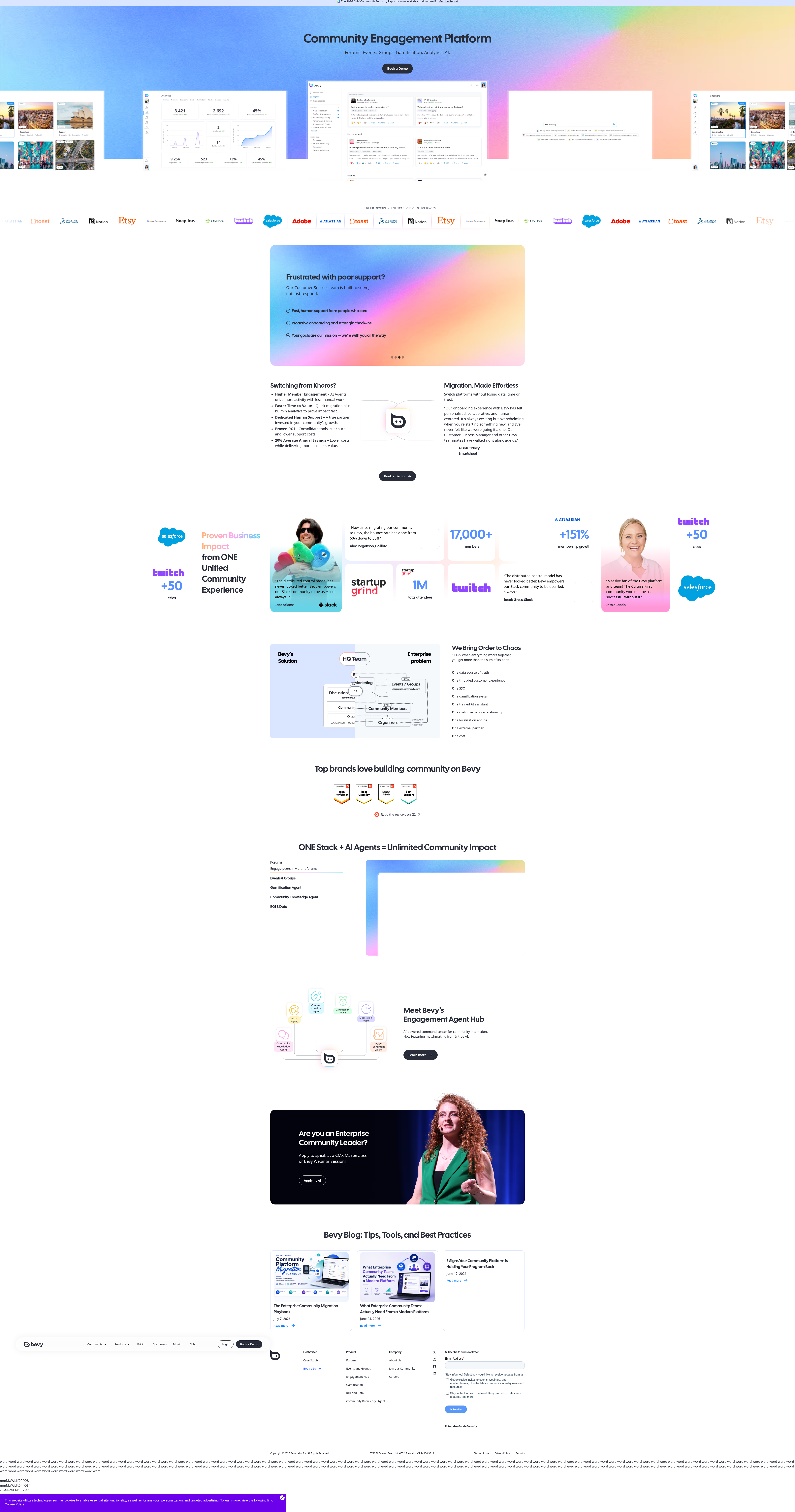
Bevy Named Khoros on Its Homepage. Here's Why That's Rare.
Bevy's homepage runs a "Switching from Khoros?" block with named-competitor proof points — a rare, evidence-backed CRO pattern most teams are too scared to ship.
Jordan Reeves
Founder & Operator · · Updated
Bevy's homepage doesn't play it safe on positioning. Right in the main layout, there's a dedicated section titled "Switching from Khoros?" — not a vague "compare us" link buried in the footer, but a named-competitor migration block sitting in prime real estate, backed by hard numbers.
TL;DR
- Detected on bevy.com homepage, layout surface, category: social proof.
- Section header directly names a competitor: "Switching from Khoros?"
- Cites a specific stat: 20% average annual savings versus the named competitor.
- Pairs the claim with a named customer testimonial about migration ease.
- ABWatcher rarity score: 75% · importance score: 70%.
- Pattern type: direct, evidence-backed comparison rather than generic positioning language.
What exactly did Bevy ship?
Bevy built a homepage module that names Khoros directly and backs the claim with a specific savings figure and a real customer quote. The evidence pulled from the page reads: "Switching from Khoros? ... 20% Average Annual Savings – Lower costs while delivering more business value." This isn't a "compare plans" table hidden three clicks deep — it's front-loaded into the homepage layout, in social-proof territory, right where most SaaS companies put logos and generic testimonials instead.
The block does three things at once: names the competitor, states a differentiated advantage (higher engagement, faster time-to-value), and quantifies it (20% savings). Then it closes the loop with a named customer testimonial specifically about how easy the migration was. That combination — named competitor plus quantified claim plus migration proof — is the part that made this a 75% rarity detection in our system. Most competitive positioning we see across 1,000+ monitored sites stays deliberately vague: "switch from your current platform," "see why teams are moving to us," no names, no numbers.
Why do so few companies name competitors on their homepage?
Legal review, brand caution, and fear of giving competitors free SEO traffic keep most teams from naming names in public-facing copy. Naming a competitor invites three risks teams instinctively want to avoid: a cease-and-desist letter, a stale claim if the competitor repositions, and free brand-search traffic for the competitor's name. I've sat in the exact meeting where legal flags this and marketing waters it down into "switching from your current vendor?" The copy survives review, but it also stops converting the one audience that matters most: people who searched "Khoros alternative" last week and are actively comparing.
That's the tension. Landing page conversion best practices consistently point to specificity and evidence as the levers that move conversion — vague claims don't reduce risk, they just reduce persuasion. Bevy's page is a bet that the SEO and trust upside of naming Khoros outweighs the legal discomfort. Given that this section survived multiple rounds of internal scrutiny to make it to a live homepage, that bet clearly won internally.
Does this kind of comparison actually convert better?
Named, quantified comparisons convert switch-intent visitors better because they answer the exact question in that visitor's head instead of making them infer it. Someone landing on a "Switching from Khoros?" block already has Khoros open in another tab. They're not being educated about a category — they're validating a decision they're already 80% of the way toward. Generic positioning forces that visitor to do translation work ("okay, but how does this actually compare to what I have?"). A named block with a specific savings percentage and a migration testimonial removes that translation step entirely.
This lines up with the core CRO principle that testing and iteration should target the visitor's actual mental state, not an average visitor persona — a point echoed in Unbounce's CRO best-practices guide, which stresses that conversion lifts come from matching page content to visitor intent stage, not from generic polish. A homepage visitor who typed "Khoros vs Bevy" into Google is in a completely different intent stage than someone landing from a brand campaign, and this block is built for exactly the former.
How rare is this pattern across the sites ABWatcher tracks?
Named-competitor comparison blocks with quantified proof points are uncommon; ABWatcher scored this detection at 75% rarity across 1,000+ monitored high-converting sites. Most competitive positioning we log falls into safer, vaguer categories. Here's how this detection compares to the broader pattern landscape we track:
| Comparison approach | Names competitor | Includes quantified claim | Frequency across monitored sites |
|---|---|---|---|
| Generic "switch to us" CTA | No | No | Common |
| Comparison page (linked, not homepage) | Sometimes | Sometimes | Common |
| Homepage social-proof block naming competitor | Yes | Rarely | Rare (this detection: 75th percentile) |
| Named competitor + quantified stat + migration testimonial | Yes | Yes | Very rare |
That bottom row is where Bevy's block sits — the rarest combination we log in this category, and the reason it scored an importance rating of 70% alongside the rarity score.
Common questions
Why did Bevy name Khoros specifically instead of using generic competitor language?
Bevy is likely targeting high-intent search and comparison traffic — people actively evaluating a switch from Khoros. Generic language ("switching platforms?") loses that specific searchable intent and reads as filler copy to a visitor who already has a competitor's name in mind.
Is naming a competitor on a homepage legally risky?
It can be, if claims aren't substantiated or if trademark use isn't handled carefully. The safest version, which Bevy appears to follow, pairs named comparisons with specific, defensible stats (20% savings) and a real customer testimonial rather than unverifiable superiority claims.
Would this pattern work for an early-stage startup with fewer customers?
It works best once you have at least one strong, named migration testimonial to anchor the claim — without that, a named-competitor block can look aggressive rather than credible. Early-stage teams can start with anonymized "switching from [category leader]?" copy and add names once proof exists.
How do I know if my own switch-intent visitors need this kind of page?
Check your search console and paid search terms for competitor-name queries and "[competitor] alternative" traffic. If that volume is meaningful, a dedicated named-comparison section will almost always outperform folding the same claims into generic homepage copy.
What I would actually do next
If you're on a growth or product team choosing between two bets this sprint, don't build a full comparison page first — ship a single homepage or landing-page module, exactly like Bevy's, that names your top switch-intent competitor and backs it with one real number and one real testimonial. Ship it to 50% of paid search traffic on competitor-name terms only, watch it for two weeks, and only then decide if it's worth the legal sign-off to make it permanent. The specificity is the whole point — don't launch it if you can't attach a real stat and a real customer name to it.
Read next
More from the ABWatcher blog
Nov 22, 2026
Snake River Farms Tests a $25-Off Popup on Its Ad Landing Page
We caught Snake River Farms split-testing an email-capture form and $25-off modal on its landing page. Here's the math on what it would take to call a winner.
Nov 21, 2026
Snake River Farms Tests Mid-Page Email Capture on Its Ad Landing Page
SRF is A/B testing a mid-page lead-capture block and a $25-off popup against a simpler hero-only promo banner on its paid landing page, detected 2024 week-over-week.
Nov 20, 2026
Attio Is Testing a New Tier, Higher Prices, and a New Pitch
Attio is running a live pricing page test with a new $1,000 "Ultra" tier, higher Plus/Pro prices, and a new headline — here's what we caught and what it means.
Nov 19, 2026
Found Quietly Tested a 25% Price Cut on Its Pricing Page
We caught Found running a live pricing A/B test with an annual billing toggle that drops Found Plus from $35 to $26.25/mo. Here's what changed and why it matters.
Nov 8, 2026
Astro Proves "Zero Lock-In" With a Live Code Demo, Not a Claim
Astro's homepage replaces a trust badge row with a working, clickable framework demo — here's the hierarchy and interaction design behind it, detected 60% rare on astro.build.
Nov 7, 2026
Basecamp's Big Numbers: Why Hyper-Precise Stats Beat Vague Social Proof
Basecamp's homepage swaps "trusted by thousands" for 1.7 billion to-dos and 5 petabytes of data. We break down why precision beats vagueness as social proof — and how to test it.
From the glossary
Vocabulary the article uses. See all terms →
- Shrinkage Estimator— A statistical adjustment that pulls noisy per-variant or per-segment estimates toward an overall average to reduce overfitting to randomness.
- Flicker Test— A diagnostic check to confirm whether users briefly see the original page before a variant renders in client-side experiments.
- Pre-Experiment Bucketing Audit— A review process confirming users are being randomly and evenly assigned to experiment variants before launch.
- Above-Fold Exclusion Rule— A test-design rule that deliberately prevents changes to above-the-fold elements so an experiment isolates below-the-fold effects.
- Flicker-Free Testing— A technical setup that prevents users from briefly seeing the original page before a test variant loads.
- Orthogonal Test Design— A test structure where multiple variables are changed independently so their individual effects can be measured without interference.
See more like this
ABWatcher catches A/B tests like this across 1,000+ brands.
Watch live experiments at 1,000+ high-converting brands, complete with hypothesis and takeaway. 7 days of Pro, free, no card, then Free forever for ten watched companies.