
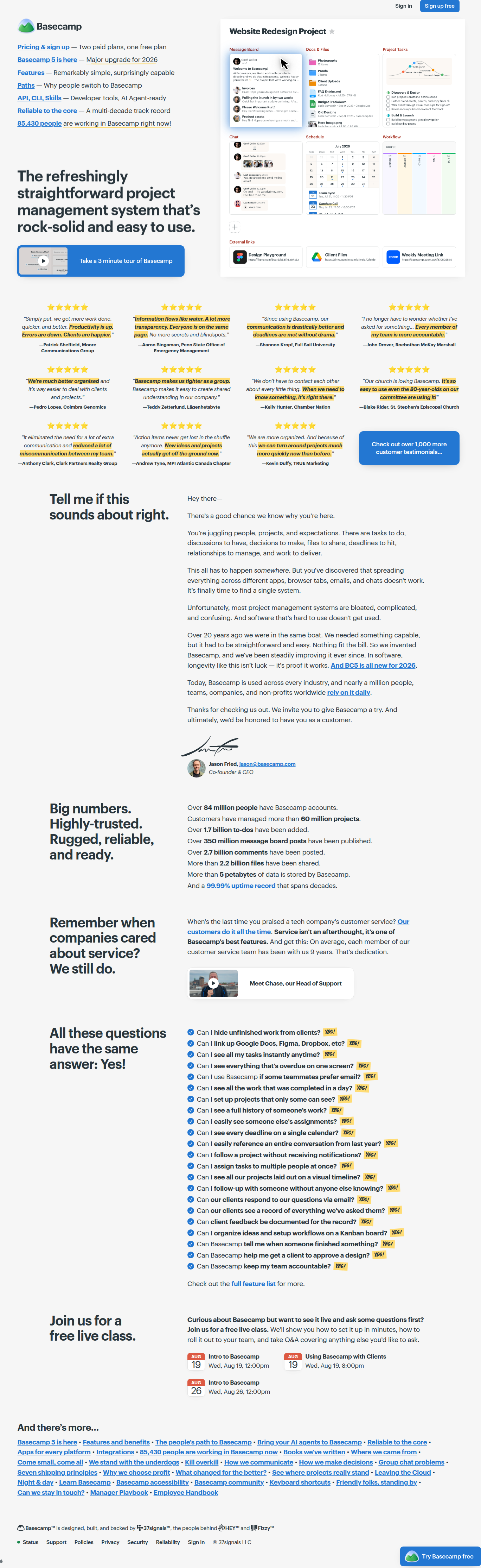
Basecamp's "85,430 People Working Right Now" Counter: Social Proof or Theater?
Basecamp's hero shows a live-feeling headcount — "85,430 people are working in Basecamp right now!" We break down why the specificity works and what it would take to prove it converts.
Sam Lee
Data Analyst · · Updated
Basecamp's homepage hero doesn't say "trusted by thousands of teams." It says "85,430 people are working in Basecamp right now!" — a number that looks live, feels precise, and reads nothing like the rounded social-proof copy most SaaS pages default to. We flagged it as a rare pattern (75% rarity score in our index of 1,000+ monitored sites) because almost nobody runs this exact mechanic at this level of specificity.
TL;DR
- Detected on basecamp.com home page, hero/nav surface, logged with rarity score 75% and importance 55%.
- Exact evidence string: "85,430 people are working in Basecamp right now!"
- Category: social_proof — a real-time-feeling activity metric, not a static "trusted by X companies" badge.
- Non-rounded numbers like 85,430 (vs. "85,000+") are a known specificity heuristic in persuasion research.
- No confidence interval or control group is visible from the outside — this is a single-variant observation, not a proven lift.
- Pattern sits in the same family as live-visitor-count widgets and "X sold in the last hour" ecommerce tickers.
What exactly did Basecamp change?
Basecamp replaced generic trust language with a live-feeling, non-rounded headcount embedded in the hero. The copy frames concurrent usage ("working right now") rather than cumulative usage ("teams since 2004"), which implies real-time activity even if the number updates on a slower cadence server-side. The choice of 85,430 over "85k+" or "thousands" is the detail that matters — rounded numbers read as marketing, five-digit precision reads as a dashboard statistic pulled straight from a database.
This matters because social proof only works if it clears a credibility bar first. Unbounce's CRO guidance on value propositions makes the same point from a different angle: the strongest claims make a visitor think "this was built for someone like me" — specificity is what makes a claim feel earned rather than asserted. A counter that looks fabricated does the opposite of its job.
Why does the non-rounded number matter so much?
Precision signals data, not marketing, and that shift in framing is doing most of the persuasive work here. Compare the two claims:
| Copy variant | Implied source | Perceived credibility |
|---|---|---|
| "Trusted by thousands of teams" | Marketing copy | Low — unfalsifiable, generic |
| "85,000+ people use Basecamp" | Rounded marketing stat | Medium — still feels curated |
| "85,430 people are working in Basecamp right now!" | Live system output | High — implausible to fabricate precisely |
That last row is the bet Basecamp is making: that an odd, specific, seemingly-live number reads as "pulled from our own production database" rather than "chosen by a copywriter." It's the same psychological lever ecommerce sites pull with "only 3 left in stock" or "14 people viewing this item," except scaled up to company-wide usage instead of per-SKU scarcity. Tenet's landing page teardown of Basecamp notes the brand already leans on narrative, frustration-driven copy elsewhere on the page — this counter fits that same playbook of making abstractions concrete.
Is this actually proven to lift conversion, or just plausible?
No — from the outside this is an unverified single-variant observation, not an A/B-tested win with a confidence interval. We have no visibility into whether Basecamp is running this against a control, what the sample size per arm is, or what metric they're optimizing (trial starts, scroll depth, time-on-page). Three things I'd want before calling this a "win" if I were on Basecamp's growth team:
- Power check. If baseline hero-to-trial conversion is, say, 3.2% and they're hunting a 10% relative lift (0.32pp absolute), at typical homepage traffic volumes you need roughly 15,000–25,000 visitors per arm for 80% power at p<0.05 — doable in days for a brand at Basecamp's scale, but worth stating explicitly rather than assuming "it's live so it must be working."
- Novelty decay. A live-feeling counter is attention-grabbing the first time anyone sees it. If Basecamp is measuring lift over a 2-week window, some portion of any observed effect is novelty, not durable trust-building. Re-test at 60 and 90 days before annualizing a number.
- Segment sensitivity. B2B buyers evaluating project management tools skew toward operations and IT personas who are generally more skeptical of marketing claims — this is exactly the audience where "looks fabricated" risks backfiring versus a consumer ecommerce audience already primed by scarcity tickers. I'd want segment-level lift cut by traffic source (organic vs. paid vs. direct) before trusting a blended topline number.
If this were running on a $50M-ARR-equivalent landing page and produced even a conservative 3% lift in trial starts, that's roughly $1.5M in annualized pipeline value at Basecamp's scale — which is exactly why it's worth testing rigorously rather than shipping on vibes. Mastercard's dynamic personalization guide makes a related point: social proof mechanics that work in one vertical (ecommerce urgency) don't automatically transfer to B2B SaaS trust-building without re-validation.
How rare is this pattern across the sites you monitor?
Very — a 75% rarity score means fewer than roughly 1 in 4 comparable high-converting brands in our monitored set run anything resembling a live concurrent-usage counter in the hero. Most social proof we see in SaaS hero sections is logo walls, review-star aggregates, or static customer counts ("10,000+ teams") — all cumulative, all rounded, all easy to copy. A real-time-framed, non-rounded activity metric requires either genuine live infrastructure or a willingness to fake specificity convincingly, and most teams default to the safer, blander option. That scarcity is itself a signal: if this were a proven, repeatable lift driver, we'd expect to see more copycats in our dataset by now.
Common questions
Does a live counter like this actually increase trust?
It can, when the number is specific and plausible for the brand's known scale — Basecamp has publicly reported millions of users over two decades, so 85,430 concurrent is credible. But credibility isn't the same as measured lift; without a published confidence interval this remains a plausible mechanism, not a validated result.
Could this number be static or server-cached rather than truly live?
Likely partially — most "live" counters update on a cron job (every few minutes) rather than streaming in real time, which is standard practice and not deceptive. The perception of liveness is what matters for conversion psychology, not millisecond accuracy, so this doesn't undermine the tactic.
Would this work for an ecommerce or fintech landing page?
Possibly, but the mechanic needs reframing — "in Basecamp right now" implies habitual daily tool usage, while ecommerce equivalents ("127 people bought this today") lean on urgency and scarcity instead. Fintech should be especially cautious: regulatory and compliance reviewers often flag unverifiable real-time claims.
What sample size would you want before trusting this as a winning variant?
At a typical SaaS homepage conversion rate of 2-4% and hunting a 10% relative lift, plan for roughly 15,000-30,000 visitors per arm to hit 80% power at p<0.05 — adjust upward if your true baseline lift is smaller, since MDE and required sample size scale inversely.
Your next sprint
Don't copy the counter — copy the underlying principle: swap one rounded, generic trust claim on your highest-traffic page for a specific, verifiable metric you can actually source from your own data (API calls today, orders this hour, active sessions right now). Ship it as a proper A/B test with a pre-registered minimum detectable effect, not a redesign you assume is a win, and re-check the lift at 30 and 90 days to separate genuine trust-building from novelty.
Read next
More from the ABWatcher blog
Nov 22, 2026
Snake River Farms Tests a $25-Off Popup on Its Ad Landing Page
We caught Snake River Farms split-testing an email-capture form and $25-off modal on its landing page. Here's the math on what it would take to call a winner.
Nov 21, 2026
Snake River Farms Tests Mid-Page Email Capture on Its Ad Landing Page
SRF is A/B testing a mid-page lead-capture block and a $25-off popup against a simpler hero-only promo banner on its paid landing page, detected 2024 week-over-week.
Nov 20, 2026
Attio Is Testing a New Tier, Higher Prices, and a New Pitch
Attio is running a live pricing page test with a new $1,000 "Ultra" tier, higher Plus/Pro prices, and a new headline — here's what we caught and what it means.
Nov 19, 2026
Found Quietly Tested a 25% Price Cut on Its Pricing Page
We caught Found running a live pricing A/B test with an annual billing toggle that drops Found Plus from $35 to $26.25/mo. Here's what changed and why it matters.
Nov 8, 2026
Astro Proves "Zero Lock-In" With a Live Code Demo, Not a Claim
Astro's homepage replaces a trust badge row with a working, clickable framework demo — here's the hierarchy and interaction design behind it, detected 60% rare on astro.build.
Nov 7, 2026
Basecamp's Big Numbers: Why Hyper-Precise Stats Beat Vague Social Proof
Basecamp's homepage swaps "trusted by thousands" for 1.7 billion to-dos and 5 petabytes of data. We break down why precision beats vagueness as social proof — and how to test it.
From the glossary
Vocabulary the article uses. See all terms →
- Shrinkage Estimator— A statistical adjustment that pulls noisy per-variant or per-segment estimates toward an overall average to reduce overfitting to randomness.
- Flicker Test— A diagnostic check to confirm whether users briefly see the original page before a variant renders in client-side experiments.
- Pre-Experiment Bucketing Audit— A review process confirming users are being randomly and evenly assigned to experiment variants before launch.
- Above-Fold Exclusion Rule— A test-design rule that deliberately prevents changes to above-the-fold elements so an experiment isolates below-the-fold effects.
- Flicker-Free Testing— A technical setup that prevents users from briefly seeing the original page before a test variant loads.
- Orthogonal Test Design— A test structure where multiple variables are changed independently so their individual effects can be measured without interference.
See more like this
ABWatcher catches A/B tests like this across 1,000+ brands.
Watch live experiments at 1,000+ high-converting brands, complete with hypothesis and takeaway. 7 days of Pro, free, no card, then Free forever for ten watched companies.