
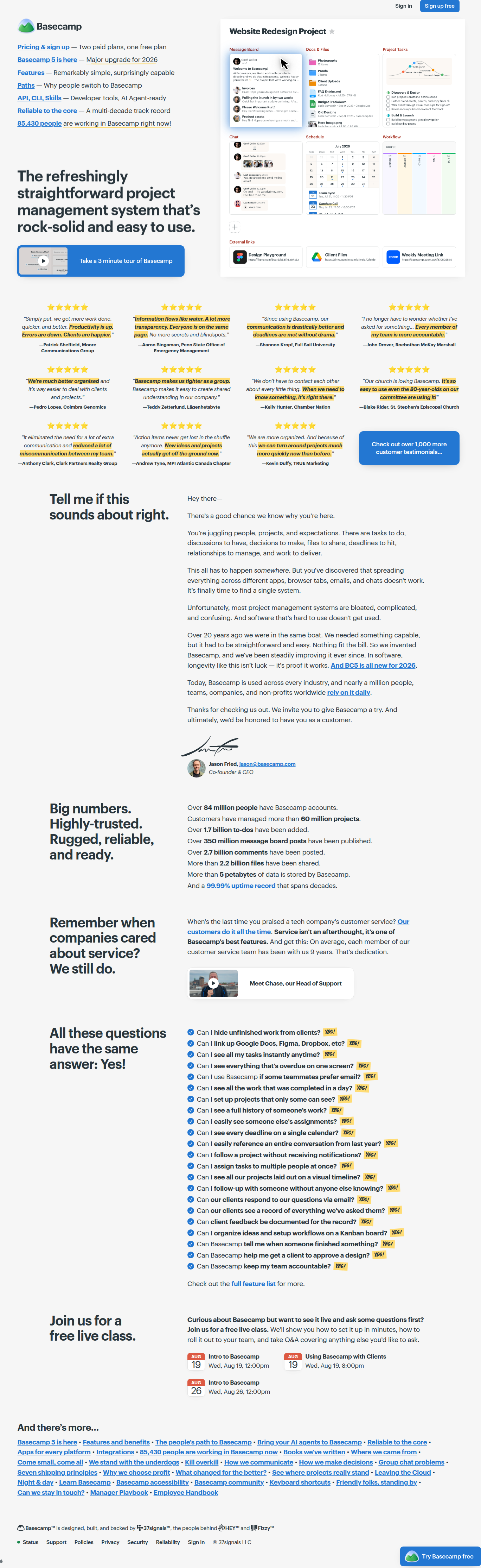
Basecamp Puts the CEO's Real Email on Its Homepage
Basecamp swapped generic "About Us" copy for a signed letter from CEO Jason Fried with his real email address — here's what that contrarian trust play means for your CRO roadmap.
Maya Patel
Senior CRO Strategist · · Updated
TL;DR
- Detection: Basecamp's homepage runs a first-person letter signed by CEO Jason Fried, logged 2026 in ABWatcher's contrarian pattern set.
- Exposed contact: the signature block reads "Jason Fried, jason@basecamp.com — Co-founder & CEO."
- Surface: copy, page type: home — no form field, no gated CTA, just static trust copy.
- Rarity score: 85 out of 100 — one of the least-replicated patterns we track across 1,000+ monitored brands.
- Importance score: 50 out of 100 — high novelty, moderate expected funnel impact.
- Category: contrarian — it inverts the standard "About Us" convention rather than optimizing within it.
What did Basecamp actually change on its homepage?
Basecamp replaced typical corporate "About Us" boilerplate with a signed personal letter from co-founder and CEO Jason Fried, closing with his direct email address. The evidence quote we pulled — "Jason Fried, jason@basecamp.com — Co-founder & CEO" — sits where most SaaS homepages place a leadership photo grid or a mission-statement paragraph. There's no ticketing system, no "contact sales" form, no obfuscated support alias. Just a name, a real inbox, and a title. The copy reads as unscripted, first-person, and accountable in a way that most public company pages actively avoid.
Why does exposing a CEO's email count as a CRO move?
It functions as an implicit risk-reversal mechanic — it tells visitors a real person is accountable for what happens after they click. Classic conversion theory treats risk reversal as a bottom-funnel lever: money-back guarantees, free trials, cancel-anytime language. Basecamp applies the same psychological mechanic to trust formation at the top of the funnel, before a visitor has even considered the product. The message implicit in "email the CEO" is: nothing here is hidden behind a support queue, and if this software disappoints you, escalation isn't theoretical. That's a stronger trust signal than a testimonial carousel, because it's falsifiable — a visitor can test it immediately by sending an email.
This matters because most landing page guidance pushes teams toward standardization, not personalization at the leadership level. Landing page optimization best practices generally recommend continuous, proactive testing cycles rather than one-off statements of belief — and a CEO's personal letter is inherently a one-off, hard to A/B test in the traditional sense. Basecamp appears to be trading test velocity for brand differentiation, which is a legitimate tradeoff but not one every team can afford to make.
Does this actually move conversion, or is it a branding flex?
Best treated as a trust-and-differentiation play, not a direct conversion lever — expect it to affect qualified inbound and brand recall more than raw CTA click-through. Standard landing page doctrine says to strip everything that doesn't support the primary conversion goal — remove navigation, keep one CTA, repeat it above the fold. A personal letter with no CTA violates that doctrine on its face. But Basecamp isn't running paid acquisition funnels that need message-match discipline the way a PPC landing page does — ad-to-page message mismatch is the single biggest driver of the 97% no-conversion rate on paid clicks, a dynamic that barely applies to organic, brand-driven homepage traffic. This is a homepage functioning as a manifesto, not a conversion funnel entry point, which changes what "success" looks like.
How should teams score a pattern like this using ICE or PIE?
Score it as high Confidence on trust, low Reach in isolation, and treat Risk as the real constraint most teams underweight.
| Framework dimension | Assessment for this pattern | Why |
|---|---|---|
| Impact / Confidence | Medium-high | Personal accountability signals correlate with trust in high-consideration B2B purchases |
| Reach / Influence | Low-medium | Only affects homepage visitors who read past the fold — not most traffic |
| Ease / Effort | Low | No engineering lift; it's a copy and legal-risk decision, not a build |
| Risk | High | Exposes a named executive to spam, support load, and scale problems past a certain traffic tier |
The honest read: this scores well on ICE's "Ease" axis and reasonably on "Confidence," but most orgs stall on "Risk" — legal and support teams will flag inbox flooding long before marketing finishes the copy draft. That's likely why this pattern shows an 85 rarity score: the upside is real but narrow, and the downside (a CEO's inbox becoming a de facto support channel) scales badly for high-traffic brands.
Which brands could reasonably copy this pattern, and which shouldn't?
Founder-led B2B software and services brands under a few million monthly visitors are the best fit; high-traffic consumer or regulated fintech brands are the worst fit. Basecamp has spent over a decade building a public-founder brand through books, blog essays, and Fried's personal Twitter/X presence — the email works because it's consistent with everything else on the site, not because it's a standalone tactic. A fintech or healthcare brand bolting a CEO email onto an otherwise corporate homepage would create a trust mismatch, not close one. As with most landing page personalization strategies, the recommendation is to build the broadly-tested version first, then layer in identity-driven differentiation only where the brand voice already supports it.
Common questions
Is putting a CEO's real email on a homepage a proven conversion tactic?
Not in the traditional statistically-tested sense. It's a trust and brand-differentiation signal rather than a CTA-driven conversion lever, so standard A/B conversion-rate metrics won't capture its full effect — track brand search lift and inbound email sentiment instead.
What's the main risk of exposing an executive's email publicly?
Volume. As traffic scales, a public CEO email becomes a support channel by default, which creates triage overhead and potential response-time expectations the company didn't intend to set. Teams should model expected inbound volume before shipping this pattern.
Can this pattern be A/B tested like a normal headline or CTA?
Poorly. A signed personal letter is qualitative and identity-bound, making it hard to isolate as a single variable. Most teams should treat it as a brand bet validated through qualitative signals (support tickets, sales mentions, social sentiment) rather than a split-test hypothesis.
Why did ABWatcher flag this as "contrarian" rather than "best practice"?
Because it deliberately breaks landing page conventions — no CTA repetition, no stripped navigation, no message-match discipline — that dominate current landing page guidance. Its 85% rarity score reflects how few of the 1,000+ monitored brands run anything comparable.
Takeaway for your next sprint
Don't copy the tactic literally — audit your own homepage for where "corporate distance" copy could be replaced with a specific, named, accountable voice, then pressure-test the support-volume risk with your CS team before you ship it. Run it as a qualitative brand experiment with a defined review window, not a revenue-metric A/B test.
Read next
More from the ABWatcher blog
Nov 22, 2026
Snake River Farms Tests a $25-Off Popup on Its Ad Landing Page
We caught Snake River Farms split-testing an email-capture form and $25-off modal on its landing page. Here's the math on what it would take to call a winner.
Nov 21, 2026
Snake River Farms Tests Mid-Page Email Capture on Its Ad Landing Page
SRF is A/B testing a mid-page lead-capture block and a $25-off popup against a simpler hero-only promo banner on its paid landing page, detected 2024 week-over-week.
Nov 20, 2026
Attio Is Testing a New Tier, Higher Prices, and a New Pitch
Attio is running a live pricing page test with a new $1,000 "Ultra" tier, higher Plus/Pro prices, and a new headline — here's what we caught and what it means.
Nov 19, 2026
Found Quietly Tested a 25% Price Cut on Its Pricing Page
We caught Found running a live pricing A/B test with an annual billing toggle that drops Found Plus from $35 to $26.25/mo. Here's what changed and why it matters.
Nov 8, 2026
Astro Proves "Zero Lock-In" With a Live Code Demo, Not a Claim
Astro's homepage replaces a trust badge row with a working, clickable framework demo — here's the hierarchy and interaction design behind it, detected 60% rare on astro.build.
Nov 7, 2026
Basecamp's Big Numbers: Why Hyper-Precise Stats Beat Vague Social Proof
Basecamp's homepage swaps "trusted by thousands" for 1.7 billion to-dos and 5 petabytes of data. We break down why precision beats vagueness as social proof — and how to test it.
From the glossary
Vocabulary the article uses. See all terms →
- Shrinkage Estimator— A statistical adjustment that pulls noisy per-variant or per-segment estimates toward an overall average to reduce overfitting to randomness.
- Flicker Test— A diagnostic check to confirm whether users briefly see the original page before a variant renders in client-side experiments.
- Pre-Experiment Bucketing Audit— A review process confirming users are being randomly and evenly assigned to experiment variants before launch.
- Above-Fold Exclusion Rule— A test-design rule that deliberately prevents changes to above-the-fold elements so an experiment isolates below-the-fold effects.
- Flicker-Free Testing— A technical setup that prevents users from briefly seeing the original page before a test variant loads.
- Orthogonal Test Design— A test structure where multiple variables are changed independently so their individual effects can be measured without interference.
See more like this
ABWatcher catches A/B tests like this across 1,000+ brands.
Watch live experiments at 1,000+ high-converting brands, complete with hypothesis and takeaway. 7 days of Pro, free, no card, then Free forever for ten watched companies.