
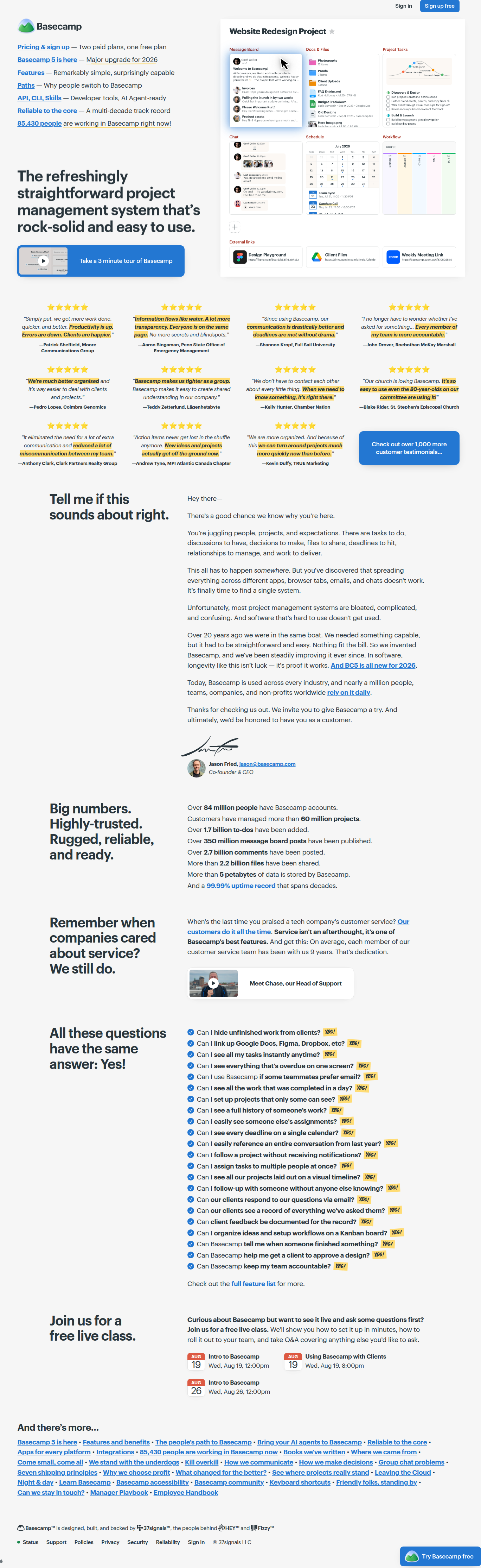
Basecamp Put a Named Human on Its Support Trust Badge
Basecamp swapped the generic support badge for a named Head of Support video with a 9-year tenure stat. Here's why that contrarian social proof move actually works.
Diego Hernandez
Growth Marketer · · Updated
TL;DR
- Detected on basecamp.com homepage, social proof surface, contrarian category.
- Rarity score: 65%. Importance score: 40%.
- Copy on page: "Remember when companies cared about service? We still do."
- Named support lead "Chase" appears in an actual video, not a stock headshot.
- Stat used as proof: customer service team members average 9 years of tenure.
- Replaces the usual live-chat widget or "24/7 support" badge most SaaS homepages default to.
What exactly did Basecamp change on its homepage?
Basecamp replaced generic support signaling with a named, on-camera Head of Support and a tenure stat. Instead of a chat bubble icon or "award-winning support" badge, visitors get a real face: Chase, introduced by name, backed by the claim that the team sticks around for 9 years on average.
The contrarian hook does the heavy lifting first. "Remember when companies cared about service? We still do." That's a jab at every SaaS company running outsourced, high-turnover support queues. Then Basecamp backs the jab with a person, not a platitude.
Most teams optimize this section by adding more trust logos or a chat widget. Basecamp went the opposite direction — fewer icons, one human.
Takeaway: a specific face beats a generic badge every time you're selling trust.
Why does a named support lead work better than a trust badge?
A named employee with a tenure stat is harder to fake and easier to remember than any icon or logo. Trust badges are mentally filtered out — visitors have seen "Verified," "Secure," and "5-Star Rated" badges thousands of times across the web. They're wallpaper. A video of an actual person saying their name and their track record interrupts that pattern.
This lines up with what landing page research keeps finding: narrative and specificity outperform generic claims. Tenet's landing page breakdown points out that Basecamp already leans hard into storytelling elsewhere on the page, positioning itself as the brand people land on after they've tried and abandoned other tools. The support video is the same playbook applied to a different section — turn an abstract promise into a specific, emotionally resonant moment.
Generic support badges answer "do you have support?" The named video answers "will this person actually help me?" Only one of those questions is what buyers are really asking.
Takeaway: if your trust signal could be copy-pasted onto a competitor's site, it's not a trust signal — it's decoration.
How rare is this pattern across the sites we track?
Named-employee video proof on a homepage trust section is uncommon — most brands default to logos, stats, or widgets instead. We scored this detection at 65% rarity and 40% importance, which tells you two things. It's not something you'll see on every tenth homepage audit. But it's also not a page-one conversion lever — it's a trust-layer tactic, not a CTA or pricing test.
Here's how this surface typically gets handled across the home pages we monitor:
| Social proof tactic on homepage | Common? | Example signal |
|---|---|---|
| Customer logo wall | Very common | Static logos, no names |
| "24/7 support" badge or chat widget | Very common | Icon + generic copy |
| Aggregate review score (G2, Trustpilot) | Common | Star rating + count |
| Named employee video with tenure stat | Rare | Basecamp's Chase, 9-year stat |
The rarity is the story here. Hundreds of companies run A/B tests tweaking headline copy or button color on this surface. Almost none test replacing the support badge with a human being.
Takeaway: when a tactic is rare but not high-importance, it's a good candidate for a low-risk experiment — not a full page overhaul.
Should your team test this on your own homepage?
Test it if your support team is actually a differentiator — don't fake tenure stats you don't have. This tactic only works because Basecamp can back the claim. If your support team churns every 8 months, a named-employee video will backfire the moment someone checks LinkedIn.
If you do have a real retention story, the lift here is cheap to test. You don't need a full production shoot — a 30-second selfie-style video from your actual support lead, with one honest stat, can replace a badge this sprint. Unbounce's CRO best practices consistently flag specificity and credibility signals as higher-leverage than aesthetic polish, and this is about as specific as social proof gets.
Run it as an A/B test against your current badge or widget, not as a blind swap. Measure scroll depth past the support section and whether support-related support-page bounce drops. That's your signal, not just raw conversion.
Takeaway: this is a one-sprint test, not a redesign — ship the human, measure engagement past that section, and kill it if the stat doesn't hold up under scrutiny.
Common questions
What section of the Basecamp homepage was this detected on?
It was detected in the social proof section of the basecamp.com homepage, the area typically reserved for trust badges, review scores, or support widgets. Basecamp used it instead for a named Head of Support video with a tenure claim.
Why is this classified as "contrarian" rather than standard social proof?
The copy directly challenges industry norms — "Remember when companies cared about service?" implies most competitors don't. That's a direct dig at the category, not a neutral trust claim, which is why it's tagged contrarian rather than standard social proof.
Is a 65% rarity score high or low compared to other detections?
It's moderate-to-high. Most homepage tactics we track score below 50% rarity because they're widely copied patterns like logo walls or star ratings. A 65% score means fewer than roughly a third of comparable brands run this specific tactic.
Can smaller DTC or SaaS brands copy this without a big production budget?
Yes — the format doesn't require polish, it requires honesty. A short, unscripted video from a real support lead with an accurate stat will outperform a generic badge, even shot on a phone. The credibility comes from specificity, not production value.
What's the risk if the tenure or team stat isn't accurate?
High risk. This tactic trades on verifiability — a visitor can check LinkedIn or leave a support ticket and find out fast if the claim is inflated. A false tenure stat turns a trust-builder into a credibility hit, which is worse than running no claim at all.
This sprint's move: audit your own support-section social proof. If it's a badge or widget, swap one experiment in with a named, real person and a stat you can actually defend. Ship it, measure engagement past that fold, and report back.
Read next
More from the ABWatcher blog
Nov 22, 2026
Snake River Farms Tests a $25-Off Popup on Its Ad Landing Page
We caught Snake River Farms split-testing an email-capture form and $25-off modal on its landing page. Here's the math on what it would take to call a winner.
Nov 21, 2026
Snake River Farms Tests Mid-Page Email Capture on Its Ad Landing Page
SRF is A/B testing a mid-page lead-capture block and a $25-off popup against a simpler hero-only promo banner on its paid landing page, detected 2024 week-over-week.
Nov 20, 2026
Attio Is Testing a New Tier, Higher Prices, and a New Pitch
Attio is running a live pricing page test with a new $1,000 "Ultra" tier, higher Plus/Pro prices, and a new headline — here's what we caught and what it means.
Nov 19, 2026
Found Quietly Tested a 25% Price Cut on Its Pricing Page
We caught Found running a live pricing A/B test with an annual billing toggle that drops Found Plus from $35 to $26.25/mo. Here's what changed and why it matters.
Nov 8, 2026
Astro Proves "Zero Lock-In" With a Live Code Demo, Not a Claim
Astro's homepage replaces a trust badge row with a working, clickable framework demo — here's the hierarchy and interaction design behind it, detected 60% rare on astro.build.
Nov 7, 2026
Basecamp's Big Numbers: Why Hyper-Precise Stats Beat Vague Social Proof
Basecamp's homepage swaps "trusted by thousands" for 1.7 billion to-dos and 5 petabytes of data. We break down why precision beats vagueness as social proof — and how to test it.
From the glossary
Vocabulary the article uses. See all terms →
- Shrinkage Estimator— A statistical adjustment that pulls noisy per-variant or per-segment estimates toward an overall average to reduce overfitting to randomness.
- Flicker Test— A diagnostic check to confirm whether users briefly see the original page before a variant renders in client-side experiments.
- Pre-Experiment Bucketing Audit— A review process confirming users are being randomly and evenly assigned to experiment variants before launch.
- Above-Fold Exclusion Rule— A test-design rule that deliberately prevents changes to above-the-fold elements so an experiment isolates below-the-fold effects.
- Flicker-Free Testing— A technical setup that prevents users from briefly seeing the original page before a test variant loads.
- Orthogonal Test Design— A test structure where multiple variables are changed independently so their individual effects can be measured without interference.
See more like this
ABWatcher catches A/B tests like this across 1,000+ brands.
Watch live experiments at 1,000+ high-converting brands, complete with hypothesis and takeaway. 7 days of Pro, free, no card, then Free forever for ten watched companies.