
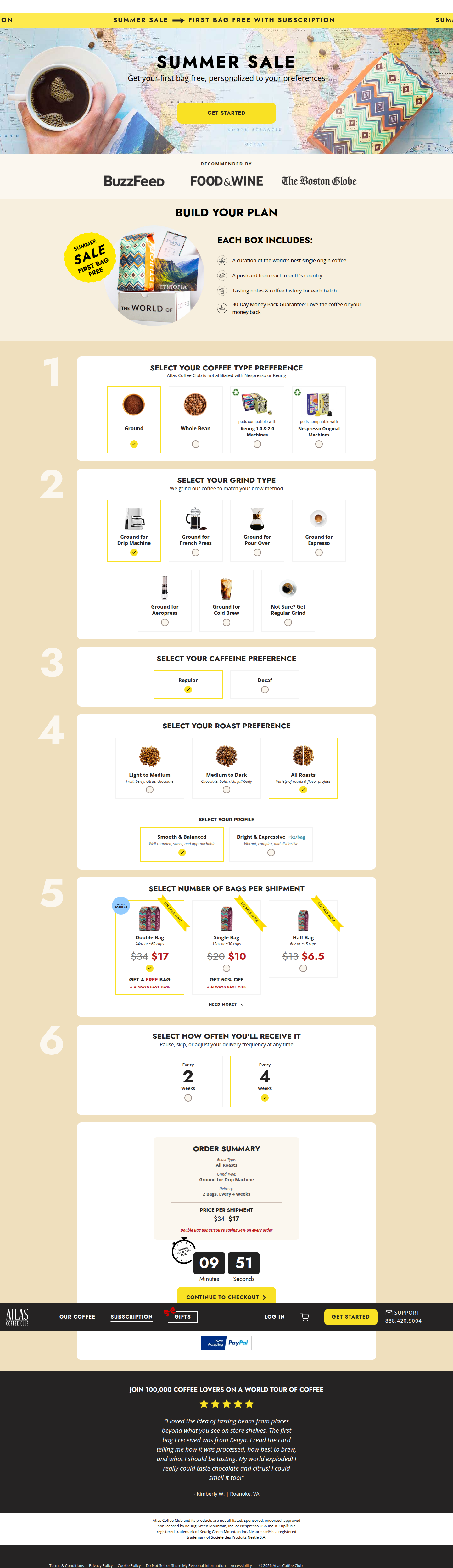
Atlas Coffee Club Tests Email Capture vs. Testimonial in Footer CTA
Atlas Coffee Club is running a live A/B test swapping a testimonial block for a "first bag free" email capture below checkout. Here's what the data shows.
Maya Patel
Senior CRO Strategist · · Updated
TL;DR
- Detected 80% confidence live A/B test on Atlas Coffee Club's subscription landing page, flagged via same-run variance.
- Page tested:
atlascoffeeclub.com/collections/coffee-subscription-service?brew=drip_machine. - Variant A: email-capture block — "TRY THE CLUB / Your first bag free" with email field and yellow CTA button.
- Variant B: 5-star customer testimonial from Kimberly W., Roanoke VA, in the identical footer slot below checkout.
- Same Chrome browser engine served both variants across visits 2 and 5, confirming genuine cookie-bucketed test, not a rendering artifact.
- Surface under test: the social-proof/CTA module directly beneath the checkout module — high-visibility, bottom-of-funnel real estate.
What did Atlas Coffee Club actually change?
Atlas Coffee Club is running a footer-level test that pits a lead-capture offer against a customer testimonial in the same slot below checkout. One bucket sees a bright yellow "TRY THE CLUB — your first bag free" module with an email field; the other sees a star-rated quote from a named customer (Kimberly W., Roanoke, VA). Everything else on the page — the checkout module above it, the surrounding layout — appears constant. This is a single-variable swap on one module, which makes it a clean read if Atlas is tracking the right downstream metric.
Our detection method, same-run variance, flagged this because two visits on identical browser engines (Chrome) rendered different content in the same DOM position. That rules out a device-rendering quirk and points to cookie-based bucketing — a real, live experiment rather than noise.
Why would a brand test social proof against a lead magnet in the same slot?
The two variants serve fundamentally different jobs in the funnel, and that's the strategic tension worth naming before picking a winner. A testimonial is a trust signal — it answers "will this actually be good?" for a visitor who has scrolled past checkout already primed to convert. An email-capture block is a lead-recovery mechanism — it assumes some visitors will bounce without buying and tries to keep the door open with a discount hook ("first bag free").
Running an ICE (Impact, Confidence, Ease) lens over this: Impact is moderate-to-high because footer placement below checkout still catches a meaningful slice of scrollers on subscription pages, particularly on mobile where checkout modules are visually dense. Confidence is medium — social proof has a long track record of lifting conversion, but only when it's specific and not just decorative. Ease is high; this is a single component swap, cheap to run and cheap to revert.
One CRO practitioner running a similar diagnosis on Atlas Coffee Club specifically found that removing social proof and trimming copy improved conversion — the logic being less cognitive load, not more reassurance, was the lift driver. That's a useful counter-hypothesis to anyone assuming testimonials always win by default.
Does social proof placement actually move conversion at this stage of the funnel?
Social proof reliably lifts conversion, but placement and specificity determine whether it helps or just adds clutter. Research aggregating thousands of social proof A/B tests makes the case that social proof performs best when it's integrated into the broader conversion narrative — not bolted on as decoration. A single testimonial after checkout is a weaker signal than proof woven earlier into the consideration stage, where it's answering objections before the visitor reaches the payment fields.
That's the risk half of a Confidence-Lift-Risk framework here: post-checkout testimonial placement may be too late to influence the buying decision, and could instead be competing for attention with a recovery mechanism (email capture) that has a clearer, more measurable job — building a remarketable list.
What should teams watch for in this kind of test?
The metric Atlas is optimizing for determines which variant should win, and that's the detail outside signals can't confirm. If the primary KPI is checkout completion rate, the testimonial's job is reassurance at the point of final commitment — arguably redundant if checkout already converted the visitor's intent. If the KPI is total funnel capture (including abandoners), the email-capture block does more strategic work by converting a "no" into a "maybe later."
Here's a quick comparison of what each variant is structurally built to do:
| Variant | Primary mechanism | Best KPI to judge it by | Funnel stage served |
|---|---|---|---|
| Testimonial (Kimberly W., 5-star) | Trust reinforcement | Checkout completion rate | Bottom-of-funnel, post-decision |
| Email capture ("first bag free") | Lead recovery / discount hook | Email capture rate, list growth, recovered conversions | Exit-intent / abandonment |
Teams monitoring this test should segment results by device and traffic source. Subscription commerce brands like Atlas — see their own positioning as a top-rated coffee subscription with global micro-lot sourcing — tend to see higher intent-to-browse ratios from earned media and reviews (e.g., third-party reviews like Taste of Home's), meaning visitors arriving with pre-formed trust may respond differently to a testimonial than cold paid traffic still evaluating the offer.
Common questions
What is same-run variance detection?
Same-run variance is a method for identifying live A/B tests by comparing page renders across multiple visits using identical browser engines and settings. If content in the same DOM position differs despite matching environments, it signals cookie-based bucketing rather than a rendering inconsistency or device-specific artifact.
Why test a testimonial against an email-capture form instead of two testimonials?
Testing structurally different modules (trust signal vs. lead magnet) answers a bigger strategic question than a copy tweak would — namely, which functional job that footer slot should perform. It's a higher-leverage test than swapping testimonial wording, though it sacrifices some diagnostic precision since two variables (message type and CTA function) change at once.
Is 80% confidence high enough to trust this detection?
Yes, for directional purposes. An 80% confidence score from same-run variance analysis indicates strong but not absolute certainty; it's sufficient to flag the pattern for competitive tracking, though teams replicating this test in-house should still run their own statistically powered experiment.
Should ecommerce brands generally favor testimonials or lead capture near checkout?
There's no universal winner — it depends on traffic composition and funnel goals. High-intent, warm traffic often responds better to trust reinforcement, while colder or paid traffic benefits more from a recovery mechanism like discounted email capture. Segmenting results by source before declaring a winner is essential.
Key takeaway for your roadmap
Before copying either variant, audit what job your own footer module is actually doing — reassurance for converters or recovery for abandoners — and pick your success metric accordingly. If you're running a similar test this sprint, split your results by traffic temperature (paid vs. organic, new vs. returning) before declaring a winner; a single blended conversion rate will likely hide which visitor segment each variant is actually serving.
Read next
More from the ABWatcher blog
Nov 22, 2026
Snake River Farms Tests a $25-Off Popup on Its Ad Landing Page
We caught Snake River Farms split-testing an email-capture form and $25-off modal on its landing page. Here's the math on what it would take to call a winner.
Nov 21, 2026
Snake River Farms Tests Mid-Page Email Capture on Its Ad Landing Page
SRF is A/B testing a mid-page lead-capture block and a $25-off popup against a simpler hero-only promo banner on its paid landing page, detected 2024 week-over-week.
Nov 20, 2026
Attio Is Testing a New Tier, Higher Prices, and a New Pitch
Attio is running a live pricing page test with a new $1,000 "Ultra" tier, higher Plus/Pro prices, and a new headline — here's what we caught and what it means.
Nov 19, 2026
Found Quietly Tested a 25% Price Cut on Its Pricing Page
We caught Found running a live pricing A/B test with an annual billing toggle that drops Found Plus from $35 to $26.25/mo. Here's what changed and why it matters.
Nov 8, 2026
Astro Proves "Zero Lock-In" With a Live Code Demo, Not a Claim
Astro's homepage replaces a trust badge row with a working, clickable framework demo — here's the hierarchy and interaction design behind it, detected 60% rare on astro.build.
Nov 7, 2026
Basecamp's Big Numbers: Why Hyper-Precise Stats Beat Vague Social Proof
Basecamp's homepage swaps "trusted by thousands" for 1.7 billion to-dos and 5 petabytes of data. We break down why precision beats vagueness as social proof — and how to test it.
From the glossary
Vocabulary the article uses. See all terms →
- Shrinkage Estimator— A statistical adjustment that pulls noisy per-variant or per-segment estimates toward an overall average to reduce overfitting to randomness.
- Flicker Test— A diagnostic check to confirm whether users briefly see the original page before a variant renders in client-side experiments.
- Pre-Experiment Bucketing Audit— A review process confirming users are being randomly and evenly assigned to experiment variants before launch.
- Above-Fold Exclusion Rule— A test-design rule that deliberately prevents changes to above-the-fold elements so an experiment isolates below-the-fold effects.
- Flicker-Free Testing— A technical setup that prevents users from briefly seeing the original page before a test variant loads.
- Orthogonal Test Design— A test structure where multiple variables are changed independently so their individual effects can be measured without interference.
See more like this
ABWatcher catches A/B tests like this across 1,000+ brands.
Watch live experiments at 1,000+ high-converting brands, complete with hypothesis and takeaway. 7 days of Pro, free, no card, then Free forever for ten watched companies.