
Ally Is Running Three Hero Narratives on Its Referral Page at Once
Ally.com's referral landing page is quietly running a three-way hero test — recipient framing, referrer framing, and brand-voice framing — each with its own CTA label.
Aiko Tanaka
Design Director · Jul 7, 2026
Load ally.com/referral/ five times across five browsers and you'll get three different stories about the same $100. That's what we caught: a live, session-bucketed A/B test on the hero of Ally's referral landing page, with headline, subhead, and CTA copy all shifting depending on which bucket you land in — not which browser you're using.
What the eye lands on first, three different ways
In a hero, the first fixation point is almost always the headline — it's the largest type, the highest-contrast element, and it sits at the top of the F-pattern's first horizontal sweep. Ally is using that real estate to test three completely different emotional entry points:
- Visits 1 & 4: "Congrats! You're invited." — followed by "You've landed an opportunity to earn a $100 bonus." CTA: Continue.
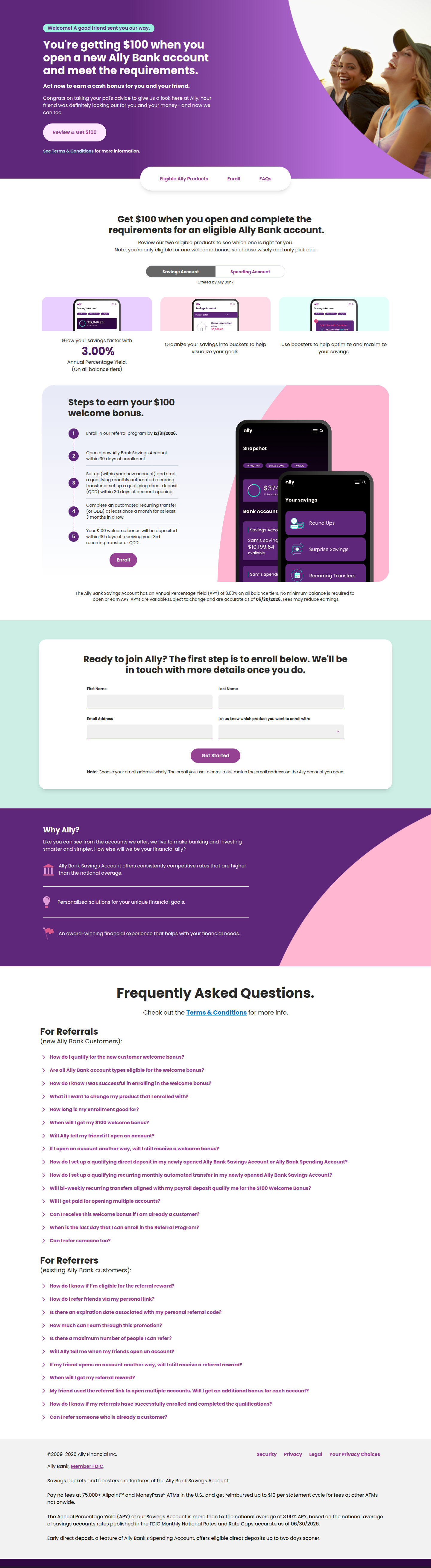
- Visit 2: "Welcome! A good friend sent you our way." — followed by "You're getting $100 when you open a new Ally Bank account and meet the requirements." CTA: Review & Get $100.
- Visits 3 & 5: "A good friend sent you our way." — followed by "It pays to have a financial ally. $100 to be exact." CTA: Enroll.
Same layout, same likely grid, same photography treatment presumably — but three distinct read-throughs of why you're here and what happens if you click. That's a meaningful design decision, not copy tweaking. Each variant reframes the visitor's relationship to the brand before they've scrolled an inch.
Headline psychology: invitation vs. transaction vs. brand voice
Look at the verb choices and who's the subject of the sentence. "Congrats! You're invited" puts the visitor at the center — it's status-driven, almost exclusive, like a guest list. "You're getting $100" is transactional and second-person direct — it front-loads the number and the mechanism. "It pays to have a financial ally" is the only variant that leans on brand wordplay ("ally" as both noun and company name), sacrificing immediate clarity for voice and memorability.
From a hierarchy standpoint, this is a genuine test of emotional register vs. information density. The invitation framing withholds the dollar amount from the headline — it's teased in the subhead instead, which is a classic curiosity-gap move. The referrer-benefit framing puts $100 in the headline itself, which is higher-contrast information but lower on delight. The brand-voice framing risks a half-second of confusion for a stronger brand signature. Three very different bets on what earns the click.
CTA labels are doing more work than they look like they are
The CTA button is the second fixation point after the headline — it's where contrast and whitespace should be doing the heavy lifting to pull the eye down the page. Ally is testing three verbs with genuinely different implied commitment levels:
- Continue — the lowest-friction word possible. Implies you're mid-flow already, reduces perceived effort.
- Review & Get $100 — restates the reward directly on the button, which is a strong Gestalt "closure" move: the eye reads the whole promise without needing the subhead.
- Enroll — the most formal, financial-services-appropriate verb, but also the coldest. It reads like a form, not a reward.
This mirrors what CRO research consistently finds about CTA copy: verb choice alone can shift conversion because it changes the perceived size of the ask. Unbounce's guide to CTA testing points out that even swapping a single verb reframes the emotional weight of the click — "Enroll" asks for a commitment, "Continue" asks for nothing. Pairing "Review & Get $100" with the referrer-framing headline isn't a coincidence — it's internally consistent: that variant leads with benefit language everywhere, headline through button.
Why this is a multivariate test, not a rendering bug
The tell here is Firefox and Chrome — two different rendering engines — both showing the "financial ally" variant (visits 3 & 5), while a separate Chrome visit (visit 2) shows something else entirely. If this were a CSS or font-rendering quirk, you'd expect variance to track with engine, not with session. It doesn't. That's the fingerprint of cookie- or session-based bucketing, which means Ally's experimentation platform is actively splitting traffic across at least three arms on a single high-intent page.
Referral pages are usually low-traffic, high-intent surfaces — the visitor already trusts the referrer, so the page's only job is to not lose that trust before the value prop lands. Running a three-way test here, rather than just A/B, tells you Ally has enough referral volume to power a proper multivariate read and is treating headline framing as a first-class conversion lever, not an afterthought. Contentful's breakdown of headline testing makes the same point — headlines are the first impression that decides whether anything below the fold gets read at all, which is exactly the bet Ally is making three different ways at once.
What to steal for your own roadmap
You don't need Ally's traffic to run this test — you need the discipline to separate who the visitor is (recipient vs. referrer) from what they get (dollar amount vs. brand story) as two independent variables in your hero copy. This sprint, pick one high-intent, low-scroll page — a referral page, a pricing page, an upgrade nudge — and test headline framing against CTA verb as a 2x2, not a single A/B swap. Watch specifically whether reward-in-headline outperforms reward-in-subhead, and whether a benefit-repeating CTA ("Get $100") beats a generic action verb ("Continue" or "Enroll"). The framing decision usually costs nothing to build and tells you more about your audience's motivation than almost any other single test you can ship.
See more like this
ABWatcher catches A/B tests like this every day.
Watch live experiments at 1,000+ high-converting brands, complete with hypothesis and takeaway. Free forever for ten watched companies.