
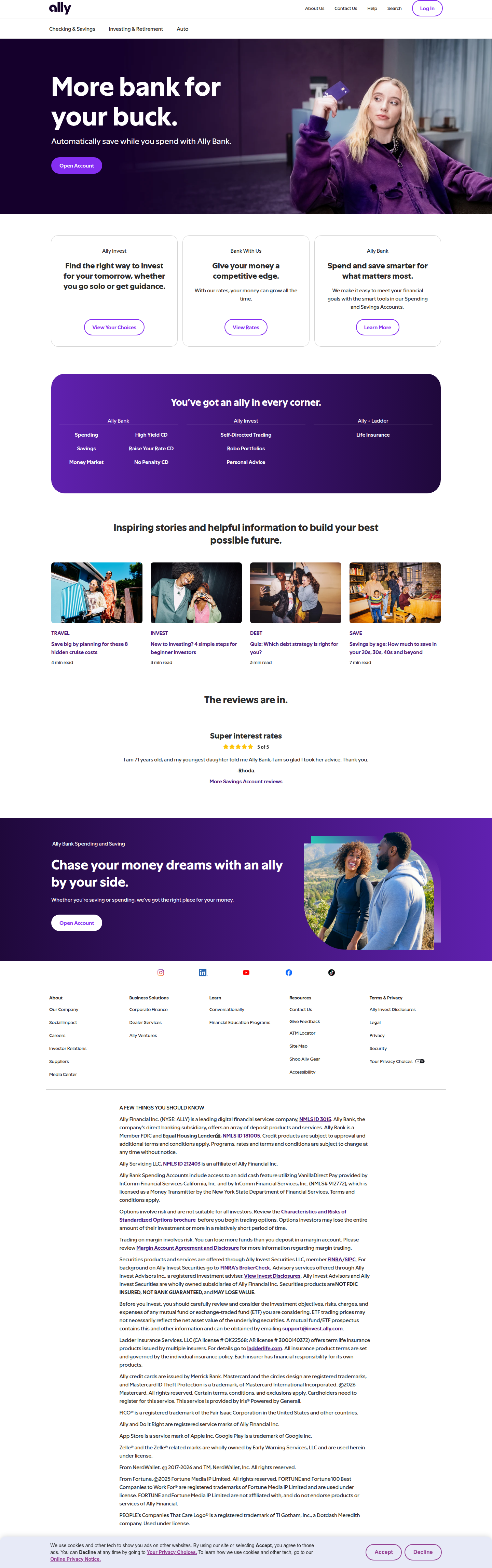
Ally Bank Tests Generic Savings Copy vs. WNBA Sponsorship Story
Ally.com is running a coordinated hero + banner A/B test pitting generic savings messaging against WNBA sponsorship storytelling. Here's what the bundled variant reveals about brand-narrative testing.
Maya Patel
Senior CRO Strategist · · Updated
TL;DR
- Detected 75% confidence, same-run variance method, on the Ally.com homepage hero, logged by ABWatcher.
- Variant A headline: "More bank for your buck." paired with lifestyle banner "Chase your money dreams with an ally by your side."
- Variant B headline: "The bank fans bank on." paired with WNBA sponsorship banner "Bank on Buckets."
- Both variants appeared across multiple visits and browser engines, ruling out rendering noise.
- Hero copy and bottom banner move together as one bundle — not two independent tests.
- Pattern suggests a full brand-narrative test, not a micro-copy tweak.
What did Ally actually change on its homepage?
Ally is testing two complete narrative bundles on ally.com's hero, not isolated headline wording. Our vision-AI analyser caught two consistent site configurations recurring across repeat visits to ally.com. In Variant A, the hero reads "More bank for your buck." — a value-driven, rate-focused pitch — and the page's bottom promotional banner reinforces it with lifestyle-brand language: "Chase your money dreams with an ally by your side." In Variant B, the hero swaps to "The bank fans bank on.", a headline built entirely around cultural relevance, and the banner beneath it shifts to WNBA sponsorship messaging: "Bank on Buckets."
What makes this detection notable isn't the copy itself — it's that the two elements never mix. We never saw "More bank for your buck." running alongside the WNBA banner, or vice versa. That consistency, observed across different browser engines including multiple Chrome sessions split cleanly between the two buckets, is what pushed our confidence to 75% and ruled out simple caching or rendering artifacts.
Why test a full narrative bundle instead of a single headline?
Testing hero copy and banner together lets Ally isolate which brand story — generic value vs. cultural relevance — drives more engagement, not just which words perform better. This is a meaningfully different test design than most homepage experiments we log. The majority of hero tests in our detection set are single-variable: one headline against another, one CTA color against another. Bundling the headline with a completely different bottom-of-page banner means Ally isn't asking "which words convert better" — they're asking "which brand narrative resonates more."
That's a bigger swing, and a riskier one. When you bundle multiple elements into a single variant, you gain a cleaner read on holistic narrative performance, but you lose the ability to attribute lift to a specific element. If Variant B wins, Ally won't know from this test alone whether it was the WNBA sponsorship, the headline framing, or the interaction between them. Standard A/B testing methodology generally recommends isolating variables specifically to avoid this ambiguity — so the fact that Ally chose a bundled test suggests they've deliberately traded diagnostic precision for a faster read on brand-level resonance, likely because sponsorship campaigns run on fixed marketing calendars that don't wait for a clean multivariate rollout.
How does this compare to typical homepage hero tests?
Most hero tests we track optimize a single conversion lever; Ally's test optimizes brand positioning at the narrative level. Here's how the two Ally variants break down against what we typically see in hero-surface experiments across financial services brands in our dataset:
| Dimension | Variant A ("More bank for your buck.") | Variant B ("The bank fans bank on.") | Typical fintech hero test |
|---|---|---|---|
| Headline angle | Rational, value/rate-driven | Cultural/emotional, sponsorship-driven | Usually rational (rate, fee, speed) |
| Banner theme | Lifestyle aspiration | WNBA partnership ("Bank on Buckets") | Usually promo offer or trust badge |
| Elements bundled | Headline + banner | Headline + banner | Usually single element |
| Likely primary metric | CTR to account signup | Engagement, dwell time, brand recall | Conversion rate to signup |
The bundling pattern is the real signal here. In our experience running and reviewing these programs, teams that bundle narrative elements are typically testing top-of-funnel brand affinity rather than bottom-of-funnel conversion efficiency — which changes what "winning" should even mean for this test.
What should Ally be measuring to call a winner?
Given the bundled design, click-through rate alone is an insufficient success metric — Ally needs engagement depth and downstream conversion, not just hero CTR. If the WNBA variant only wins on top-of-funnel engagement (time on page, scroll depth, secondary link clicks) but doesn't move signup starts or funded-account rate, that's a confidence-lift-risk problem: high confidence in a directional preference, but real risk that the lift doesn't survive contact with the conversion funnel. A team applying the ICE framework here would likely score this test high on Impact (brand positioning affects lifetime value, not just single conversions) but only moderate on Confidence, precisely because the bundled structure muddies attribution.
There's also a timing dimension worth flagging. Sponsorship-tied creative like "Bank on Buckets" has a natural expiration — it's tied to the WNBA season and Ally's sponsorship window — so this test likely can't run to full statistical maturity the way an evergreen headline test could. That's a real-world constraint that pure CRO theory doesn't always account for: sometimes the business calendar caps your sample size before your p-value gets there.
What's the takeaway for teams running hero tests this sprint?
If you're planning a hero test that touches brand narrative rather than just conversion copy, decide upfront whether you're optimizing for engagement or for hard conversion — and pick your primary metric before you look at results, not after. Consider also whether bundling elements (headline + banner, as Ally did) actually serves your learning goal, or whether isolating variables would give you a cleaner attribution path even if it takes longer to ship. And if your narrative variant is tied to a sponsorship or seasonal campaign, build a decision deadline into your test plan now — you may not get to full statistical significance before the business moves on, so define what "good enough evidence" looks like in advance.
Common questions
Why does Ally's hero test bundle the headline with a bottom banner instead of testing them separately?
Bundling suggests Ally is testing a full brand narrative (generic value vs. WNBA sponsorship storytelling) rather than isolated copy performance. This sacrifices precise attribution but gives a faster read on which overall positioning resonates, which matters more when creative is tied to a time-boxed sponsorship campaign.
How confident is ABWatcher in this detection?
Our analyst confidence is 75%, based on same-run variance detected across multiple visits and browser engines. The consistent pairing of headline and banner within each bucket, rather than random mixing, is what supports a true A/B test rather than rendering noise.
What metric should determine the winner of a bundled brand-narrative test like this?
Click-through rate alone is insufficient; teams should weigh engagement depth (scroll, dwell time) alongside downstream conversion (signup starts, funded accounts). A narrative variant can win attention without moving the metrics that ultimately matter to revenue.
Is testing full narrative bundles a common CRO practice?
It's less common than single-variable testing but not rare, especially for brands running time-boxed sponsorship or campaign creative. Most hero tests in financial services isolate one element (headline, CTA, offer); bundled tests trade diagnostic clarity for a faster directional read.
What's the risk of running a bundled test instead of isolating variables?
If the bundled variant wins, you can't cleanly attribute the lift to the headline, the banner, or their interaction. This is a meaningful gap when planning your next iteration, since you'd be guessing which element to keep rather than knowing.
Read next
More from the ABWatcher blog
Nov 22, 2026
Snake River Farms Tests a $25-Off Popup on Its Ad Landing Page
We caught Snake River Farms split-testing an email-capture form and $25-off modal on its landing page. Here's the math on what it would take to call a winner.
Nov 21, 2026
Snake River Farms Tests Mid-Page Email Capture on Its Ad Landing Page
SRF is A/B testing a mid-page lead-capture block and a $25-off popup against a simpler hero-only promo banner on its paid landing page, detected 2024 week-over-week.
Nov 20, 2026
Attio Is Testing a New Tier, Higher Prices, and a New Pitch
Attio is running a live pricing page test with a new $1,000 "Ultra" tier, higher Plus/Pro prices, and a new headline — here's what we caught and what it means.
Nov 19, 2026
Found Quietly Tested a 25% Price Cut on Its Pricing Page
We caught Found running a live pricing A/B test with an annual billing toggle that drops Found Plus from $35 to $26.25/mo. Here's what changed and why it matters.
Nov 8, 2026
Astro Proves "Zero Lock-In" With a Live Code Demo, Not a Claim
Astro's homepage replaces a trust badge row with a working, clickable framework demo — here's the hierarchy and interaction design behind it, detected 60% rare on astro.build.
Nov 7, 2026
Basecamp's Big Numbers: Why Hyper-Precise Stats Beat Vague Social Proof
Basecamp's homepage swaps "trusted by thousands" for 1.7 billion to-dos and 5 petabytes of data. We break down why precision beats vagueness as social proof — and how to test it.
From the glossary
Vocabulary the article uses. See all terms →
- Shrinkage Estimator— A statistical adjustment that pulls noisy per-variant or per-segment estimates toward an overall average to reduce overfitting to randomness.
- Flicker Test— A diagnostic check to confirm whether users briefly see the original page before a variant renders in client-side experiments.
- Pre-Experiment Bucketing Audit— A review process confirming users are being randomly and evenly assigned to experiment variants before launch.
- Above-Fold Exclusion Rule— A test-design rule that deliberately prevents changes to above-the-fold elements so an experiment isolates below-the-fold effects.
- Flicker-Free Testing— A technical setup that prevents users from briefly seeing the original page before a test variant loads.
- Orthogonal Test Design— A test structure where multiple variables are changed independently so their individual effects can be measured without interference.
See more like this
ABWatcher catches A/B tests like this across 1,000+ brands.
Watch live experiments at 1,000+ high-converting brands, complete with hypothesis and takeaway. 7 days of Pro, free, no card, then Free forever for ten watched companies.