
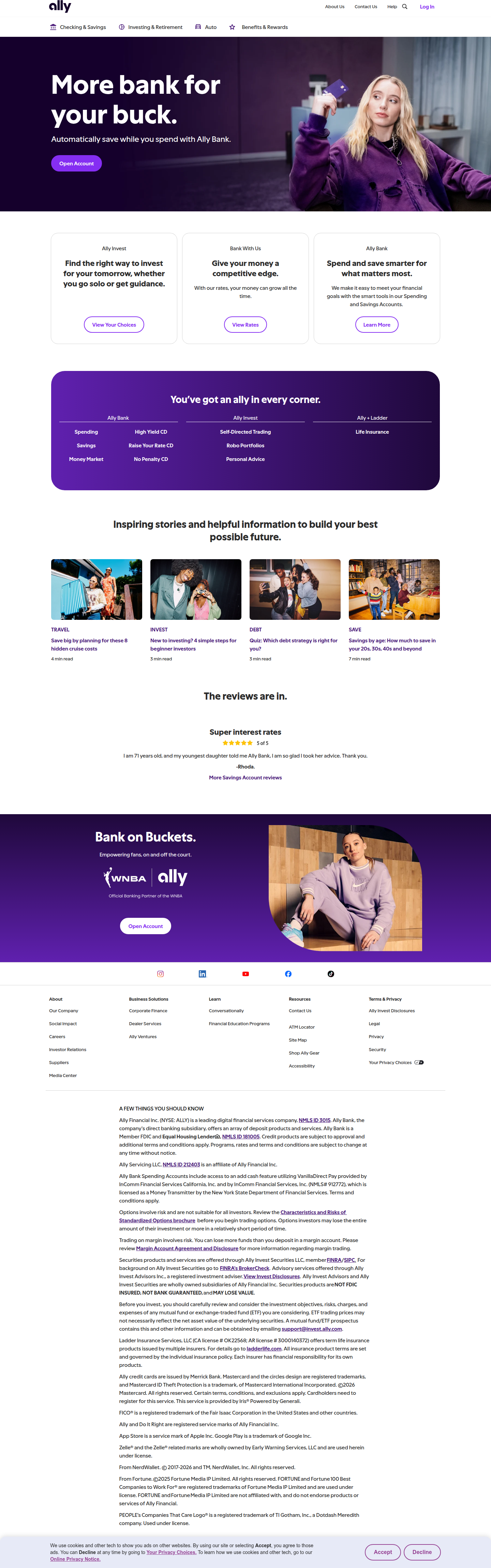
Ally Bank Splits Its Homepage Hero: WNBA Hype vs. Lifestyle Copy
Ally.com is running a bucketed hero test pitting a WNBA sponsorship banner against lifestyle-driven copy — here's the detection data and what it means for your own test hygiene.
Sam Lee
Data Analyst · · Updated
TL;DR
- Detected 80% confidence live A/B test on ally.com homepage hero, logged via same-run variance method.
- Variant A: "More bank for your buck" headline + WNBA "Bank on Buckets" promo banner.
- Variant B: "The bank fans bank on" headline + "Chase your money dreams with an ally by your side" banner.
- Both variants appeared across Chrome (2/5 vs. 6 visits) and Firefox (3 vs. 7 visits) sessions — ruling out a browser-rendering artifact.
- Bucketing is consistent with cookie signatures from VWO, ABTasty, and Statsig, suggesting a real, tool-managed experiment rather than a caching glitch.
- No sample size, duration, or conversion metric disclosed — this is a detection, not a results readout.
What did ABWatcher actually catch on ally.com?
We caught two distinct hero/banner pairings serving to different session buckets on the Ally.com homepage, confirmed independent of browser engine. Variant A leans into sports sponsorship ("Bank on Buckets," tied to the WNBA), while Variant B leans into lifestyle aspiration ("Chase your money dreams"). The headline swap is the primary lever — "More bank for your buck" (a value/pricing angle) versus "The bank fans bank on" (a trust/social-proof angle) — with the promo banner riding shotgun as a secondary creative axis. This was flagged 80% confidence using same-run variance: the same crawl run, same day, same device class, returned two mutually exclusive combinations.
The tell that separates a real experiment from a CDN or personalization glitch is the cross-tab: Chrome sessions split 2-vs-6 across the two variants, Firefox sessions split 3-vs-7. If this were a browser-rendering quirk, you'd expect one engine to consistently show one version. Instead both engines show both variants, in roughly similar proportions (Chrome ~25/75, Firefox ~30/70) — that consistency across engines, combined with divergent VWO/ABTasty/Statsig cookies, is what pushes this from "maybe caching" to "yes, bucketed test."
Is a 25/75 or 30/70 split unusual for a homepage test?
An uneven traffic split is common practice, not a red flag, and usually signals either a holdback design or a staged rollout of a challenger. Ally.com is a high-traffic destination — Similarweb-class estimates put major bank homepages in the multiple-millions of monthly visits range — so even a 25% allocation to Variant A likely clears five-figure weekly sessions, more than enough to power a hero-level test if the true effect size is above roughly 1-2 percentage points on click-through to account opening. The catch: we don't have Ally's actual sample size or runtime, so we can't compute the minimum detectable effect ourselves. Treat the split ratio as evidence of test design maturity, not as a proxy for the eventual winner.
What is Ally actually trying to learn?
The likely hypothesis is whether a sports-partnership hook or a lifestyle/aspirational hook drives more engagement on the primary conversion path — account opens, rate-page clicks, or app downloads. This is a classic message-testing structure: hold the CTA and page architecture constant, vary the emotional register of the headline plus a matching banner. It mirrors the approach described in Unbounce's step-by-step A/B testing guide, which frames hero copy tests as isolating "the one variable that's most likely to move the needle" — in this case, brand affinity framing versus a direct value proposition. Pairing headline and banner together (rather than testing them independently) does introduce a confound: if Variant B wins, Ally won't cleanly know whether it was the headline, the banner, or the interaction between them, without a follow-up factorial test.
What should you flag before calling either variant a winner?
Nothing here should be reported as a "win" yet — we have no conversion lift, no confidence interval, and no test-end date. A few things I'd want before drawing any conclusion:
| Question | Why it matters |
|---|---|
| What's the primary metric? | Account opens vs. clicks vs. time-on-page produce very different "winners" |
| What's the daily traffic split going into each arm? | Confirms it's not a slow ramp-up still stabilizing |
| Is the WNBA banner time-boxed to a sponsorship window? | A seasonal tie-in can look like novelty lift but decay once the campaign ends |
| Has this run longer than 1-2 full weekly cycles? | Financial-services conversion often has weekday/weekend skew that needs 2+ cycles to average out |
The WNBA tie-in specifically raises a novelty-effect flag: sponsorship-linked creative often shows an initial engagement bump correlated with real-world game schedules or media coverage, then reverts toward baseline once the news cycle fades. Any readout taken mid-season should be treated as provisional, not a stable estimate of the true effect.
How should teams replicate this kind of detection on their own site?
Cross-referencing multiple signals — device/browser split, experiment cookies, and same-run variance — is the only reliable way to confirm a bucketed test versus a rendering artifact, a discipline familiar to anyone who's set up tools like Split Hero on WordPress, where the standard workflow is explicitly: create two page versions, set a duration, run, then analyze before touching the copy again. The mistake we see most often is treating a single anomalous screenshot as proof of a test. You need at least two independent axes of variance (e.g., browser × session) pointing to the same split before you can rule out caching, CDN edge nodes, or geo-based personalization.
Common questions
Is Ally's hero test statistically significant yet?
Unknown from this detection. We captured the existence and structure of the test (two variants, cross-browser confirmed, cookie-verified) on the dates observed, but not conversion counts or a p-value. Statistical significance requires Ally's internal event data, which isn't exposed by front-end monitoring.
Why does a 2/5 vs. 6 split within Chrome matter more than a single screenshot?
A single screenshot could be a cache artifact, a geo-personalization layer, or a stale CDN node. Seeing both variants recur within the same browser across multiple visits, and again in a second browser, is what statistically rules out rendering noise and confirms real bucketing.
Could the WNBA banner be a seasonal campaign rather than an A/B test variant?
Possibly a hybrid — sponsorship banners are often layered into one arm of a broader messaging test. The headline pairing ("More bank for your buck" vs. "The bank fans bank on") is the true experimental variable; the banner may just be creative dressing tied to Ally's existing WNBA sponsorship deal.
What sample size would Ally need to detect a 2% lift in account opens?
Assuming a baseline conversion rate around 3-5% for homepage-to-account-open and wanting 80% power at 95% confidence, a 2-percentage-point relative lift typically requires tens of thousands of sessions per arm. Given bank.com-scale traffic, that threshold is likely reachable within 1-3 weeks.
What's the risk of shipping the sports-tie-in variant without a longer runtime?
The main risk is novelty and seasonality bias — sponsorship-linked messaging can spike during an active WNBA season and decay afterward, producing an inflated short-run lift that doesn't hold once the campaign context disappears.
Takeaway for your sprint
If you're running a hero test this sprint, don't bundle headline and banner into a single variant the way this test does — you'll win the A/B but lose the ability to attribute the lift. Split them into a 2×2 if traffic allows, log your experiment cookie IDs alongside screenshots, and require at least two full weekly cycles before reading results, especially if any creative is tied to a live sponsorship or seasonal event.
Read next
More from the ABWatcher blog
Nov 22, 2026
Snake River Farms Tests a $25-Off Popup on Its Ad Landing Page
We caught Snake River Farms split-testing an email-capture form and $25-off modal on its landing page. Here's the math on what it would take to call a winner.
Nov 21, 2026
Snake River Farms Tests Mid-Page Email Capture on Its Ad Landing Page
SRF is A/B testing a mid-page lead-capture block and a $25-off popup against a simpler hero-only promo banner on its paid landing page, detected 2024 week-over-week.
Nov 20, 2026
Attio Is Testing a New Tier, Higher Prices, and a New Pitch
Attio is running a live pricing page test with a new $1,000 "Ultra" tier, higher Plus/Pro prices, and a new headline — here's what we caught and what it means.
Nov 19, 2026
Found Quietly Tested a 25% Price Cut on Its Pricing Page
We caught Found running a live pricing A/B test with an annual billing toggle that drops Found Plus from $35 to $26.25/mo. Here's what changed and why it matters.
Nov 8, 2026
Astro Proves "Zero Lock-In" With a Live Code Demo, Not a Claim
Astro's homepage replaces a trust badge row with a working, clickable framework demo — here's the hierarchy and interaction design behind it, detected 60% rare on astro.build.
Nov 7, 2026
Basecamp's Big Numbers: Why Hyper-Precise Stats Beat Vague Social Proof
Basecamp's homepage swaps "trusted by thousands" for 1.7 billion to-dos and 5 petabytes of data. We break down why precision beats vagueness as social proof — and how to test it.
From the glossary
Vocabulary the article uses. See all terms →
- Shrinkage Estimator— A statistical adjustment that pulls noisy per-variant or per-segment estimates toward an overall average to reduce overfitting to randomness.
- Flicker Test— A diagnostic check to confirm whether users briefly see the original page before a variant renders in client-side experiments.
- Pre-Experiment Bucketing Audit— A review process confirming users are being randomly and evenly assigned to experiment variants before launch.
- Above-Fold Exclusion Rule— A test-design rule that deliberately prevents changes to above-the-fold elements so an experiment isolates below-the-fold effects.
- Flicker-Free Testing— A technical setup that prevents users from briefly seeing the original page before a test variant loads.
- Orthogonal Test Design— A test structure where multiple variables are changed independently so their individual effects can be measured without interference.
See more like this
ABWatcher catches A/B tests like this across 1,000+ brands.
Watch live experiments at 1,000+ high-converting brands, complete with hypothesis and takeaway. 7 days of Pro, free, no card, then Free forever for ten watched companies.