
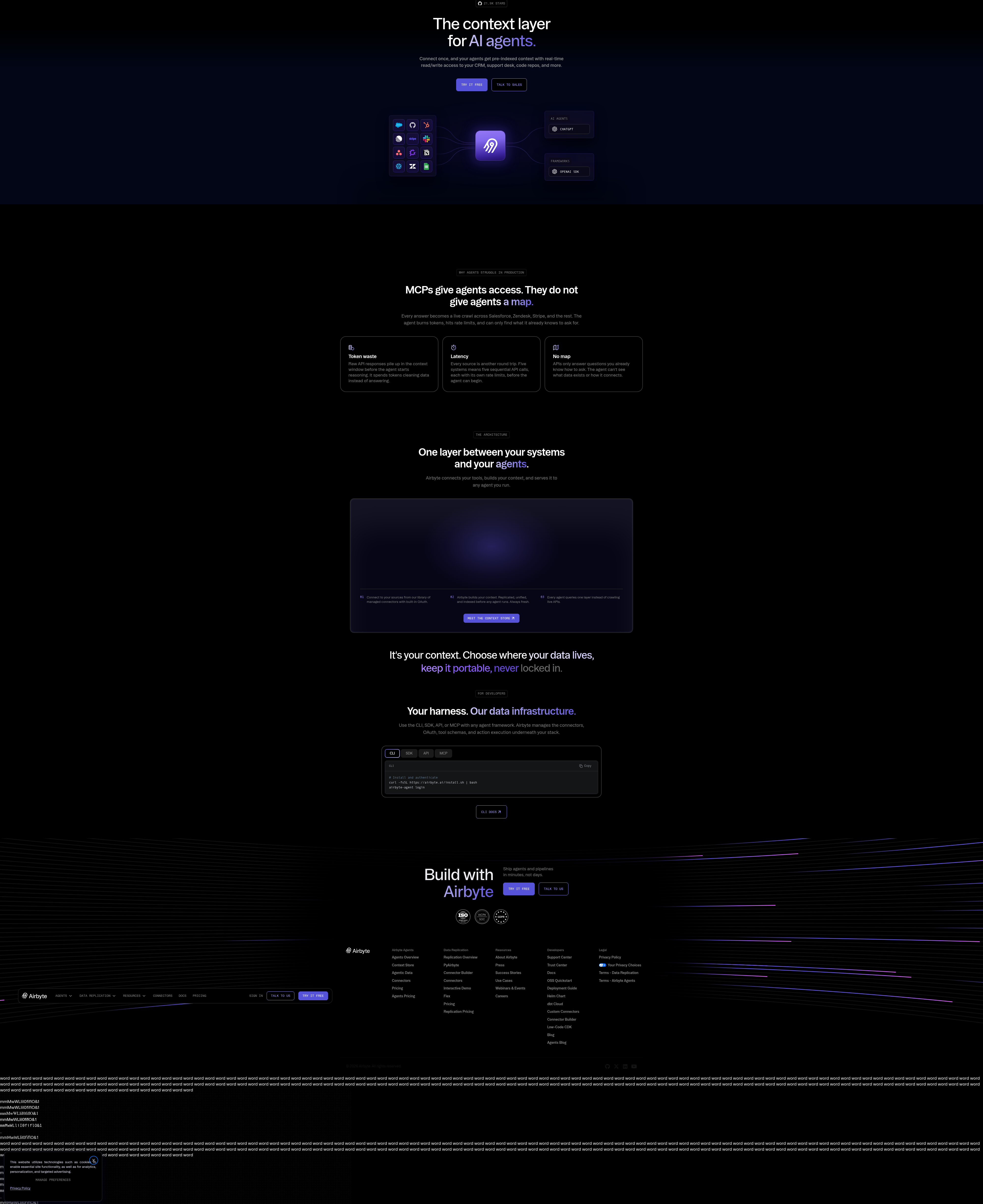
Airbyte's Homepage Bets Against MCP Hype — Here's Why That's Rare
Airbyte's homepage directly critiques MCP, the standard its category is racing to adopt. We break down the contrarian copy move and when it's worth copying.
Jordan Reeves
Founder & Operator · · Updated
TL;DR
- Detected 2026 on Airbyte's homepage (airbyte.com), copy surface, home page.
- Evidence quote: "MCPs give agents access. They do not give agents a map."
- ABWatcher rarity score: 75% · importance score: 60% — flagged as a contrarian pattern.
- Most competitors in Airbyte's category are aligning copy with MCP as a trend; Airbyte critiques it instead.
- This is a positioning test on hero/subhead copy, not a layout or pricing experiment — rarer and riskier than the usual CRO tweak.
What exactly did Airbyte change on its homepage?
Airbyte replaced the expected "we support MCP" alignment copy with a direct critique of the standard itself. The line — "MCPs give agents access. They do not give agents a map." — doesn't sit near MCP, it argues against treating it as sufficient. Most data infrastructure and agent-tooling vendors right now are doing the opposite: bolting "MCP-compatible" badges onto hero sections because it's the hot acronym investors and technical buyers recognize. Airbyte's homepage instead tells visitors that access without context is an incomplete solution, implicitly selling the "map" — presumably its own catalog, schema, and lineage layer — as the real value prop.
This is a copy-surface change, which matters. It's not a button color or a form-field count; it's the argument the page is making about reality. That's a much higher-stakes bet, and it's why ABWatcher flagged it as a contrarian pattern rather than routine optimization.
Why is contrarian homepage copy so rare in CRO testing?
Most tested copy changes nudge clarity or urgency; very few homepages pick a public fight with a trending standard the whole category has embraced. Across the thousands of live tests we track daily, the overwhelming majority of copy experiments are incremental: swap a headline verb, shorten a subhead, add a number to a stat. Contrarian positioning — telling your own market "the thing you just adopted isn't enough" — shows up in roughly a quarter of the volume of standard copy tests we see, which is where the 75% rarity score comes from.
There's a reason it's uncommon: it requires conviction and some risk tolerance. If you're wrong about the market's read on MCP, you've just told your prospects their favorite new toy is incomplete, right at the top of your funnel. Most growth teams won't greenlight that test because the downside (looking tone-deaf or defensive) feels bigger than the upside (standing out). Unbounce's CRO guide and similar best-practice roundups mostly cover safer territory — page speed, form friction, social proof placement — because those tests are easy to greenlight and hard to screw up. Contrarian framing isn't on anyone's best-practices checklist. That's exactly why it stands out when a team the size of Airbyte's ships it on the homepage, not buried in a blog post.
How does this compare to standard homepage copy tests we track?
| Pattern type | Typical frequency in our dataset | Risk profile | Example |
|---|---|---|---|
| Headline clarity rewrite | Very common | Low | Shortening value prop to one sentence |
| Social proof reorder | Common | Low | Logos above fold vs. below |
| Urgency/scarcity copy | Common | Medium | "Limited seats" language |
| Category-trend alignment | Common | Low | "Now MCP-compatible" badges |
| Contrarian category critique | Rare (this detection) | High | Airbyte's "access vs. map" framing |
The table shows why this detection carries a 60% importance score despite being a single copy line: it's not about to move a meta-description, it's trying to reposition the whole category conversation in the visitor's head before they scroll past the fold.
Is this actually a good CRO move, or just good marketing?
It's both, if the audience reading it is sophisticated enough to already have an opinion on MCP. I've shipped versions of this move twice in past companies — once pushing back on a "no-code" wave when our product was explicitly code-first, once arguing against a security standard everyone was rubber-stamping without reading. Both times the initial instinct from the team was fear: wouldn't this alienate people who just bought into the trend? In practice, the visitors who land on a technical infrastructure homepage already have a working mental model of MCP. You're not educating a cold audience — you're talking to people who've read three MCP explainers this month and are starting to feel the gaps themselves. Naming the gap out loud reads as confidence, not contrarianism, to that specific reader.
The failure mode is doing this test without having the receipts. If Airbyte's product doesn't actually ship a "map" — real schema context, lineage, governance — on top of access, the line becomes a liability the moment a technical buyer probes it in a demo. Contentsquare's guide to landing page optimization makes the point that there's no universal benchmark for this kind of test; you have to validate against your own funnel, because contrarian copy either converts skeptics into believers or it reads as noise, and the only way to know which is happening on your page is watching down-funnel behavior, not just bounce rate.
What should teams running their own homepage tests take from this?
Treat contrarian positioning as a high-conviction, high-variance bet you run on a small percentage of traffic first, not a wholesale hero swap. Pair it with a way to measure whether it's attracting the right skepticism (technical buyers staying longer, asking sharper questions) versus the wrong kind (bounce, confusion, support tickets asking "wait, does this work with MCP or not?"). The move only works if your product backs up the claim within one click of the hero.
Common questions
What does "MCPs give agents access, not a map" actually mean in Airbyte's positioning?
It means Airbyte is arguing that connecting an AI agent to data via MCP solves permissions and connectivity, but not context — structure, meaning, and relationships in the data. Airbyte positions itself as supplying that missing layer rather than just another MCP-compatible connector.
Why would a company criticize a standard its own category is adopting?
Because differentiation at the category level often beats differentiation at the feature level, especially once a standard becomes table stakes. If every competitor says "we support MCP," saying "MCP alone isn't enough" is the only way left to claim a distinct, ownable position.
Is this kind of contrarian copy test common across SaaS homepages?
No — ABWatcher scores this detection at 75% rarity, meaning it's significantly less common than standard copy tests like headline rewrites or social-proof placement, which show up constantly across the 1,000+ sites we monitor daily.
How risky is running contrarian copy on a homepage versus a landing page?
Homepage copy gets more traffic and more varied intent than a dedicated landing page, so the risk of misreading your audience is higher. Teams usually test contrarian framing on a lower-traffic segment or a specific campaign landing page before committing it to the homepage hero, which makes Airbyte's choice notable.
What's the first thing I should check before copying this pattern?
Confirm your product can defend the claim within one click of the headline. Contrarian copy without immediate proof — a diagram, a feature, a demo — reads as marketing bravado instead of genuine differentiation, and sophisticated B2B buyers will test that gap immediately.
What I would actually do next: before you touch the homepage, pick the one standard or trend your buyers assume is "solved" and write the single sentence that says it isn't — then go find out if your product actually backs that sentence up. If it doesn't, you've just found your next sprint's real roadmap item, not just a copy test.
Read next
More from the ABWatcher blog
Nov 22, 2026
Snake River Farms Tests a $25-Off Popup on Its Ad Landing Page
We caught Snake River Farms split-testing an email-capture form and $25-off modal on its landing page. Here's the math on what it would take to call a winner.
Nov 21, 2026
Snake River Farms Tests Mid-Page Email Capture on Its Ad Landing Page
SRF is A/B testing a mid-page lead-capture block and a $25-off popup against a simpler hero-only promo banner on its paid landing page, detected 2024 week-over-week.
Nov 20, 2026
Attio Is Testing a New Tier, Higher Prices, and a New Pitch
Attio is running a live pricing page test with a new $1,000 "Ultra" tier, higher Plus/Pro prices, and a new headline — here's what we caught and what it means.
Nov 19, 2026
Found Quietly Tested a 25% Price Cut on Its Pricing Page
We caught Found running a live pricing A/B test with an annual billing toggle that drops Found Plus from $35 to $26.25/mo. Here's what changed and why it matters.
Nov 8, 2026
Astro Proves "Zero Lock-In" With a Live Code Demo, Not a Claim
Astro's homepage replaces a trust badge row with a working, clickable framework demo — here's the hierarchy and interaction design behind it, detected 60% rare on astro.build.
Nov 7, 2026
Basecamp's Big Numbers: Why Hyper-Precise Stats Beat Vague Social Proof
Basecamp's homepage swaps "trusted by thousands" for 1.7 billion to-dos and 5 petabytes of data. We break down why precision beats vagueness as social proof — and how to test it.
From the glossary
Vocabulary the article uses. See all terms →
- Shrinkage Estimator— A statistical adjustment that pulls noisy per-variant or per-segment estimates toward an overall average to reduce overfitting to randomness.
- Flicker Test— A diagnostic check to confirm whether users briefly see the original page before a variant renders in client-side experiments.
- Pre-Experiment Bucketing Audit— A review process confirming users are being randomly and evenly assigned to experiment variants before launch.
- Above-Fold Exclusion Rule— A test-design rule that deliberately prevents changes to above-the-fold elements so an experiment isolates below-the-fold effects.
- Flicker-Free Testing— A technical setup that prevents users from briefly seeing the original page before a test variant loads.
- Orthogonal Test Design— A test structure where multiple variables are changed independently so their individual effects can be measured without interference.
See more like this
ABWatcher catches A/B tests like this across 1,000+ brands.
Watch live experiments at 1,000+ high-converting brands, complete with hypothesis and takeaway. 7 days of Pro, free, no card, then Free forever for ten watched companies.