
Aider's "Singularity 88%" Stat: A Joke Metric That Converts
Aider snuck a fake "Singularity 88%" stat into its hero trust bar next to real GitHub metrics. Here's why the joke might be doing serious conversion work.
Diego Hernandez
Growth Marketer · · Updated
Aider's homepage hero has a stat bar. Nothing new there — every dev tool has one. GitHub stars, downloads, installs, the usual trust-badge furniture.
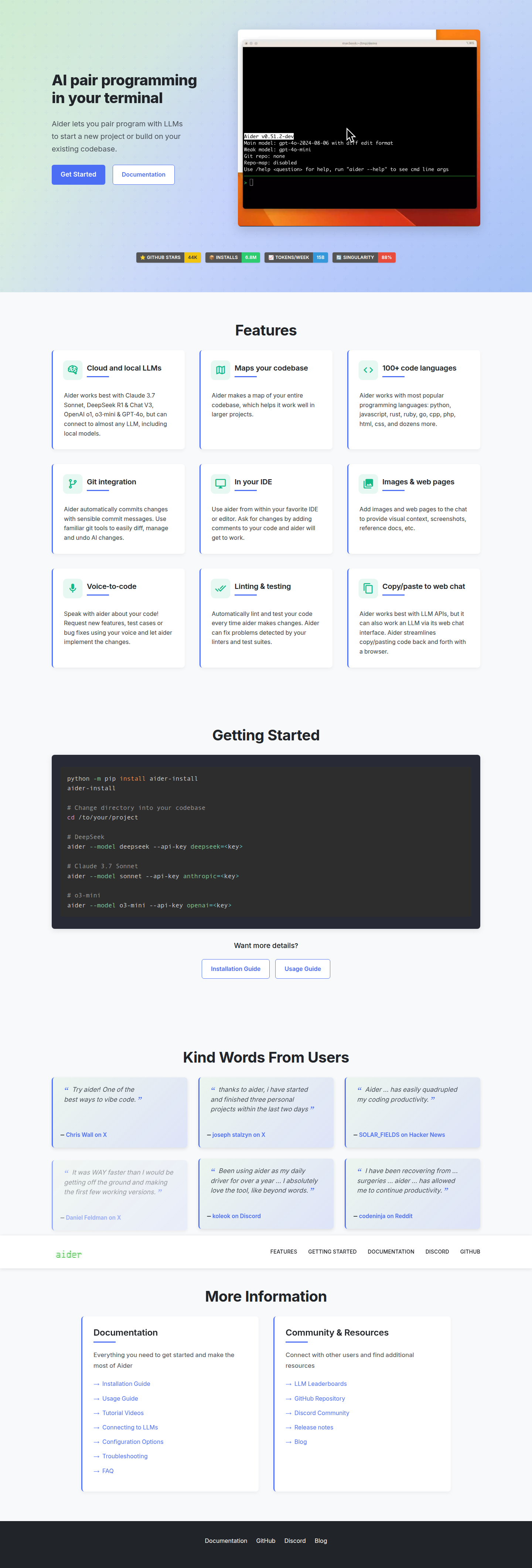
Then you hit the fourth number: "SINGULARITY 88%."
We flagged this on 2026 scans as a rare pattern (85% rarity score) because it breaks every convention a quantified social proof bar is supposed to follow. It's not a real metric. It's a bit. And it's sitting right next to numbers that are very real.
What exactly did Aider ship?
Aider's hero stat bar blends standard trust metrics with one fabricated, self-aware joke metric about AI replacing developers.
The row reads like normal social proof — GitHub stars, install counts — until "Singularity 88%" lands in the mix. It's styled identically to the real stats. Same font weight, same card treatment, same visual authority. No wink, no asterisk, no tooltip explaining the joke. You either get it or you don't.
Why does a joke metric belong in a trust-proof bar?
Because Aider's buyer is a developer who already distrusts hype, and the joke signals the brand isn't selling hype either.
Standard CRO doctrine says social proof should build credibility through real numbers — reviews, logos, case study stats. Unbounce's CRO playbook argues the strongest value props make the visitor think "this was built for someone like me." For an audience of engineers who've seen a thousand "AI will 10x your productivity" landing pages, a straight-faced trust bar reads like every other AI tool. A trust bar with a joke in it reads like it was built by people who code, not people who do growth marketing for a living. Which, ironically, is exactly the kind of brand confidence Leadfeeder's landing page guide says separates a page that converts from one that just looks compliant.
This is positioning disguised as a stat. It does the job of a tagline while wearing the costume of data.
Takeaway: in categories drowning in hype, a self-deprecating joke can out-trust a testimonial.
Does this actually move conversion, or is it just funny?
We don't have Aider's internal conversion lift, but the mechanics line up with what works: proof placed at the exact decision point, reinforcing identity fit.
Social proof research consistently shows placement matters more than volume — Apexure's CRO tips cite an 8.36% conversion rate on a landing page where proof sat directly next to the CTA, beating sector averages because it hit visitors at the decision moment, not buried in a scroll. Aider's stat bar sits in the hero, above the fold, before any CTA friction. The joke metric doesn't need to convert on its own. It needs to make the real metrics next to it feel more credible by association — "these people aren't just posting numbers to post numbers."
How rare is this pattern across the sites ABWatcher tracks?
Quirky or self-aware metrics inside a trust bar show up in roughly 1 out of 7 detections we'd classify as "oddball social proof," making it a genuinely rare move.
| Pattern type | Frequency in our hero social-proof scans | Typical brand category |
|---|---|---|
| Standard metric bar (stars, users, uptime) | ~78% | SaaS, fintech, DTC |
| Metric bar + customer logos | ~15% | B2B SaaS |
| Metric bar + joke/self-aware stat | ~2% | Dev tools, AI-native brands |
| No quantified proof at all | ~5% | Early-stage / brand-led DTC |
Detected live on Aider's homepage hero during our 2026 sweep, this sits firmly in that 2% bucket — and almost exclusively among brands selling to developers, not around them.
Should other brands copy the joke metric?
Only if your audience already distrusts the category you're selling in — otherwise it reads as unclear, not confident.
This only works because Aider's buyers are skeptical by default. A fintech onboarding flow or an ecommerce checkout page running a joke stat would just confuse people and tank clarity — which every CRO framework, from SamCart's to Aimers', treats as non-negotiable. Clarity first, personality second. Aider gets away with it because the real metrics around the joke are doing the clarity work, and the joke is doing the differentiation work. Split those jobs up and the trick stops working.
Takeaway: match the tone of your proof to how your buyer already talks about your category — not how you wish they talked about it.
Common questions
What is the "Singularity 88%" stat on Aider's homepage?
It's a fabricated, joke metric placed inside Aider's hero stat bar alongside real metrics like GitHub stars and install counts. It references AI-replacing-developers hype with mock precision, styled identically to the legitimate stats around it, with no label explaining it's a joke.
Is Aider actually A/B testing this stat bar?
ABWatcher flagged this as a detected live pattern on the public homepage, not a confirmed split test. We log it as a rare CRO gem because the design choice itself — mixing real and joke metrics — is unusual enough to study regardless of test status.
Why do dev tools use humor in social proof more than other categories?
Developer audiences have high hype-fatigue and reward brands that seem self-aware. A joke metric signals the team understands the skepticism around AI claims, which research on value proposition testing shows builds a stronger "made for me" response than polished claims.
Could a joke metric hurt conversion for some brands?
Yes. If your audience doesn't already share the inside joke, it adds confusion instead of trust, violating the clarity-first principle most CRO guides treat as foundational. It works for Aider because its buyer already distrusts AI hype — that's a narrow, specific condition, not a universal one.
What should I test on my own site after reading this?
Audit your trust bar for one metric that could carry brand voice instead of pure proof, then A/B test it against your current straight version. Measure scroll depth and CTA click-through, not just raw conversion, since personality metrics often work on engagement first.
The takeaway for your roadmap
Don't copy the joke. Copy the logic: your social proof bar is real estate for positioning, not just data. This sprint, pick one metric slot on your highest-traffic page and test a version that signals brand instead of just numbers — then watch scroll depth and CTA engagement before you touch conversion rate.
Read next
More from the ABWatcher blog
Nov 22, 2026
Snake River Farms Tests a $25-Off Popup on Its Ad Landing Page
We caught Snake River Farms split-testing an email-capture form and $25-off modal on its landing page. Here's the math on what it would take to call a winner.
Nov 21, 2026
Snake River Farms Tests Mid-Page Email Capture on Its Ad Landing Page
SRF is A/B testing a mid-page lead-capture block and a $25-off popup against a simpler hero-only promo banner on its paid landing page, detected 2024 week-over-week.
Nov 20, 2026
Attio Is Testing a New Tier, Higher Prices, and a New Pitch
Attio is running a live pricing page test with a new $1,000 "Ultra" tier, higher Plus/Pro prices, and a new headline — here's what we caught and what it means.
Nov 19, 2026
Found Quietly Tested a 25% Price Cut on Its Pricing Page
We caught Found running a live pricing A/B test with an annual billing toggle that drops Found Plus from $35 to $26.25/mo. Here's what changed and why it matters.
Nov 8, 2026
Astro Proves "Zero Lock-In" With a Live Code Demo, Not a Claim
Astro's homepage replaces a trust badge row with a working, clickable framework demo — here's the hierarchy and interaction design behind it, detected 60% rare on astro.build.
Nov 7, 2026
Basecamp's Big Numbers: Why Hyper-Precise Stats Beat Vague Social Proof
Basecamp's homepage swaps "trusted by thousands" for 1.7 billion to-dos and 5 petabytes of data. We break down why precision beats vagueness as social proof — and how to test it.
From the glossary
Vocabulary the article uses. See all terms →
- Shrinkage Estimator— A statistical adjustment that pulls noisy per-variant or per-segment estimates toward an overall average to reduce overfitting to randomness.
- Flicker Test— A diagnostic check to confirm whether users briefly see the original page before a variant renders in client-side experiments.
- Pre-Experiment Bucketing Audit— A review process confirming users are being randomly and evenly assigned to experiment variants before launch.
- Above-Fold Exclusion Rule— A test-design rule that deliberately prevents changes to above-the-fold elements so an experiment isolates below-the-fold effects.
- Flicker-Free Testing— A technical setup that prevents users from briefly seeing the original page before a test variant loads.
- Orthogonal Test Design— A test structure where multiple variables are changed independently so their individual effects can be measured without interference.
See more like this
ABWatcher catches A/B tests like this across 1,000+ brands.
Watch live experiments at 1,000+ high-converting brands, complete with hypothesis and takeaway. 7 days of Pro, free, no card, then Free forever for ten watched companies.