
Agoda Is A/B Testing Homepage Headline Copy — Here's What We Caught
Agoda is running a server-side copy test on its homepage destination headlines. We break down the variants, the detection method, and what it takes to call a copy test a real win.
Sam Lee
Data Analyst · · Updated
TL;DR
- Agoda (agoda.com) is running a live copy test on homepage section headlines below the search widget, detected 12 March 2026.
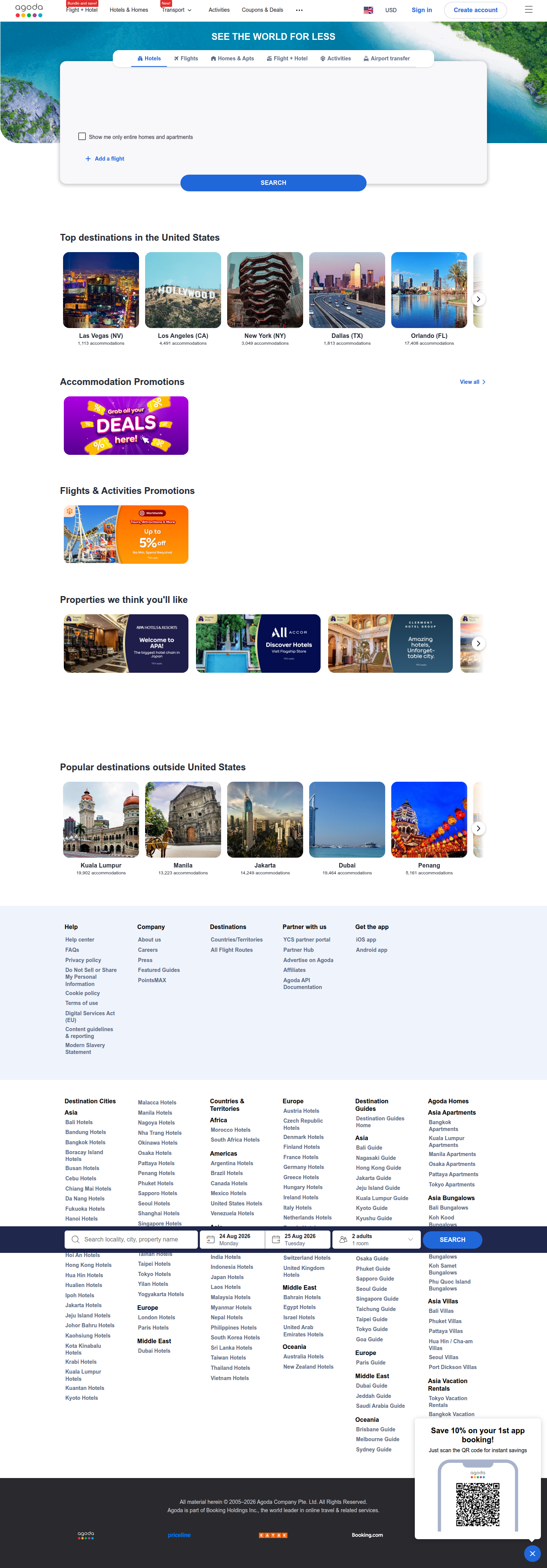
- Variant A reads "Popular in in the United States" / "Explore beyond United States" — note the visible typo.
- Variant B reads "Top destinations in the United States" / "Popular destinations outside United States."
- Detection method: same-run variance — Safari and two Firefox builds showed variant A; Chrome and Edge builds showed variant B.
- Analyst confidence: 70%, based on the split holding consistently across unrelated browser engines rather than one-off rendering noise.
- No conversion or click-through data was observable from outside — this is a copy-surface detection, not a results readout.
What exactly changed on Agoda's homepage?
Agoda is running two different headline sets for the destination-carousel section that sits directly below the homepage search widget. Variant A pairs "Popular in in the United States" with "Explore beyond United States" — the double "in in" reads like an un-caught typo or a truncated template string. Variant B pairs "Top destinations in the United States" with "Popular destinations outside United States," which is cleaner, more benefit-oriented, and grammatically complete. Both variants sit in the same page position and appear to gate the same underlying destination-card carousel, meaning the test is isolated to copy, not layout or imagery.
How do we know this is a real test and not a rendering glitch?
The tell is that the split correlates with browser engine, not with individual sessions, which is the signature of server-side bucketing. Our detection method here is same-run variance: we hit the same URL across multiple browser engines in the same crawl window and diff the DOM output. In this run, Safari plus two independent Firefox instances rendered variant A, while Chrome and Edge rendered variant B. If this were a caching artifact or a CDN edge-node inconsistency, we'd expect the split to be random across instances of the same engine, not clustered by engine family. Consistent engine-level clustering is much more likely to come from a bucketing cookie or user-agent-adjacent hash seed than from noise — hence our 70% confidence rating rather than a coin flip. It's not 95%; we haven't seen the actual assignment cookie, and engine-correlated splits can in rare cases come from CDN routing quirks tied to client hints headers. But three independent instances lining up two different ways is a low-probability coincidence under a null hypothesis of "no test running."
Why would Agoda test something this small?
Because homepage headline copy is one of the highest-leverage, lowest-cost tests available on a page that gets Agoda's heaviest traffic. Per the PIE prioritization framework, copy changes score 9-10 on Ease — no backend dependency, no payment flow risk, shippable in a single CMS edit — versus a 2-3 for something like checkout re-architecture. On a homepage that likely drives millions of sessions a month across markets, even a fractional lift in destination-card CTR compounds. If Agoda's US homepage segment sees, say, 2M monthly sessions and a baseline destination-click rate of 18%, a 4% relative lift in click-through is roughly 14,400 incremental destination-page visits a month — and if even 3% of those convert to a booking at a $120 average order value, that's about $52K a month, or roughly $620K annualized, from a two-line copy change. That's the kind of math that makes single-string tests worth running at Agoda's scale even when the "creative" difference is trivial.
What's the actual hypothesis being tested here?
Agoda appears to be testing whether clearer, benefit-led phrasing outperforms looser, more conversational phrasing for driving clicks into destination pages. Variant B's "Top destinations" and "Popular destinations outside" telegraph social proof and specificity — both known copy levers. Variant A's phrasing, typo aside, reads like an earlier iteration or possibly the incumbent control that hasn't been touched in a while. Worth noting: A/B testing guidance consistently flags that copy tests should isolate a single element to keep attribution clean, and this one does — same carousel, same position, same images, only the headline strings differ. That's a well-isolated test design, which is good practice regardless of who's running it.
What should you watch for before calling this a win?
Nothing here tells us who's winning yet, and that's the point worth flagging to any team tempted to copy the "cleaner" variant onto their own site. A few things we'd want before drawing a conclusion:
| Question | Why it matters |
|---|---|
| What's the sample size per arm? | Agoda's homepage traffic is large, but a headline-level CTR test still needs enough destination-page clicks per arm to detect a small effect; a 2-3% relative lift needs tens of thousands of sessions per arm to hit 80% power. |
| Is this geo-segmented? | Both variants reference "United States" — this could be a US-only test running alongside other locale variants, which would understate total traffic if you're benchmarking global reach. |
| Is there a novelty effect? | Copy changes to a heavily trafficked page section often show an initial lift that decays over 1-2 weeks as returning users acclimate; travel-industry CRO testing guidance recommends running tests long enough to span at least one full return-visit cycle before reading results. |
| Is the "typo" variant actually the control? | If variant A is legacy code nobody's cleaned up, this may be as much a QA gap as it is an active experiment. |
Without Agoda's internal dashboard, we can't give you a confidence interval on lift — and neither should you accept one from anyone claiming to know the outcome from the outside. What we can say confidently is that the test is real, isolated, and running as of this detection.
The takeaway for your roadmap this sprint
If you're running a subscription or travel product with a high-traffic homepage, audit your own section headlines for the same kind of copy-only test Agoda is running here — it's PIE-friendly, cheap to ship, and isolates cleanly from layout and image variables. But build your test plan around statistical power before you launch, not after: back into your minimum detectable effect from your actual homepage sessions and baseline click-through, and pre-commit to a run length that survives a novelty-effect decay curve. A clean single-variable test like this one is exactly the shape you want — just don't call a winner until the interval says so.
Common questions
Is Agoda definitely running an A/B test on its homepage?
Most likely yes. The copy split correlates with browser engine family across multiple independent instances in the same crawl window, which is the signature of server-side bucketing rather than random rendering noise. Our confidence is 70%, reflecting strong but not conclusive evidence absent visibility into the actual assignment cookie or backend config.
Which variant is Agoda's control and which is the challenger?
We can't say for certain from outside detection. Variant A's typo ("Popular in in the United States") suggests it may be an older or unedited control string, while variant B's cleaner phrasing looks more like a deliberate challenger, but that's an inference, not confirmed test metadata.
How long should a homepage copy test like this run?
Long enough to cover at least one full return-visit cycle for the audience, often 1-2 weeks minimum for high-traffic consumer sites, and long enough to hit your pre-calculated sample size per arm. Stopping early on an apparent lift is one of the most common ways teams misread noise as a real effect.
Why does browser-engine clustering matter for detection confidence?
Because it rules out the two most common false positives: random CDN caching noise and single-session rendering bugs. If a copy difference were noise, it would scatter randomly across instances of the same engine; consistent clustering by engine family points to a deterministic bucketing mechanism instead.
What's a realistic revenue estimate for a homepage headline test at Agoda's scale?
Using illustrative assumptions of 2M monthly US homepage sessions, an 18% baseline destination-click rate, and a 4% relative CTR lift, that's roughly 14,400 incremental clicks a month. At a 3% booking conversion and $120 average order value, that's approximately $620K annualized — directional only, not Agoda's actual figures.
Read next
More from the ABWatcher blog
Nov 22, 2026
Snake River Farms Tests a $25-Off Popup on Its Ad Landing Page
We caught Snake River Farms split-testing an email-capture form and $25-off modal on its landing page. Here's the math on what it would take to call a winner.
Nov 21, 2026
Snake River Farms Tests Mid-Page Email Capture on Its Ad Landing Page
SRF is A/B testing a mid-page lead-capture block and a $25-off popup against a simpler hero-only promo banner on its paid landing page, detected 2024 week-over-week.
Nov 20, 2026
Attio Is Testing a New Tier, Higher Prices, and a New Pitch
Attio is running a live pricing page test with a new $1,000 "Ultra" tier, higher Plus/Pro prices, and a new headline — here's what we caught and what it means.
Nov 19, 2026
Found Quietly Tested a 25% Price Cut on Its Pricing Page
We caught Found running a live pricing A/B test with an annual billing toggle that drops Found Plus from $35 to $26.25/mo. Here's what changed and why it matters.
Nov 8, 2026
Astro Proves "Zero Lock-In" With a Live Code Demo, Not a Claim
Astro's homepage replaces a trust badge row with a working, clickable framework demo — here's the hierarchy and interaction design behind it, detected 60% rare on astro.build.
Nov 7, 2026
Basecamp's Big Numbers: Why Hyper-Precise Stats Beat Vague Social Proof
Basecamp's homepage swaps "trusted by thousands" for 1.7 billion to-dos and 5 petabytes of data. We break down why precision beats vagueness as social proof — and how to test it.
From the glossary
Vocabulary the article uses. See all terms →
- Shrinkage Estimator— A statistical adjustment that pulls noisy per-variant or per-segment estimates toward an overall average to reduce overfitting to randomness.
- Flicker Test— A diagnostic check to confirm whether users briefly see the original page before a variant renders in client-side experiments.
- Pre-Experiment Bucketing Audit— A review process confirming users are being randomly and evenly assigned to experiment variants before launch.
- Above-Fold Exclusion Rule— A test-design rule that deliberately prevents changes to above-the-fold elements so an experiment isolates below-the-fold effects.
- Flicker-Free Testing— A technical setup that prevents users from briefly seeing the original page before a test variant loads.
- Orthogonal Test Design— A test structure where multiple variables are changed independently so their individual effects can be measured without interference.
See more like this
ABWatcher catches A/B tests like this across 1,000+ brands.
Watch live experiments at 1,000+ high-converting brands, complete with hypothesis and takeaway. 7 days of Pro, free, no card, then Free forever for ten watched companies.