
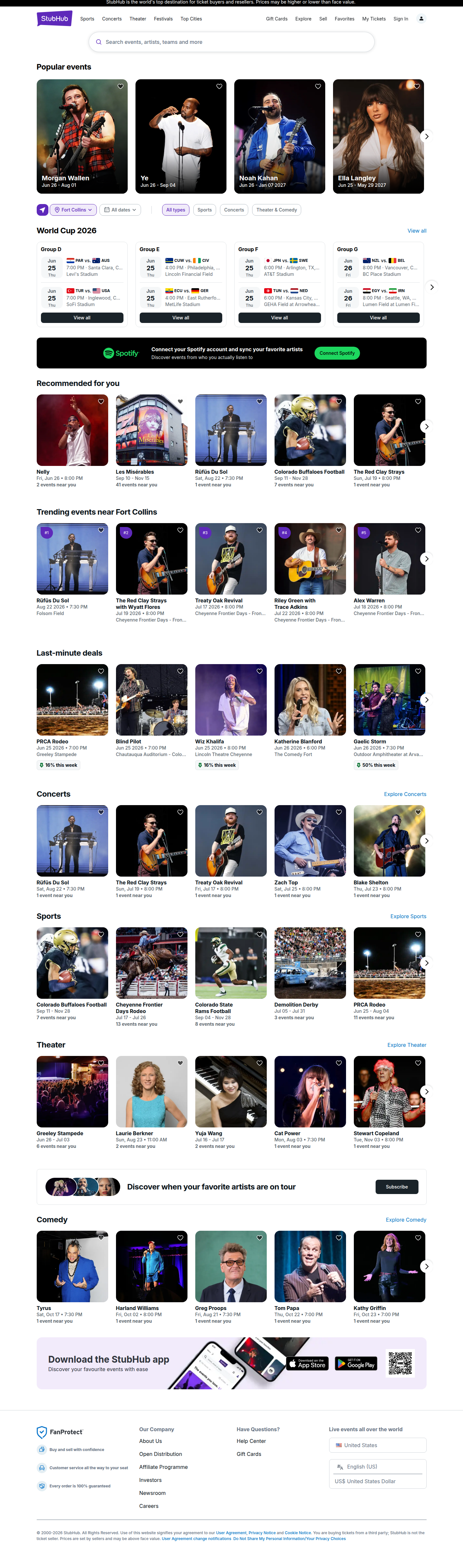
StubHub's Spotify Sync Is the Smartest Hero Test We've Seen in Ticketing
StubHub is testing a Spotify account sync on its homepage hero to serve personalized event picks before users even search. Here's why this mechanic is worth stealing.
Diego Hernandez
Growth Marketer · Jun 26, 2026
StubHub Just Flipped the Script on Event Discovery
Most ticketing sites open with a search bar and a prayer. You show up, you already know what you want, you type it in.
StubHub is testing something different — and it's one of the more interesting hero mechanics we've caught on a high-traffic homepage in a while.
The prompt, pulled directly from the live page: "Connect your Spotify account and sync your favorite artists. Discover events from who you actually listen to. — Connect Spotify."
That's not a search bar. That's a personalization handshake happening before the user types a single character. And it changes the entire conversion dynamic on the page.
What the Variant Actually Does
The mechanic is dead simple on the surface. A CTA in the hero section asks users to connect their Spotify account. Once connected, StubHub can pull listening data — artists the user actually plays on repeat — and surface relevant shows, concerts, and events immediately.
No search. No browse. No decision paralysis in front of a catalog of 10 million listings.
The variant turns a passive homepage into an active discovery engine. The user goes from "where do I even start" to "here are three shows from artists you love, happening near you this month."
That shift in experience — from generic to relevant in under 10 seconds — is the whole bet.
Why Decision Fatigue Was the Real Problem
StubHub's inventory is massive. That's a strength in SEO and supply, but it's a liability the second an undecided user lands on the homepage. Too many choices without a filter = bounce.
This is textbook decision fatigue. And the Spotify sync is a clean solution to it because it doesn't ask the user to tell StubHub what they like — it already knows.
The friction isn't zero (OAuth flow, permission screens, loading state), but the value exchange is strong. You're not filling out a preferences quiz. You're clicking "Connect" and getting a curated feed. That's a trade most music fans will take.
Unbounce's CRO best practices research makes the point well: smart personalization lets you extract more value from the traffic you already have without spending another dollar on acquisition. You're not buying better visitors. You're making the page smarter for the visitors already arriving.
The Rarity Signal: Why This Mechanic Stands Out
ABWatcher flagged this at 85% rarity. That number matters.
Cross-platform data integrations as a hero CTA are basically unheard of in ticketing. Most brands treat personalization as a logged-in, post-conversion feature — something you unlock after you've already bought a ticket or created an account. StubHub is deploying it as the primary hook for cold traffic.
That's a meaningful strategic call. They're betting that the novelty and utility of the Spotify sync will outperform a traditional "search for events" CTA at the top of the funnel.
It also works as an account creation wedge. Connecting Spotify almost certainly triggers a StubHub account creation or login prompt somewhere in the flow. So the conversion goal isn't just "click" — it's "we now have a known user with rich preference data." That's a session-one activation play dressed up as a discovery feature.
What the Research Says About Personalization in the Hero
Landing page optimization guidance from Brizy is consistent on one point: personalizing content directly impacts how effectively a page converts. Reducing the cognitive load of deciding what to do next is one of the highest-leverage moves you can make above the fold.
StubHub's variant does exactly this. It answers the implicit question every homepage visitor has — "what should I look at?" — before they even ask it.
There's also a targeting angle here. Spotify users skew younger, digitally fluent, and concert-inclined. If StubHub is running paid social to that demographic, this hero mechanic is a near-perfect message match. The user sees an ad for their favorite artist, clicks through, and is immediately invited to connect the platform where they already listen to that artist. The narrative is tight.
Steal This for Your Roadmap
You don't need Spotify's API to run a version of this experiment. The underlying mechanic is: use existing behavioral data to replace generic CTAs with personalized ones.
A few ways to adapt it:
- SaaS: Integrate with a tool your user already uses (Slack, Google, HubSpot) as a hero CTA. The integration is the value prop.
- Ecommerce: Surface "based on your last order" or "complete your look" as the hero experience for returning visitors instead of a generic hero banner.
- Fintech: Ask one high-signal question above the fold ("what are you saving for?") and fork the entire page experience based on the answer.
The core principle is the same across all three: eliminate the blank-slate browsing experience for users who already have preferences. Make the page feel like it knows them.
StubHub's Spotify sync is a 85%-rarity mechanic for a reason. Most brands haven't built the integration. But the idea — personalization as a hero-level CTA, not a logged-in-only feature — is table stakes thinking for any growth team serious about conversion.
Run your version of this test. Ship it before your competitor does.
See more like this
ABWatcher catches A/B tests like this every day.
Watch live experiments at 1,000+ high-converting brands, complete with hypothesis and takeaway. Free forever for ten watched companies.