
Ro Tests Skipping the Insurance Question Entirely for Cash-Pay Users
Ro is server-side routing some GLP-1 signup traffic past the insurance-type question straight to a cash-pay options screen. Here's what the branch reveals about qualification-step friction.
Maya Patel
Senior CRO Strategist · Jul 14, 2026
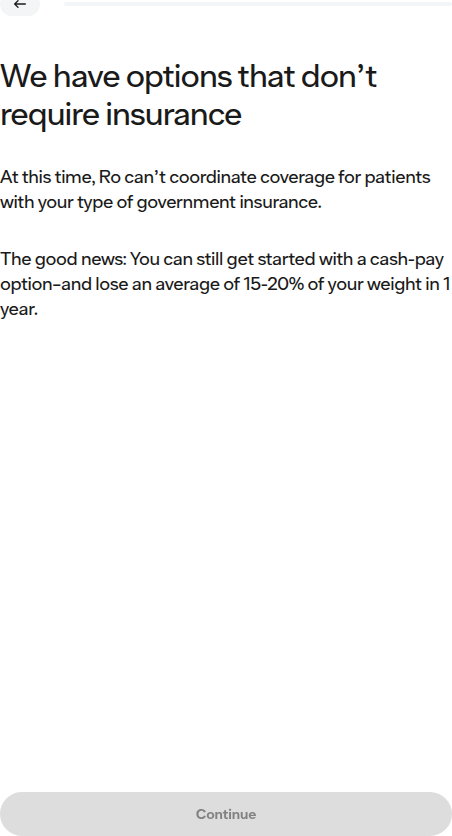
Ro's GLP-1 insurance checker signup flow normally asks a simple qualifying question: "What type of insurance do you have?" with six answer options. But in one of five visits we captured to the same URL, that step never appeared. Instead, the visit was routed — server-side, on Edge — directly to a different page entirely: "We have options that don't require insurance," backed by a single Continue CTA.
Same funnel, same day, two structurally different paths. That's the signature of a live server-side split, and it's one of the more consequential funnel tests we've caught this quarter.
What we actually saw
Visits 1, 2, 3, and 5 followed the standard path: land on the insurance-type checker, pick from six carrier/coverage categories, presumably branch into eligibility logic downstream. Visit 4 skipped the question altogether. The user was routed to a URL further down the funnel that presupposes the answer — no insurance, or insurance that won't cover GLP-1s — and immediately reframes the conversation around cash-pay options.
This isn't a copy tweak or a button color change. It's a structural bypass: the qualifying step itself is being removed for a subset of traffic, and the server is making the routing decision before the page renders. That's a strong signal Ro has enough first-party or referral-level signal (ad campaign, UTM source, geo, prior session data) to make an educated guess about a visitor's insurance status before they've told the site anything.
The friction Ro is likely trying to remove
Insurance-type questions are notorious drop-off points in healthcare and benefits-adjacent signup flows. Users without commercial coverage, or unsure how their plan handles GLP-1 prescriptions, often abandon at exactly this step — not because the form is hard, but because the honest answer feels like a dead end. Asking someone to self-classify as "uninsured" or "not sure" before showing them any path forward invites hesitation and exit.
Routing straight to "we have options that don't require insurance" reframes the interaction: instead of a qualification gate, the cash-pay message arrives as a solution, not a rejection. In CRO terms, this is a classic reduce-perceived-effort play — fewer steps, faster time-to-value, and a narrative that pre-empts the objection ("I don't have insurance so this won't work for me") before the user has to voice it.
The tradeoffs worth naming before calling it a win
A few things we'd flag if we were running the readout on this test internally:
- Segmentation risk. If the server-side signal used to route users is imperfect, some visitors who do have usable coverage get funneled into a cash-pay narrative anyway. That's a monetization play that could quietly suppress insurance-covered conversions or create post-signup friction when billing reality doesn't match the message.
- Trust cost. Skipping a question a user expects to answer can read as presumptuous if the cash-pay framing feels misaligned with their actual situation. Healthcare intake flows carry higher trust sensitivity than typical ecommerce checkout — a wrong guess here isn't just a bad recommendation, it can feel like the site "assumed" something about the user's financial situation.
- Attribution complexity. Because the split happens server-side and changes the URL structure, standard client-side analytics and heatmapping tools may not cleanly capture both arms without deliberate event tagging. Teams testing this pattern need to make sure downstream conversion and revenue-per-visitor metrics are tied to the original entry cohort, not just the page a user happens to land on.
None of this means the test is wrong — server-side branching based on likely coverage status is a defensible growth lever, especially for a company like Ro where cash-pay is a real and growing revenue line for GLP-1s. But the ICE math (Impact, Confidence, Ease) on this kind of test should weigh Impact against a real Risk column for misrouted segments, not just topline conversion lift.
What the benchmarks suggest about the payoff
The case for cutting a qualifying step is strong on paper. Ecommerce benchmarks show the gap between average and top-performing conversion flows is substantial — average stores convert around 2.5% of visitors while top performers hit 5.5%, a gap largely explained by exactly this kind of friction removal at decision points. Every additional question in a signup flow is a chance for a user to reconsider, and qualification steps that ask users to self-disclose a potentially disqualifying fact (no insurance, unclear coverage) are disproportionately costly compared to neutral form fields.
That said, best-practice A/B testing guidance is explicit that a test isn't validated by directional lift alone — it needs a clear hypothesis, sufficient run length for statistical significance, and analysis that accounts for segment-level effects, not just an aggregate conversion delta. A server-side branch like this one is exactly the kind of test where the aggregate number can look good while masking a subgroup that's being poorly served.
The takeaway for your roadmap
If your funnel has a self-disclosure step that risks framing users as "disqualified" before they see any path forward — insurance status, budget range, credit tier, eligibility criteria — audit whether that question needs to come before you show a viable path, or whether it can be inferred and the messaging front-loaded instead.
This sprint: pull your funnel's qualifying steps and rank them by (a) how confidently you can infer the answer from existing signal, and (b) how much perceived-effort or rejection-risk the question introduces. Any step that's both high-inferability and high-rejection-risk is a candidate for the kind of server-side branch Ro is running here — just make sure your experiment design includes a misrouting-rate metric, not just a conversion-rate one.
See more like this
ABWatcher catches A/B tests like this every day.
Watch live experiments at 1,000+ high-converting brands, complete with hypothesis and takeaway. Free forever for ten watched companies.