
PlanetScale's YouTube Credibility Anchor Is a Masterclass in Social Proof
PlanetScale turns a technical claim into instant trust by naming YouTube as the proof of scale. Here's why this copy pattern converts.
Diego Hernandez
Growth Marketer · Jun 24, 2026
The Copy Doing Heavy Lifting on PlanetScale's Homepage
Most database companies lead with specs. Nodes. Latency numbers. Uptime SLAs. Eyes glaze over.
PlanetScale does something smarter on their home page. Right in the product copy, they drop this:
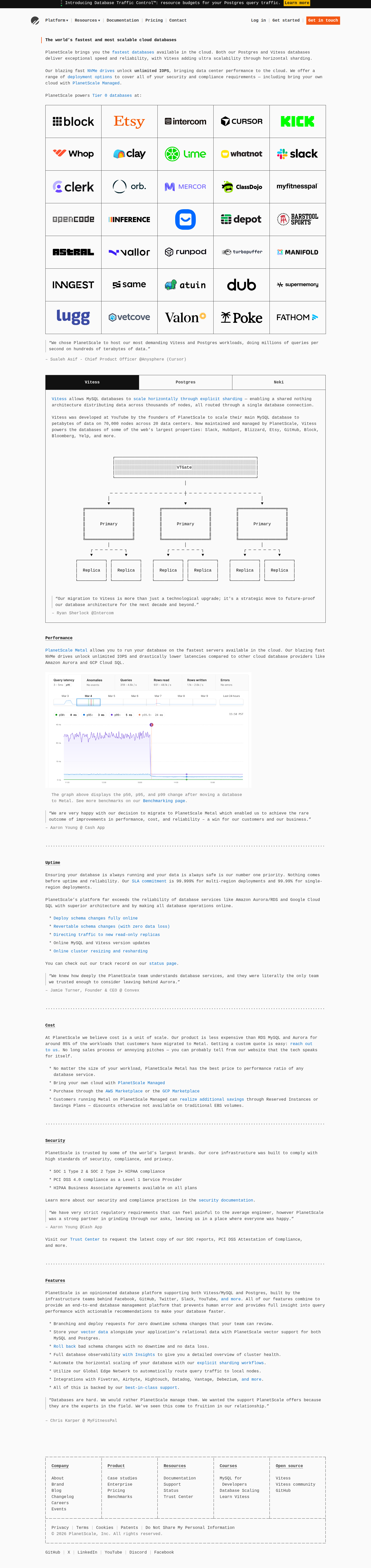
"Vitess was developed at YouTube by the founders of PlanetScale to scale their own MySQL database to petabytes of data on 70,000 nodes across 20 data centers."
That single sentence is doing four jobs at once. Origin story. Technical credibility. Scale proof. Founder legitimacy. All without a testimonial widget or a logo wall in sight.
We flagged this as a rare CRO pattern — and it's worth pulling apart why it works.
Why "Built at YouTube" Hits Different Than a Logo Badge
Logo walls are wallpaper at this point. Visitors scroll past them. They're expected, so they're invisible.
Naming YouTube as the proving ground is different. It's a story, not a badge. And it's specific enough to be believed.
Think about what the reader's brain does with that sentence. YouTube. Petabytes. 70,000 nodes. 20 data centers. Those aren't abstract metrics — they map to something the reader already understands as impossibly large. Everyone knows YouTube is enormous. So when PlanetScale says their tech is what made that scale possible, the claim lands with weight that a generic "enterprise-ready" label never could.
This is what landing page optimization best practices consistently point to: articulate your value proposition fast and make it concrete. PlanetScale isn't saying "we scale well." They're saying "we scaled YouTube." One is a claim. The other is proof.
Tactical note: Borrowed authority beats abstract authority every time. Name the recognizable thing.
The Founder Angle Is the Secret Multiplier
Here's what most people miss when they read that sentence: it doesn't just say Vitess was built at YouTube. It says the founders of PlanetScale built it to solve their own problem.
That's a different trust signal entirely.
Founder-built-for-own-use is one of the strongest credibility frames in B2B. It answers the skeptic's question before it's asked: "Do these people actually understand the problem?" The answer is baked into the origin story. They didn't acquire this tech. They didn't license it. They lived the problem at YouTube scale and built the solution themselves.
For a technical buyer — an engineering leader, a CTO, a senior backend dev — that provenance matters enormously. It signals deep domain expertise without requiring a whitepaper.
Tactical note: If your founding team has a "we built this for ourselves first" story, it belongs on your homepage, not buried in an About page.
Specificity Is the Credibility Engine
Vague social proof is almost worse than none. "Used by thousands of companies" tells me nothing. "Scales to petabytes across 70,000 nodes and 20 data centers" tells me exactly where the ceiling is — and for most buyers, that ceiling is so high it's irrelevant as a concern.
The numbers in PlanetScale's copy aren't there to impress data engineers (though they will). They're there to make the scale real. Concrete figures short-circuit skepticism. Research on social proof in conversion optimization reinforces this — specificity signals authenticity. Vague claims feel manufactured. Precise ones feel earned.
70,000 nodes is not a round number. Nobody makes up 70,000. That specificity is doing credibility work all by itself.
Tactical note: Audit your social proof copy for round numbers. If everything is "thousands" and "millions," find the actual figures. Odd numbers convert better because they're believable.
What Makes This Pattern Rare (and Stealable)
ABWatcher flagged this at 70% rarity. That tracks. Most brands either:
- Lead with logos and call it done
- Write generic "built for scale" copy that nobody reads
- Bury the origin story in a blog post from 2019
What PlanetScale does is pull the origin story into the product positioning on the homepage, above the fold, where it can actually do conversion work. That's the rare part.
The pattern is fully stealable. You don't need a YouTube story. You need:
- A recognizable reference point (a company, a scale metric, a known problem)
- A specific outcome with real numbers
- The founder or team connection to make it personal
That combination — recognizable context + specific proof + human origin — is what turns a technical claim into a trust signal.
Tactical note: Look at your case studies and founder bios. There's probably a "we built this because we suffered through X at [recognizable company]" story sitting unused. Move it to the homepage.
Add This to Your Sprint Backlog
Here's the test to run this week:
Find the most technical, abstract claim on your homepage — the one your team is proud of but visitors ignore. Now rewrite it as an origin story with a named reference and real numbers. Run an A/B test against your control.
The hypothesis: specificity + recognizable reference > generic capability claim.
PlanetScale didn't invent this playbook, but they're running it cleaner than most. One sentence. Four trust signals. Zero logo-wall fatigue.
That's the kind of copy worth forwarding to your CMO.
See more like this
ABWatcher catches A/B tests like this every day.
Watch live experiments at 1,000+ high-converting brands, complete with hypothesis and takeaway. Free forever for ten watched companies.