
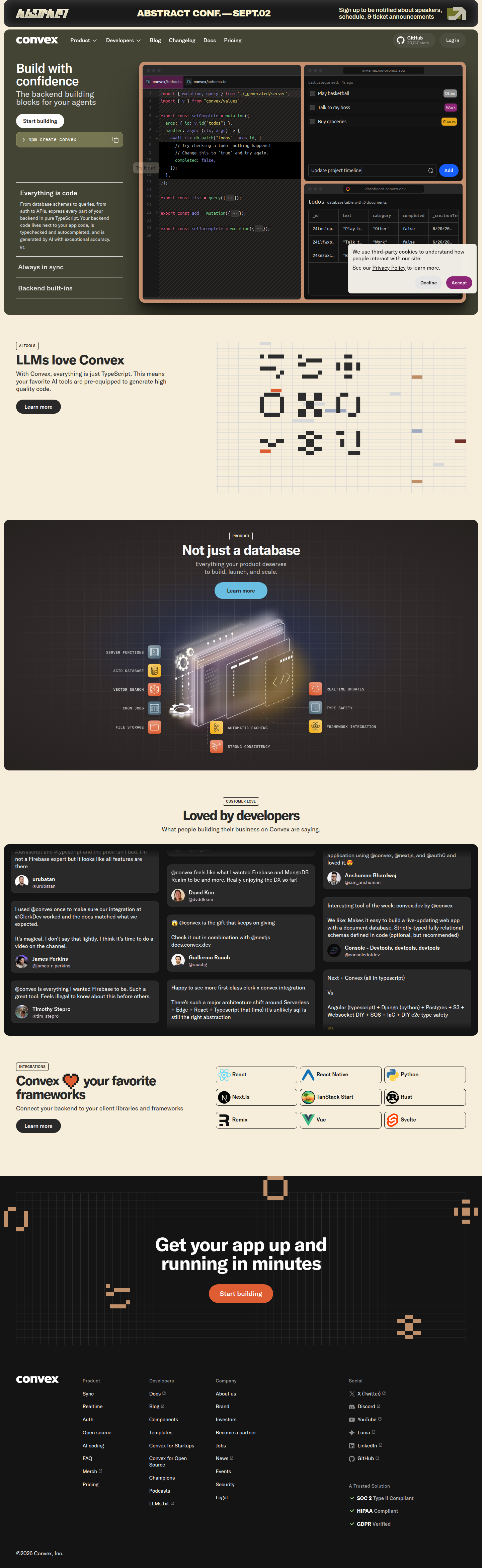
Convex's Verifiable Tweet Wall: A Social Proof Pattern Worth Stealing
Convex replaces generic testimonial carousels with real, named tweets from actual developers. Here's why that specificity drives conversion — and how to replicate it.
Maya Patel
Senior CRO Strategist · Jun 24, 2026
Convex's homepage has a section called "Loved by developers" — and it doesn't look like any standard testimonial block you've seen a hundred times before. Instead of anonymous avatars, star ratings, or a polished quote from "John D., Software Engineer," the page surfaces real tweets with real Twitter handles: @srubeban, @james_r_perkins, @tim_steps, @davidklim. You can verify them. You can click through. They exist in the world outside Convex's control — and that's exactly the point.
This is a rare execution in B2D (business-to-developer) marketing. ABWatcher flagged it with an importance score of 65 — not because the concept is exotic, but because so few brands execute it with this level of authentic specificity.
What the Variant Actually Does
The "Loved by developers" section forgoes the carousel format entirely. Each entry presents a tweet in its native context: the user's display name, their Twitter handle, and the full quote as it appeared publicly. One example pulled from the live page: "I'm not a Firebase expert but it looks like all features are there" — attributed to @srubeban, not sanitized into marketing copy.
This matters structurally. The quote isn't polished. It's qualified ("I'm not a Firebase expert but..."). That's a flag a standard marketing review process would likely cut. Convex kept it. That restraint signals confidence — and credibility.
The format also makes each testimonial independently verifiable in under 10 seconds. A skeptical developer can open a new tab, search the handle, and confirm the tweet exists. That's a friction-reducing trust signal most landing pages completely ignore.
Why Verifiability Is Doing Heavy Lifting Here
The developer audience is a particularly high-skepticism cohort. They're trained to find edge cases, question claims, and distrust anything that looks polished to the point of inauthenticity. Generic testimonials — "This tool saved us 40 hours a week!" — read as marketing noise to this segment.
Real handles change the calculus. The social proof isn't asking to be believed on faith; it's offering a verification path. That shifts the cognitive load from "should I trust this?" to "let me check this." For most visitors, the mere availability of that verification path is enough — they won't click through, but knowing they could reduces doubt.
Unbounce's CRO best practices research puts it plainly: the strongest value propositions make visitors think, "This was made specifically for someone like me." A tweet from a developer using Convex in a real context — not a curated case study, not an enterprise logo — hits that recognition threshold for the technical buyer scrolling this page.
The Specificity Principle: Why Imperfect Quotes Convert
There's a common instinct in brand marketing to edit testimonials toward clarity and enthusiasm. That instinct tends to produce quotes that feel manufactured. The @srubeban example on Convex's page is instructive precisely because it's hedged. The user isn't saying "Convex is the best database I've ever used." They're saying: I compared it to Firebase and the feature parity looks solid from where I sit.
That's a specific, believable claim. It maps to a real purchase objection — does this have everything Firebase offers? — and answers it through a peer voice rather than vendor copy.
MailerLite's analysis of high-converting landing page social proof reinforces this: social proof only works if the visitor can see themselves in the story. A hedged, technical, handle-verified tweet from a developer who's clearly evaluating options is more mirror-like for a developer prospect than a CEO quote about ROI.
The imperfection isn't a bug. It's the signal.
ICE Assessment: Should You Prioritize This Pattern?
Let's score this against a standard ICE framework for teams evaluating whether to add it to their roadmap:
Impact — 7/10. Social proof placement near conversion points is a proven lift driver for developer and technical audiences. Verified, handle-linked testimonials raise the authenticity ceiling beyond what curated quotes can achieve. The lift potential is real but bounded — this won't compensate for a weak value proposition or slow page load.
Confidence — 6/10. The pattern is rare (ABWatcher rarity: 58%), which means there's limited direct benchmark data. Adjacent evidence from user-generated content and verified review strategies (G2, Trustpilot widget tests) consistently shows 10–30% improvement in trust metrics. Extrapolating to tweets is reasonable but not proven at scale.
Ease — 5/10. This isn't technically complex, but it has operational friction: you need a permission or fair-use position on the tweets, a curation process for finding authentic quotes worth displaying, and enough brand presence on social to generate quotable public content. For early-stage products with limited social footprint, this pattern is a future state, not a sprint-ready action.
ICE composite: 6/10 — a strong candidate for a Q2 or Q3 priority, especially for B2D or developer-tool companies with an existing Twitter/X community.
Risks and Tradeoffs Before You Ship
A few tradeoffs worth pressure-testing before you replicate this:
Content decay. Tweets get deleted. If Convex's @srubeban deletes that tweet, the block either breaks or displays orphaned content. You need a monitoring and refresh process, or a static screenshot approach that doesn't depend on live embeds.
Permission ambiguity. Public tweets are public, but displaying them on a commercial landing page for marketing purposes sits in a legal gray zone in some jurisdictions. A lightweight outreach step — asking the user for explicit permission — turns this risk into a relationship-building moment and strengthens the authenticity signal further.
Curation bias. The selection of which tweets appear is still editorial. If the section only shows enthusiastic quotes, sophisticated visitors will wonder what's being left out. Including mildly qualified quotes (like the Firebase comparison) actually helps here — it signals editorial honesty.
Volume requirements. Four to six handles feel thin. Enough to establish the format, not enough to convey broad adoption. If you have the social footprint, scaling to a denser grid or a filterable tag system (by use case or company size) compounds the signal.
What to Take Into Your Next Sprint
If you're running a developer tool, fintech API, or any product where credibility with a technical audience is the conversion bottleneck, this pattern is worth a focused sprint:
- Audit your existing social mentions. Pull the last 90 days of tagged or untagged mentions. Identify 8–12 quotes that are specific, verifiable, and address a real objection — not just enthusiasm.
- Reach out for explicit permission. A two-line DM asking to feature their words converts the passive mention into an active advocate relationship.
- Keep the imperfect ones. Resist the edit toward polish. Hedged, specific quotes convert because they're believable.
- Place it near your primary CTA or a known friction point — not buried in a footer. Social proof earns its real estate when it's adjacent to the moment of hesitation.
- Build a monitoring step. Set a calendar reminder to audit the displayed tweets quarterly for deletion or account changes.
Convex isn't doing anything technically impossible here. They're doing something editorially disciplined: trusting that a developer audience responds to authenticity more than aspiration. That's a hypothesis worth testing on your own landing page before the quarter closes.
See more like this
ABWatcher catches A/B tests like this every day.
Watch live experiments at 1,000+ high-converting brands, complete with hypothesis and takeaway. Free forever for ten watched companies.