
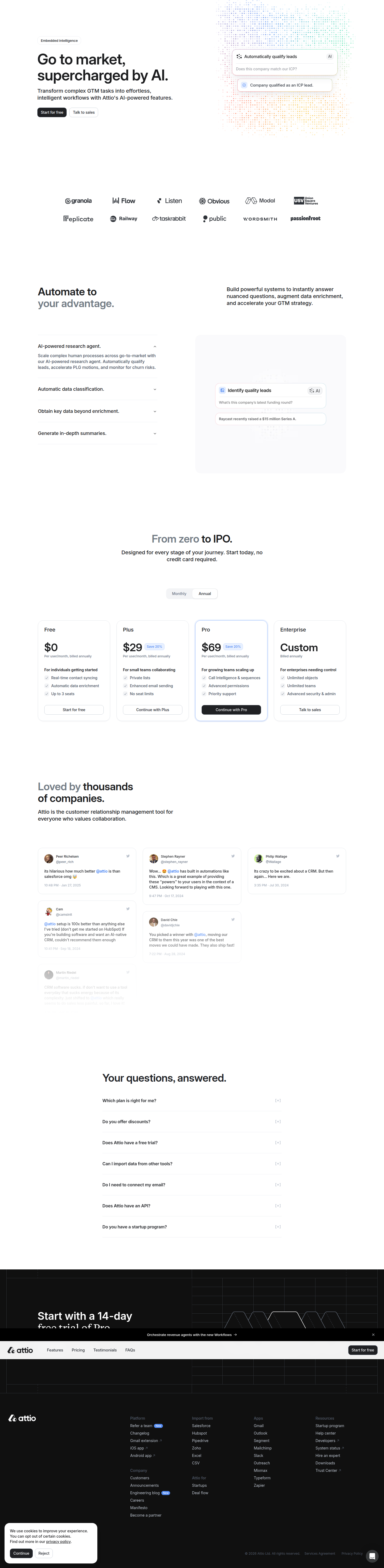
Attio Is A/B Testing Its Entire Funnel Narrative, Not Just Its Hero
Attio's live test pits a simple 3-card overview against a narrative, accordion-style page with a 4th Enterprise tier. Here's the math on why this is a real structural bet, not a button-color test.
Sam Lee
Data Analyst · Jul 20, 2026
Attio (attio.com) is running a server-side A/B test on its AI CRM landing page at /p/ai_crm-0212-25, and it's a bigger swing than most tests we log. This isn't a headline tweak or a CTA color change — it's a full information-architecture rewrite, detected via URL cluster variance with 90% analyst confidence.
What's actually different between the two variants
Control is the "simple" version: centered hero, three feature cards (Research agent, AI automations, Call intelligence), a 3-tier pricing table, testimonial grid, headline "Start today for free."
Variant is the "narrative" version: left-aligned hero with a single visual panel, an expandable feature-list section titled "Automate to your advantage," a 4-tier pricing table that adds an Enterprise/Custom plan, headline "From zero to IPO," and Twitter-style testimonial cards instead of a grid.
Four things are changing simultaneously: layout orientation, information density, pricing tier count, and social proof format. That's a compound test, not a single-variable one — which matters for how we should interpret any result Attio reports internally.
Why the pricing tier is the real story here
The headline swap from "Start today for free" to "From zero to IPO" is copy theater. The pricing table change is the substantive bet. Adding an Enterprise/Custom tier to a 3-tier table doesn't just add an option — it re-anchors the entire table. Classic decoy-pricing research (see Optimizely's field notes on pricing tests) shows that a 4th "custom quote" tier typically pulls mid-tier selection up, because buyers anchor against the visible-but-unattainable top option rather than comparing bottom-to-top.
If Attio's variant lifts average contract value even 8-10% among converting accounts, that matters more than top-of-funnel signup rate. This is the segment-level lift question CROs routinely get wrong by only watching the aggregate conversion number. If variant B converts 5% fewer visitors into free trials but those trials are 15% more likely to be self-identified as "team of 20+" and land on a $30k ACV plan instead of $8k, the variant wins on revenue despite losing on the top-line rate. Attio needs to be measuring pipeline-weighted conversion, not click-through, or they'll ship the wrong page.
The expandable feature section is a comprehension trade-off
Three cards versus an expandable list is a classic scan-vs-depth trade-off. Cards work when the buyer already knows what "Research agent" or "Call intelligence" means and just needs a menu to click. Accordions work when the buyer needs to be convinced feature-by-feature, which is more typical of a considered B2B SaaS purchase with multiple stakeholders.
Attio's ICP is spreading — SDRs evaluating a CRM swap-in look very different from an RevOps lead evaluating a platform migration. The accordion variant is a bet that the median visitor now needs more hand-holding before trusting an AI-native CRM. That's plausible given AI CRM is still a category buyers have to be educated on, not just sold. But it's also exactly the kind of change that produces a novelty effect in week one — new interaction pattern draws clicks and dwell time that don't convert into the metric you actually care about. If Attio is reading "time on page" or "expand rate" as a leading indicator, I'd want at least 2-3 weeks of stable data before trusting it, since accordion novelty typically decays over the first 10-14 days per session-replay analyses cited in Landingi's CRO case study roundup.
Do the power math before calling this
Let's assume Attio's landing page runs somewhere in the range of 5,000-15,000 monthly sessions (reasonable for a funded B2B SaaS product page, not a homepage). At a baseline free-trial conversion rate of ~3%, detecting a true 15% relative lift (3.0% → 3.45%) at 80% power and 95% confidence requires roughly 14,000 sessions per arm — call it 28,000 total. At the low end of that traffic range, this test needs 5-6 months to reach significance on trial-start rate alone, before you even get to enterprise-inquiry rate, which will have an order of magnitude fewer events.
That's the uncomfortable truth about most "detailed page vs. simple page" tests: the headline metric (signup rate) is usually adequately powered within weeks, but the metric that actually matters here — enterprise pipeline generated — is starved for sample size for months. Elevation B2B's overview of CRO best practices notes that only about one in eight A/B tests reaches statistical significance at all; compound structural tests with multiple simultaneous changes and a low-frequency downstream metric (enterprise deals) are exactly the profile that produces false negatives or noisy false positives.
What Attio is really deciding
Strip away the copy and this test is Attio deciding whether its ICP has shifted upmarket enough to justify a heavier, more enterprise-coded page permanently. The 4-tier pricing table and "zero to IPO" framing are both enterprise signals. If this variant wins, expect Attio to lean into enterprise positioning sitewide — not just on this landing page. If it loses on trial volume but wins on ACV, watch for a hybrid: 4-tier pricing kept, simple card layout restored.
Takeaway for your roadmap: before you copy this pattern, define your primary metric and required sample size before you launch, not after. If your downstream metric (enterprise deal count, ACV) fires less than a few hundred times a month, budget the test for a quarter, not two weeks, and set an explicit rule for how you'll weigh trial-volume lift against deal-value lift if they disagree — because on a compound test like this one, they usually will.
See more like this
ABWatcher catches A/B tests like this every day.
Watch live experiments at 1,000+ high-converting brands, complete with hypothesis and takeaway. Free forever for ten watched companies.