
Ally.com's Hero Is Running Two Experiments at Once
ABWatcher caught Ally testing a spending-vs-savings hero swap and a WNBA partnership banner simultaneously. Here's what the variants reveal about their conversion strategy.
Maya Patel
Senior CRO Strategist · Jun 27, 2026
ABWatcher's vision-AI scanner flagged a live multivariate experiment running across Ally's homepage hero — ally.com — with a 92% analyst confidence score. Across five sampled visits, we observed at least two distinct test layers operating simultaneously: a full hero swap and an independent bottom-of-page promotional banner test. This is worth unpacking carefully, because the structure of what Ally is doing reveals as much about their CRO maturity as the variants themselves.
What We Actually Caught
Here's the breakdown by visit:
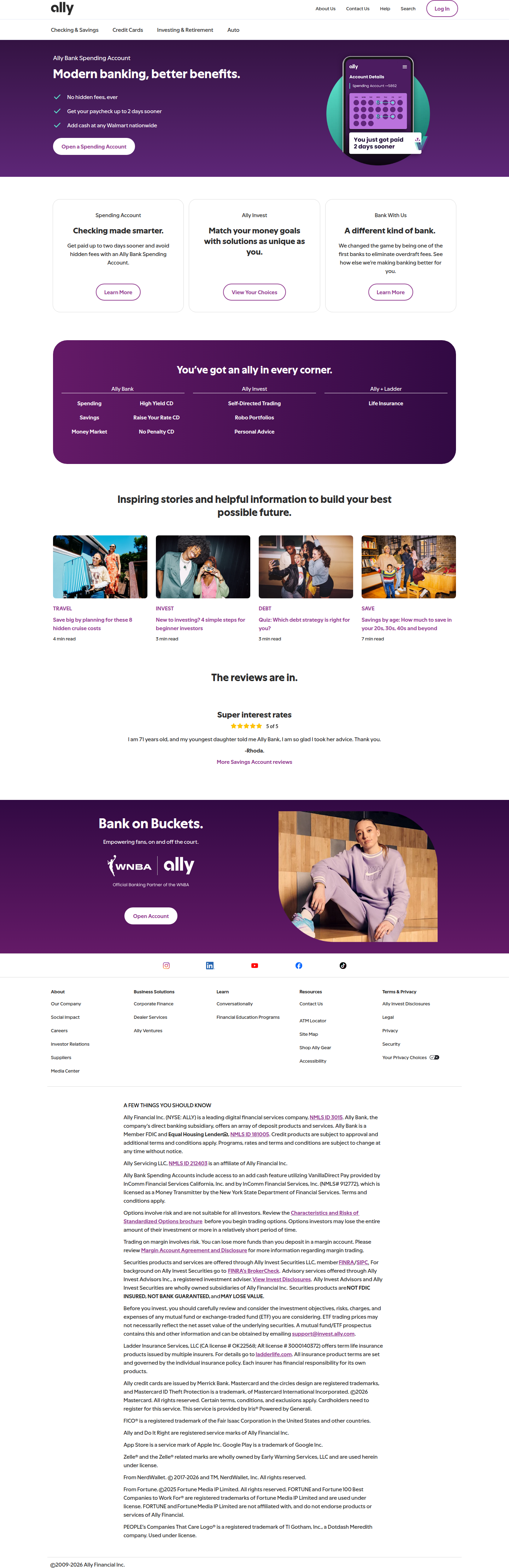
- Visits 1, 3, 4 (Control hero): Headline reads "Modern banking, better benefits." The hero centers on the Ally Bank Spending Account, anchored by a phone mockup showing the message "You just got paid 2 days sooner." The bottom promotional section carries the copy "Chase your money dreams with an ally by your side."
- Visit 2 (Control hero + variant banner): Same "Modern banking" hero as above, but the bottom CTA section swaps to a "Bank on Buckets." WNBA partnership banner — a brand-campaign-style creative that replaces the aspirational savings copy.
- Visit 5 (Variant hero): Headline reads "Open both, save more." The hero image changes entirely to a lifestyle shot of a couple laughing. The subhead copy shifts to support a dual-account value proposition, and a "Savings Round Up" widget appears in the hero — a product-feature callout that wasn't present in the control.
The detection method — same_run_variance — indicates these differences appeared across visits within the same session window, ruling out a simple content refresh or seasonal rotation.
The Hypothesis Ally Is Likely Testing
Two distinct bets are being evaluated here, and it's worth separating them clearly.
Bet 1 (Hero): Does a savings-forward value proposition ("Open both, save more" with Round Up feature merchandising and a lifestyle image) outperform a spending-account-focused hero ("Modern banking, better benefits" with an early paycheck proof point and a product mockup)?
This is a classic headline A/B test — but Ally isn't just swapping copy. They're changing the primary audience signal, the visual register (aspirational couple vs. product utility), and the featured product benefit all at once. That's closer to a landing page concept test than a headline test.
Bet 2 (Bottom banner): Does a culturally resonant brand moment — the WNBA partnership — drive more bottom-of-funnel conversion than straightforward aspirational copy? Or does it introduce enough distraction to hurt CTA click-through?
These two bets appear to be running independently, which is consistent with a multivariate or parallel A/B structure rather than a single factorial experiment.
The Tradeoffs in This Experimental Design
Running two tests simultaneously on the same page — one at the top, one at the bottom — is a common acceleration strategy for high-traffic pages. The tradeoff is real: if both variants influence conversion, you risk interaction effects that muddy attribution. Was it the hero that moved the needle, or the banner? If a user sees the spending-account hero and the WNBA banner, is that a coherent experience?
That said, Ally likely has the traffic volume to absorb this risk. With sufficient daily sessions, the interaction cells can be adequately powered, and the signals on each layer can be isolated with appropriate segmentation in the analytics layer.
The more notable design decision is the scope of the hero swap. Best practice in A/B testing calls for isolating a single variable so lift can be attributed cleanly. Ally's variant 5 changes the headline, subhead, image, and a product widget simultaneously. This is a concept test, not a variable test — which suggests they're optimizing for learning speed over variable-level precision. They want to know which story wins before they fine-tune the telling of it.
Why the Savings Angle Is the More Interesting Bet
The control hero leads with speed ("You just got paid 2 days sooner") — a concrete, product-specific proof point with strong resonance for paycheck-to-paycheck audiences. It's a well-worn conversion lever in consumer banking: tangibility beats abstraction.
The variant, however, bets on a different psychological frame: the dual-account upsell. "Open both, save more" targets customers who are already banked somewhere and are evaluating Ally as an upgrade — or who are open to bundling a checking and savings account together. The Savings Round Up widget reinforces this by making the savings mechanic visible in the hero rather than buried in a features section.
From a funnel perspective, this is a meaningful shift in who the page is optimized to convert. The control targets someone persuadable on a single product feature. The variant targets someone whose primary motivation is financial progress and who can be sold on a product ecosystem.
If Ally's analytics show that multi-product customers have materially higher LTV (a safe assumption in retail banking), the variant's lower top-of-funnel CTR may be acceptable if it pulls in a higher-value segment.
The WNBA Banner: Brand Equity or Conversion Drag?
The "Bank on Buckets." banner is a brand partnership play. These tests tend to be politically sensitive internally — there's usually a sponsorship team with OKRs attached to visibility — which may explain why it's being validated against the aspirational copy rather than removed entirely.
The honest CRO read: bottom-of-page promotional banners that introduce a new brand narrative (sports partnership) right before a primary CTA create a context switch. A user who has processed the hero's value proposition now has to re-orient to a different brand association. That re-orientation has a cost.
The counter-argument is that partnership banners can build trust and cultural credibility, particularly for younger audiences who may be unfamiliar with Ally as a brand. Whether that trust delta offsets any CTA friction is exactly what the test is designed to answer.
What to Take Into Your Roadmap This Sprint
Ally's experiment structure offers a useful playbook for teams operating on high-traffic acquisition pages:
Concept-test before variable-testing. If you have genuine uncertainty about which story your hero should tell, run a full-concept swap first. Swapping headline + image + feature callout together gives you directional signal faster than running three sequential single-variable tests. Once you know which concept wins, isolate variables to optimize it.
Separate your test layers explicitly. Ally is running the hero and the banner as distinct experiments. If you're testing more than one section on a page, make sure your analytics setup can isolate interaction effects — or your winning variant may be a false positive driven by an adjacent change.
Segment by intended customer profile, not just conversion rate. If your variant attracts a different type of converter (higher ACV, higher LTV, different product), aggregate CVR is the wrong primary metric. Define your success metric around the customer profile you're trying to grow before the test runs.
Ally's homepage is one of the highest-stakes acquisition surfaces in consumer banking. The fact that they're running two simultaneous experiments here — not one — signals confidence in their experimentation infrastructure and urgency in their growth goals. The savings-angle concept is the more strategically interesting bet. Watch for follow-on tests that isolate the Round Up widget and the lifestyle imagery if the variant shows directional lift.
See more like this
ABWatcher catches A/B tests like this every day.
Watch live experiments at 1,000+ high-converting brands, complete with hypothesis and takeaway. Free forever for ten watched companies.